Download the full report here
Abstract
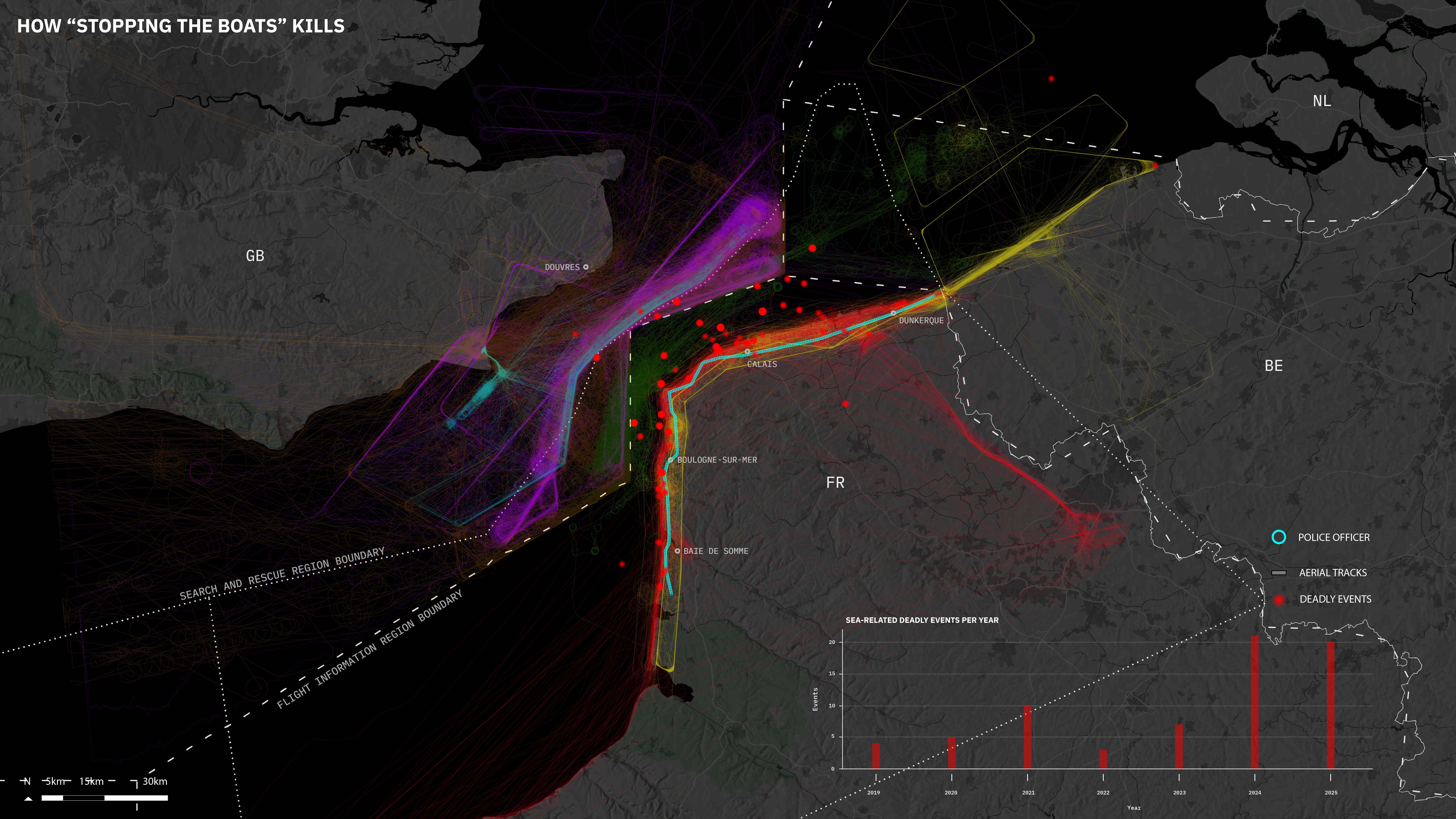
How ‘stopping the boats’ kills presents findings from a year-long collaborative investigation by researchers at the ESRC Centre for Sociodigital Futures at the University of Bristol, and Border Forensics, an independent research agency based in Geneva, Switzerland. The report demonstrates how the UK government’s ‘Stop the Boats’ policies, and over £625 million given to the French to prevent departures, have directly contributed to a sharp rise in deaths of people attempting to cross the Channel in so-called small boats.
Drawing on data from migrant solidarity activists in northern France, French coastguard records, and UK Home Office transparency data, this investigation identifies a dramatic surge in fatal incidents beginning Summer 2023. Crucially, this rise in deaths came as the numbers of dinghies and people arriving to the UK fell, and despite an increase in aerial surveillance and maritime search-and-rescue capacity.
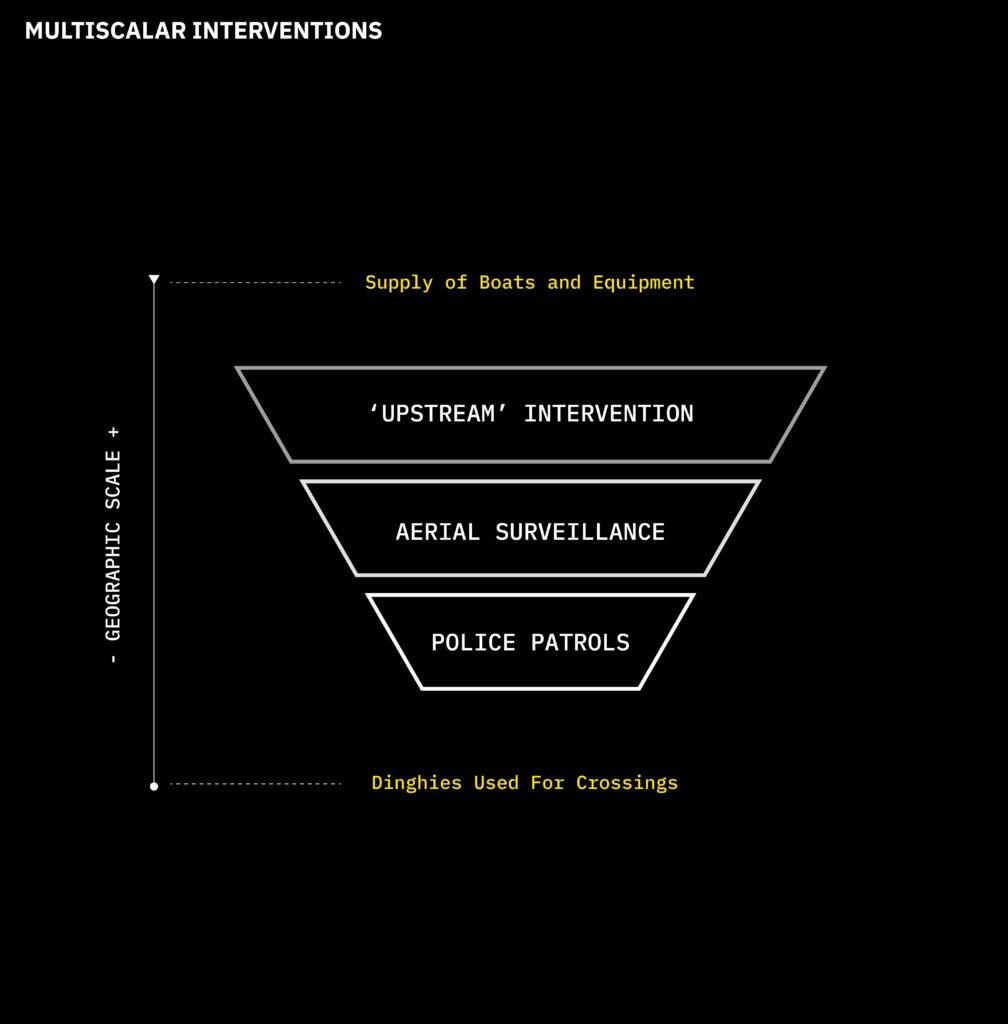
Geospatial analysis showed these increased deaths occurred closer to French shores, and interviews with activists and migrants revealed them to be the result of new deadly mechanisms: extreme overcrowding, resulting in people being crushed inside of dinghies, and chaotic launches, often in the midst of violent police interventions to prevent departures. The entangled effects of three border policing practices behind these mechanisms are examined in detail in the report:
- ‘Upstream’ anti-smuggling measures and supply-chain disruption: International cooperation has reduced the availability of dinghies and other materials needed for small boat journeys, leading facilitators to source larger and lower quality inflatables which are increasingly overcrowded. Anti-smuggling measures have also reduced the opportunities for under-resourced groups to organise their own journeys—strengthening the hold of professionalised smugglers on the market—and fuelled competition for places onboard.
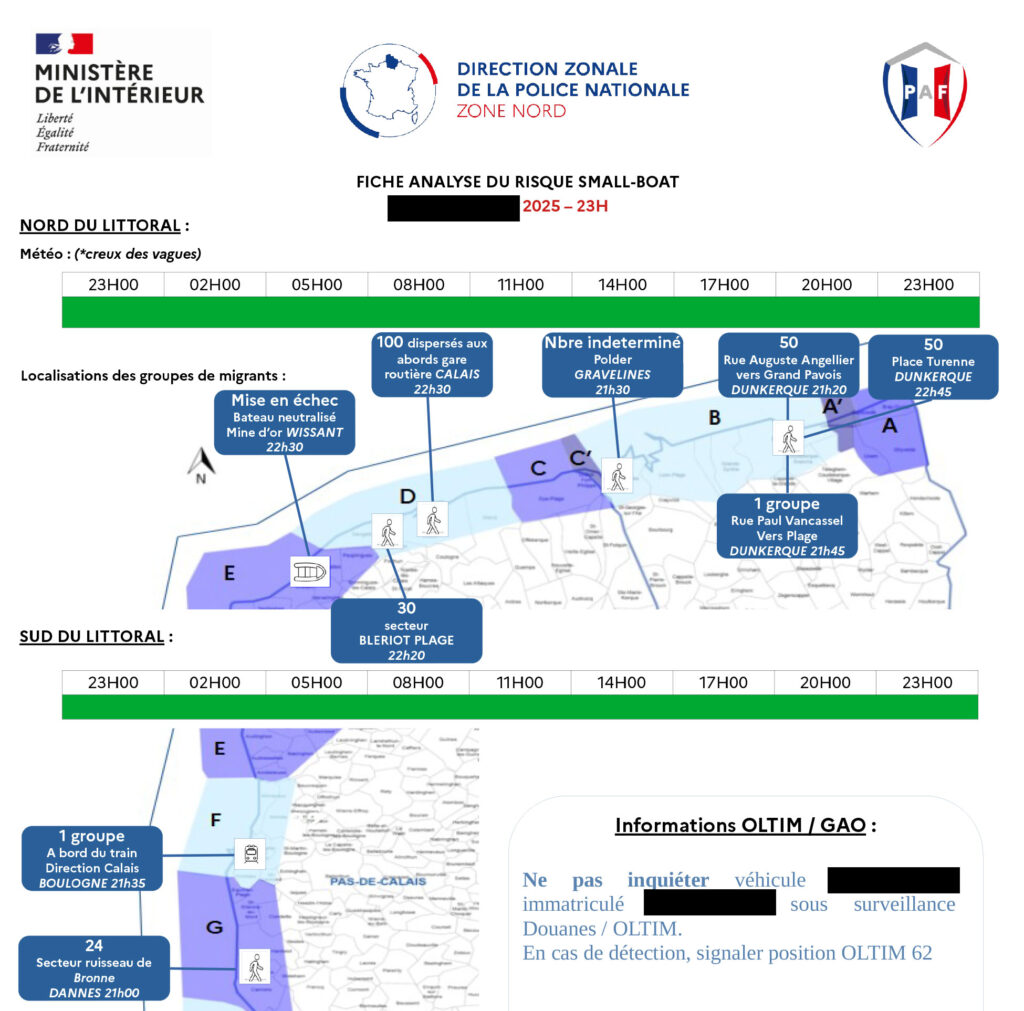
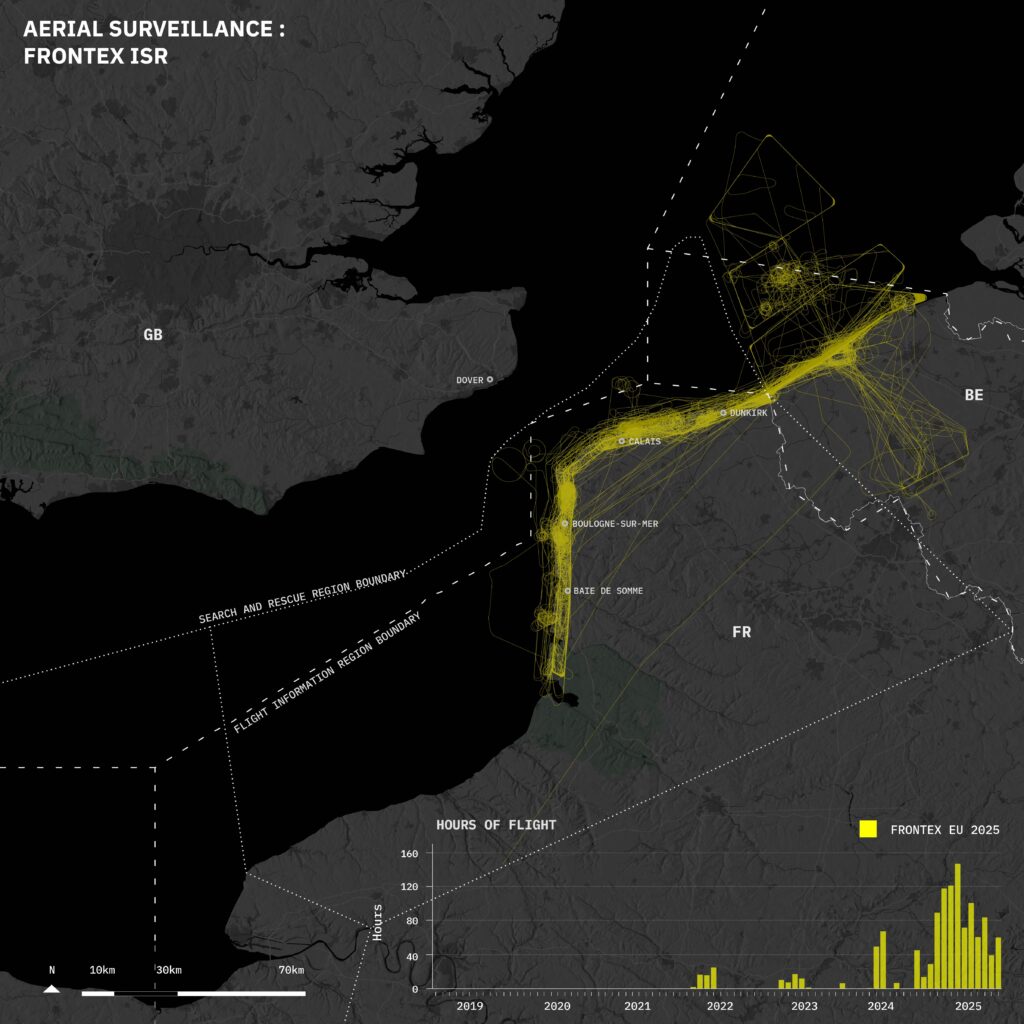
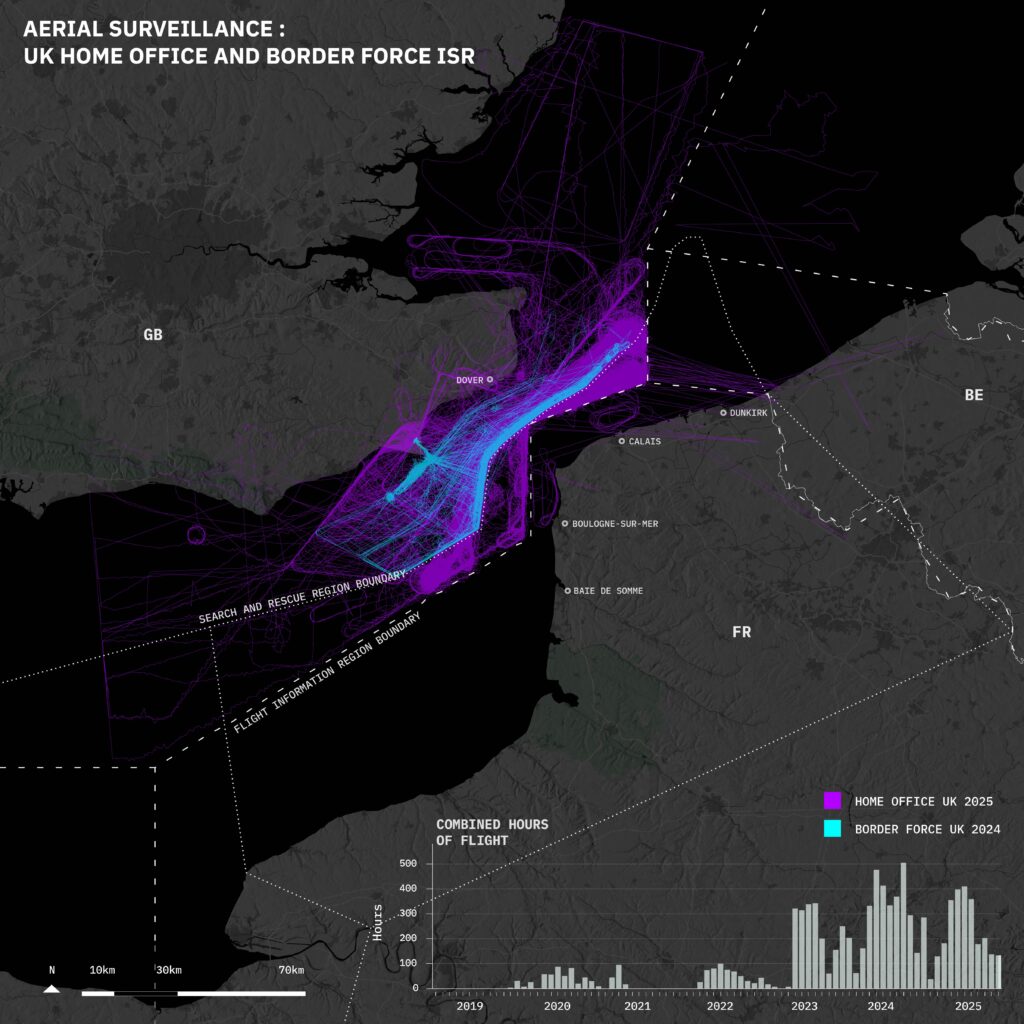
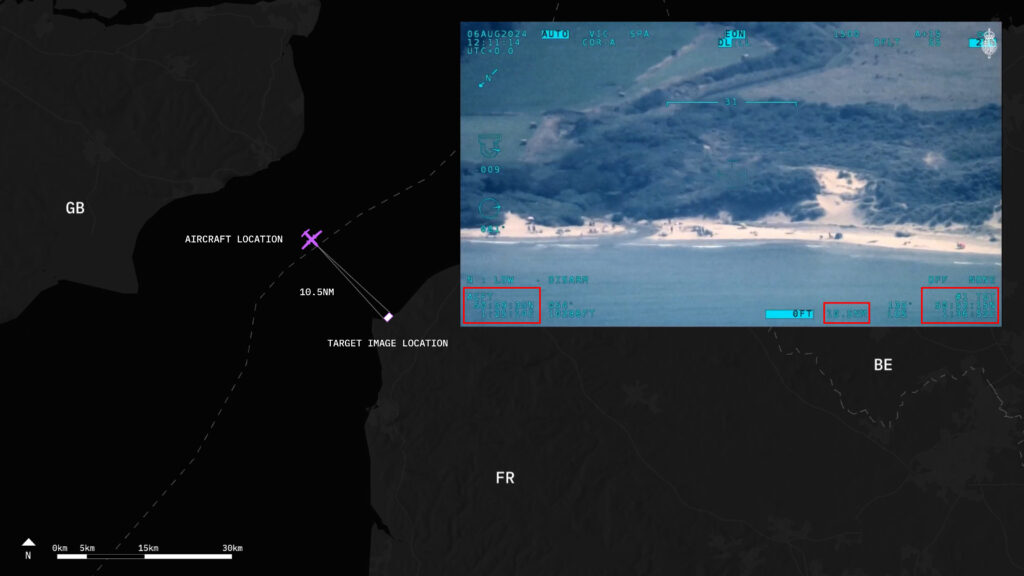
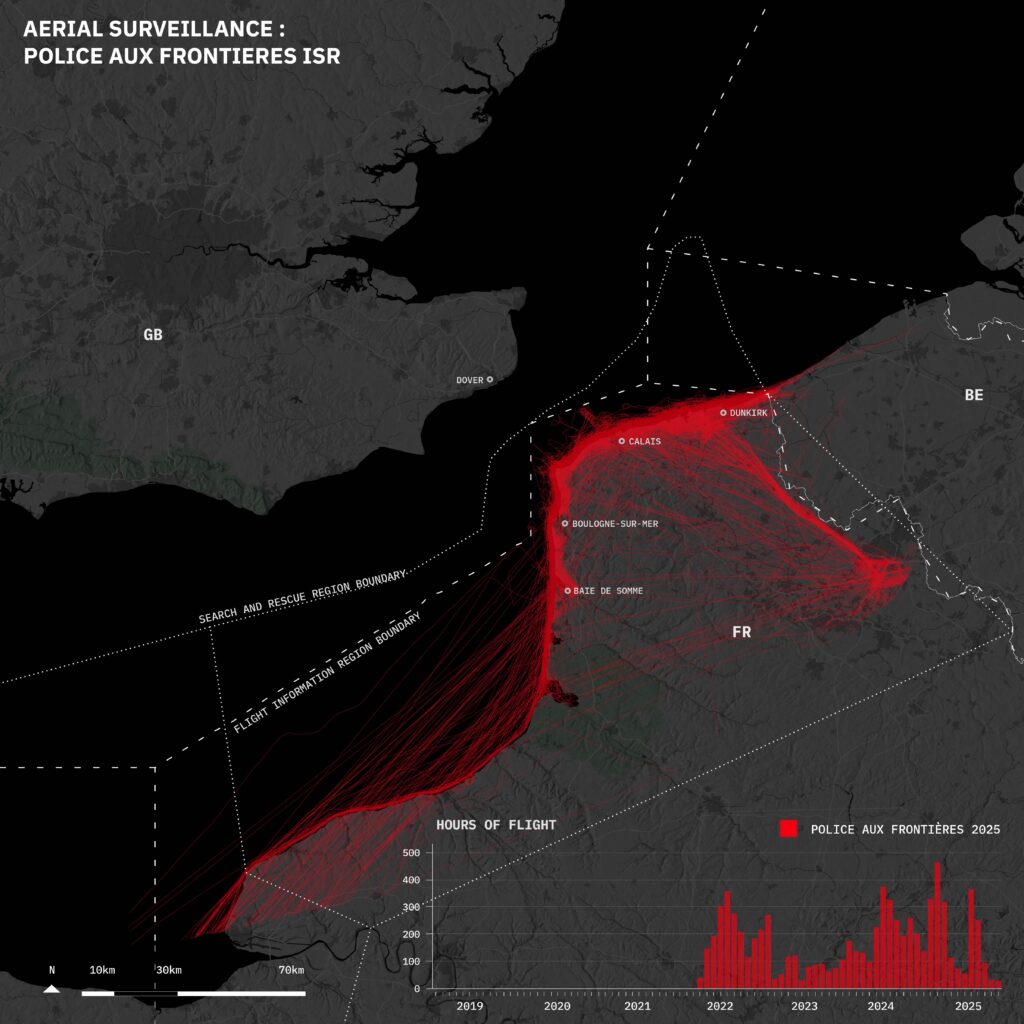
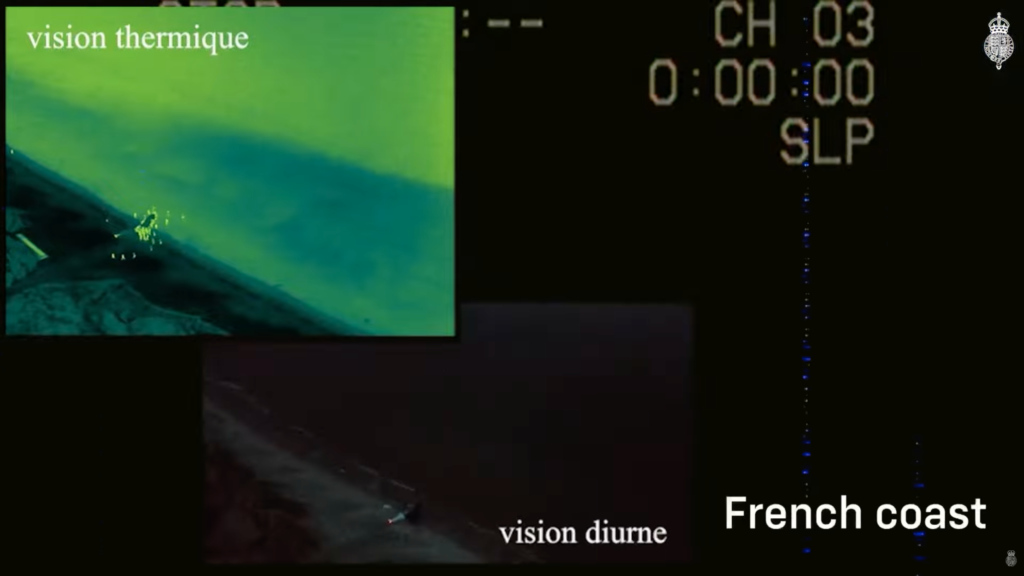
- Expanded aerial surveillance: Although framed primarily in terms of supporting search and rescue operations, analysis of flight tracks and state documentation showed most aerial surveillance of the Channel is focused on coordinating police patrols on the ground, and gathering data and intelligence for prosecutions. By enabling faster detection and police intervention, surveillance has contributed to overcrowding and the advent of new dangerous tactics for small boat departures.
- Increased police activity on the French coast: The ever larger numbers of police on the French coast, funded by the UK, has altered the geography of small boat departures, and driven the adoption of the ‘taxi boats’ which present greater risks for travellers who must board dinghies already afloat. Police’s violent tactics, especially the use of riot control weapons such as tear-gas, stun grenades, and rubber bullets, have also directly endangered travellers and led to panics, crushes, and people drowning in shallow waters.
The report demonstrates how these border policing practices, which authorities claim ‘save lives’ by preventing crossing attempts, have amplified the risks facing people compelled to make illegalised journeys to reach the UK. It also shows that British and French officials knew, or ought to have known, the deadly consequences of their policies.
Decades of increased security and policing at the UK’s externalised border have not ended illegalised journeys and, despite being a political priority since 2019, small boat journeys have not stopped. As this report shows, greater enforcement has not only failed to achieve its stated objective, but led to more deaths in the Channel. Whether this reality can be recognised by policy-makers and prompt a fundamental reassessment of UK border externalisation remains an open question. For now, as the next phase of bilateral cooperation for 2026-29 is set to begin, the UK government appears determined to continue using large payments to leverage the French to adopt ever riskier tactics to police its border, regardless of the human costs.
Introduction
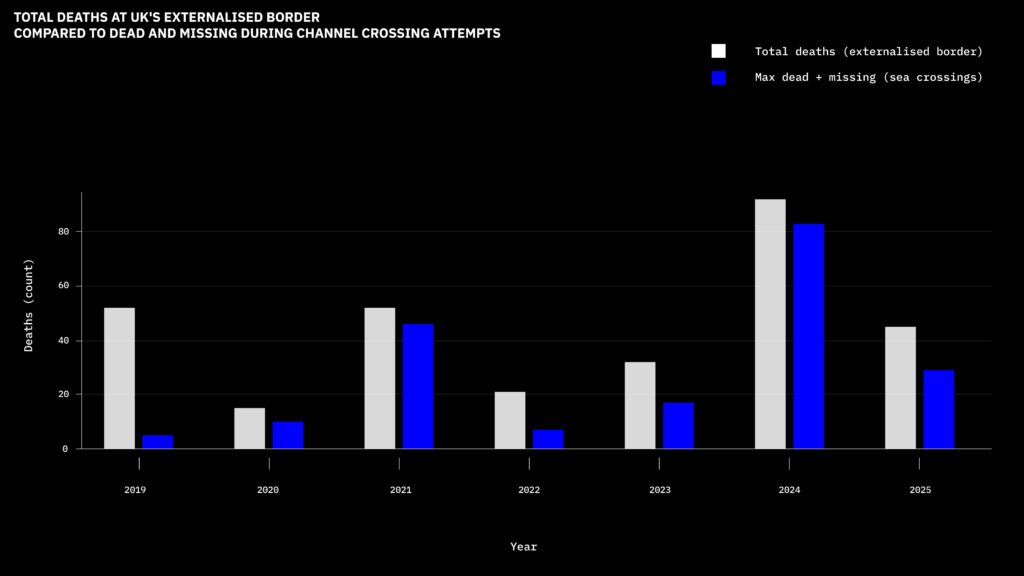
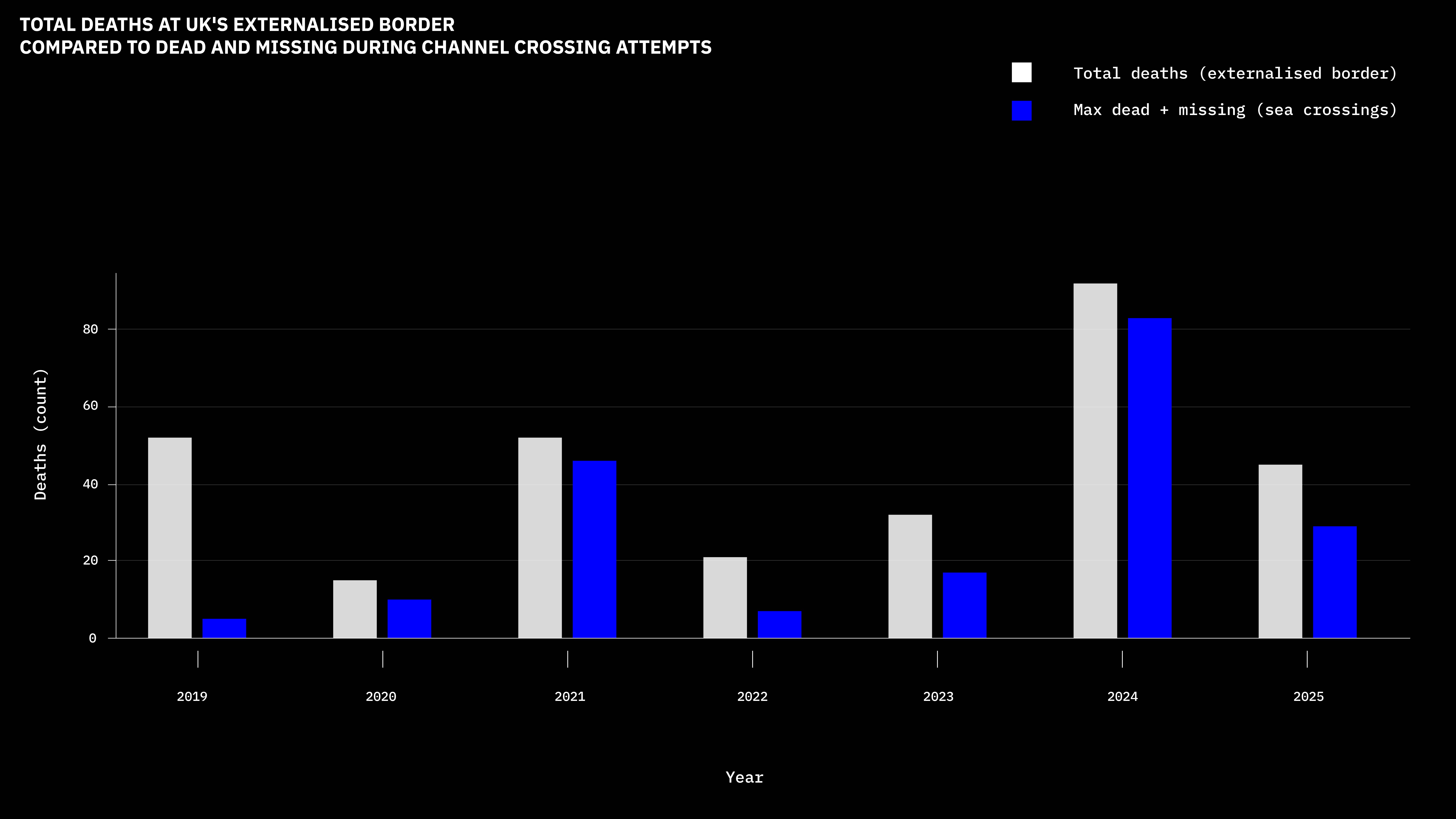
In 1999 the Red Cross opened a shelter in Sangatte, France for people denied safe transport to the United Kingdom (UK) by ‘juxtaposed’1For more information on the UK’s juxtaposed controls across the Channel see Home Office, ‘The UK’s Juxtaposed Border Controls’, Home Office in the Media, 6 April 2023, https://homeofficemedia.blog.gov.uk/2023/04/06/the-uks-juxtaposed-border-controls/. border controls requiring travellers clear immigration before crossing the Channel. From that year until 2026 journalists recorded at least 525 migrant deaths at Britain’s border with Europe.2Maël Galisson, ‘Voir Calais et mourir, 367 fois’, Les Jours, 15 May 2023, https://lesjours.fr/obsessions/calais-migrants-morts/ep1-memorial/. For more than 20 years those who lost their lives were mostly attempting to travel hidden in trucks, trains, and shipping containers. More than half of all deaths (309) have occurred since 2019, when crossings in so-called small boats3This report uses the term small boat for coherence with the most widely used nomenclature in the media, and to avoid the negatively racialised connotations of alternatives such as ‘migrant crossings’. However, it must be stated that the term first came to be used to refer to this type of journey at a time when mostly small purpose-built, seaworthy craft were being used for Channel crossings in 2018. The large rubber inflatable dinghies used today cannot faithfully be described as boats, and regularly hold between 50 and 100 passengers. The reasons for the shift to larger, unseaworthy vessels—which are still referred to as small boats by the government and in the media—is discussed at length in Section 3. became commonplace. Of those, as many as 197 died or went missing in the Channel, with 129—nearly a quarter of all deaths in the history of the UK’s externalised border—in the three years from 2023 to the end of 2025.
This recent surge in the numbers of people dying does not clearly correlate with increased numbers making the journey. Instead, the Channel has become deadlier following an explosion of investment from the British government, and increased cooperation with European states, to ‘Stop the Boats’.
This recent surge in the numbers of people dying does not clearly correlate with increased numbers making the journey. Instead, the Channel has become deadlier following an explosion of investment from the British government, and increased cooperation with European states, to ‘Stop the Boats’.
Repeating the pattern well-known from other border-zones of the rich world such as the Sonoran Desert,4Denise N. Obinna, ‘Death in the Borderlands: Necropolitics and Migration-Related Mortality at the US-Mexico Border’, Politics & Policy 53, no. 3 (2025): e70046, https://doi.org/10.1111/polp.70046. Mediterranean Sea,5Laura Lo Presti, ‘Terraqueous Necropolitics: Unfolding the Low-Operational, Forensic, and Evocative Mapping of Mediterranean Sea Crossings in the Age of Lethal Borders’, ACME: An International Journal for Critical Geographies 18, no. 6 (2019): 1347–67, https://doi.org/10.14288/acme.v18i6.1829. and Atlantic Ocean,6Òscar Prieto-Flores, ‘Necropolitics at the Southern European Border: Deaths and Missing Migrants on the Western Mediterranean and Atlantic Coasts’, Journal of Race, Ethnicity, and Politics, 24 March 2025, 1–17, https://doi.org/10.1017/rep.2025.19. increased policing and strengthened security at the UK’s externalised border has imperilled travellers. From counter-forensic investigations in the Mediterranean it is by now well-known that European state actors can kill illegalised7H. Bauder, ‘Why We Should Use the Term “Illegalized” Refugee or Immigrant: A Commentary’, International Journal of Refugee Law 26, no. 3 (2014): 327–32, https://doi.org/10.1093/ijrl/eeu032. migrants by abandoning them to die at sea8Charles Heller and Lorenzo Pezzani, ‘The Left-to-Die Boat’, Forensic Architecture, 11 April 2012, https://forensic-architecture.org/investigation/the-left-to-die-boat. or using force to push them back.9Stefanos Levidis and Christina Varvia, ‘The Pylos Shipwreck’, Forensic Architecture, 7 July 2023, https://forensic-architecture.org/investigation/the-pylos-shipwreck. There have also been cases where state-related (in)action played a role in migrants’ deaths in the Channel.10Sir Ross Cranston, The Cranston Inquiry Report: Report of the Public Inquiry into the Events of 23 to 24 November 2021, When over 30 People Died Attempting to Cross the English Channel in a Small Boat, HC 1581 (2026), https://cranston.independent-inquiry.uk/wp-content/uploads/2026/02/DFT_Cranston-inquiry-report_WEB.pdf.
However, migrants are not only killed during crossing attempts through state actors’ direct interventions. Border security policies affect how journeys are conducted and the level of danger travellers face. In the Channel region, the rising number of deaths from 2023 resulted more from changes in the material circumstances of small boat journeys—increasing numbers of people per boat, the poorer quality of dinghies used, chaos during launches—than the actions of state agents in ‘spectacular’11Nicholas De Genova, ‘Spectacles of Migrant “Illegality”: The Scene of Exclusion, the Obscene of Inclusion’, Ethnic and Racial Studies 36, no. 7 (2013): 1180–98, https://doi.org/10.1080/01419870.2013.783710. moments of enforcement. This investigation shows how the British and French governments have knowingly manipulated these material circumstances, and therefore hold as much responsibility for the contextual factors contributing to fatalities during crossing attempts as they do the operations of their border police.
Outline and key findings
Produced collaboratively by researchers at the Centre for Sociodigital Futures and Border Forensics, this report demonstrates how state policies to ‘Stop the Boats’ have made crossings more dangerous, and ultimately led to a dramatic rise in deaths in the Channel.
This report begins with a brief description of the investigation’s ‘digital counter-forensic’ methodology. Through analysis of data primarily produced by state actors, it demonstrates not only the lethal effects of increased border policing in the Channel, but that authorities have been or ought to have been aware of the lethal consequences of their policies.
The first substantive section summarises bilateral agreements between the French and British governments to police the UK’s externalised border, focusing specifically on payments intended to prevent small boat departures. Since the 2018 Sandhurst Treaty, the UK has provided over £625m for more police, equipment, and surveillance technology along the French coast, a huge sum which has been consistently used in negotiations to push the bounds of what the French are willing to do to stop small boat crossings.
Section 2 analyses trends in the numbers of people dying during small boat crossings, highlighting a peak in 2023-24 following the signing of the £476m UK-France Joint Leaders Declaration.12Prime Minister’s Office, ‘UK-France Joint Leaders’ Declaration’, GOV.UK, 10 March 2023, https://www.gov.uk/government/publications/uk-france-joint-leaders-declaration/uk-france-joint-leaders-declaration. On an annual scale, deaths do not clearly correlate with numbers of arrivals, meaning more crossings do not necessarily mean more fatalities. However, there is a positive association between deaths and overcrowding which has increased year on year. The Home Office’s averages for the numbers of people per boat are derived from arrivals data, and therefore may underestimate the actual passenger density of small boats upon departure. Analysing location data from the French coastguard has shown this to be the deadliest moment of the journey, and uncovered a shift in where and how migrants are dying in the Channel: from occasional mass casualty shipwrecks further offshore to frequent crushes and drownings close to French beaches.
Section 3 analyses three state border practices which have contributed to the recent rise in deadly incidents despite improvements in maritime search and rescue (SAR)
- ‘upstream’ anti-smuggling interventions intended to disrupt the supply chains of materials necessary for small boat crossings;
- increased aerial surveillance along the coast to better coordinate police activity on the ground; and
- more frequent and violent police interventions to small boats departing the French coast.
Underlying these practices is the UK government’s strategy to stop and deter illegalised migrants by working with the French government to prevent crossings. They are also rhetorically justified by the claim that ‘prevent[ing] dangerous small boats crossings’ will ‘ultimately save lives’.13Home Office, ‘Factsheet: Maritime Primacy’, Home Office in the Media, 14 April 2022, https://homeofficemedia.blog.gov.uk/2022/04/14/factsheet-maritime-primacy/. On its face this argument may appear logical; if no one is able to take to sea, no one would drown. The reality, however, has been that attempts to prevent crossings have endangered more people. As supply chains have been disrupted, facilitators have had to use different suppliers with inferior products. Fewer dinghies reaching the French coast have meant the ones which do get through take on more passengers. More intensive surveillance has made it impossible for under-resourced groups to organise their own journeys, driving overcrowding and the demand for professionalised facilitators. Greater numbers of police patrolling the beaches, and improved capabilities to detect launches, have led to new dangerous tactics such as the ‘taxi boats’, and police’s aggressive use of riot control weapons has created panic amongst travellers which have caused deadly crushes and dinghies departing underinflated.
Despite the increased efforts to prevent small boat crossings and their accompanying dangers, people have always and will continue to cross borders, even as European states introduce ever more restrictive immigration policies and withdraw legal protections for asylum seekers. With political interest in small boat crossings remaining high, the final section looks at the latest policy proposals for ‘stopping the boats’—interceptions and forced returns at sea—and considers the increased dangers they present for travellers.
Considerations for policy-makers
The publication of this report coincides with the anniversary of the UK-France Joint Leaders’ Declaration,14Prime Minister’s Office, ‘UK-France Joint Leaders’ Declaration’. which precipitated the steepest rise in deaths during Channel crossing attempts in 2023-24. When that agreement was announced in March 2023 there was already sufficient evidence for policy-makers to be aware that their efforts to disrupt supply chains and increase police patrols were leading to more overcrowded dinghies and other risks such as small boats departing from further along the French coast.
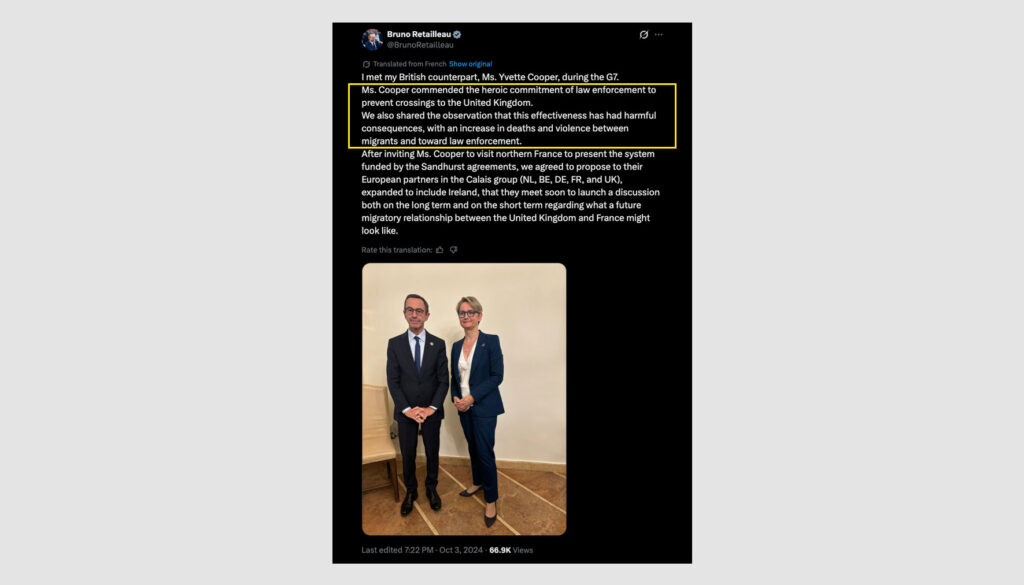
Since the Declaration, the harmful effects of intensified border policing efforts have been widely acknowledged in government. In its 2023-24 corporate risk register the Home Office added the new critical risk of ‘serious harm, injury or death… as a result of people attempting to arrive in the UK by dangerous methods’ but proposed to mitigate that risk with measures, such as upstream intervention and ‘engagement with the French’, which this report shows contributed to it.15Home Office, Annual Report and Accounts 2023 to 2024, HC 184 (Home Office, 2024), https://assets.publishing.service.gov.uk/media/66b249b40808eaf43b50de07/2023-24_Home_Office_Annual_Report_and_Accounts.pdf.Ministers have also directly attributed deaths in the Channel to increased border policing, although they still attempt to deflect responsibility onto ‘appalling people-smuggling gangs who are risking people’s lives’.16Suella Braverman, ‘Small Boats Incident in the Channel’, Hansard, 14 December 2022, https://hansard.parliament.uk/commons/2022-12-14/debates/D6B7CC8D-19CC-4664-8E71-547E343B5ABC/SmallBoatsIncidentInTheChannel. In November 2024 Angela Eagle, then Minister of State for Border Security and Asylum, conceded that the number of deaths in the Channel ‘has been the highest on record… because more pressure is being put on the gangs, the boats are being overloaded and there is more anarchy on the beaches in France’.17Small Boat Crossings: Hearing on Volume 756, House of Commons 6 November 2024 (2024), https://hansard.parliament.uk/Commons/2024-11-06/debates/77B1E99D-C873-49E1-9EB9-B6F57C0B939C/SmallBoatCrossings. In a frank exchange during the 2024 G7 Summit between the then French Interior Minister and UK Home Secretary, Yvette Cooper was said to have ‘praised the heroic efforts of law enforcement to prevent crossings’, but ‘agreed that this effectiveness had harmful consequences, leading to an increase in deaths and violence both amongst migrants and against the police’ [emphasis added].18Bruno Retailleau, ‘Bruno Retailleau on X: “J’ai Rencontré Mon Homologue Britannique, Mme Yvette Cooper, Lors Du G7…”, X (Formerly Twitter), 3 October 2024, https://x.com/BrunoRetailleau/status/1841891630007124414. Despite being fully aware of the harmful consequences, ministers persisted with their policies, and have even pushed for adopting new dangerous tactics to intercept and disable dinghies already at sea.19Hugh Schofield and Paul Pradier, ‘France Makes First Interception Targeting Small Boat Crossings to UK’, BBC News, 20 January 2026, https://www.bbc.co.uk/news/articles/ceqz1lzdxw1o.
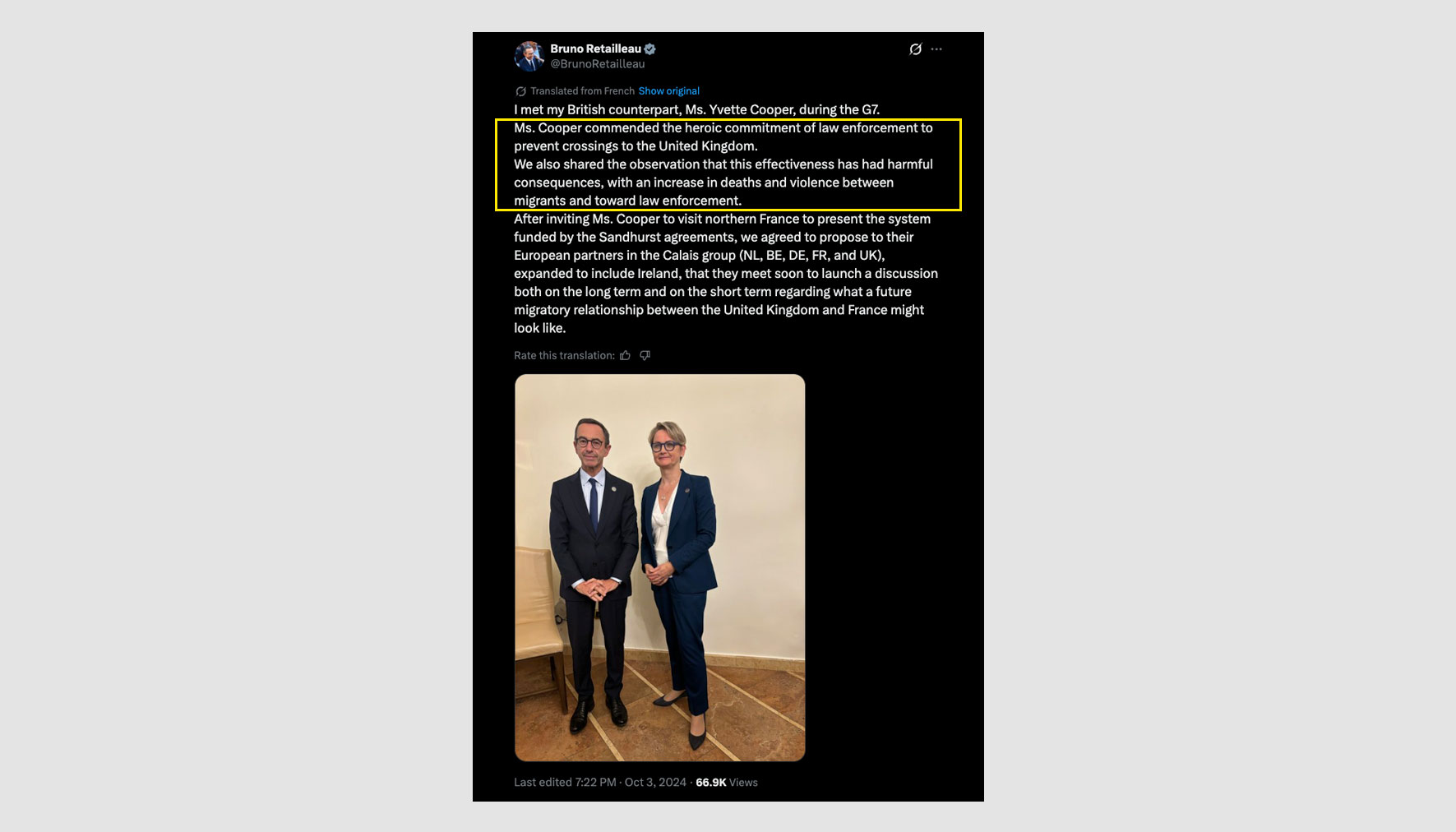
The implications of state actors recognising the harmful effects of border policing in this way are not merely academic. As lawyers acting for the families of those who died in the UK’s largest small boat shipwreck argued during the Cranston Inquiry,20Cranston, The Cranston Inquiry Report: Report of the Public Inquiry into the Events of 23 to 24 November 2021, When over 30 People Died Attempting to Cross the English Channel in a Small Boat. Article 2 of the European Convention on Human Rights, given effect in UK legislation by section 6 of the Human Rights Act 1998, places a positive duty on states to protect individuals whose lives are at risk ‘which the State knows or ought to know of’.21Sonali Naik et al., ‘Closing Statement on Behalf of the Bereaved Families and Survivor’, The Cranston Inquiry, 17 April 2025, 4, https://cranston.independent-inquiry.uk/wp-content/uploads/2025/04/Cranston-Inquiry-Closing-Statement-Bereaved-Families-and-Survivor-17-04-2025.pdf. The data and statements presented in this report show that the governments of the United Kingdom and France knew or ought to have known the risk of death faced by illegalised migrants attempting to cross the Channel, and that those risks were increasing as greater efforts were being made to stop them. For the ministers to then explicitly admit the link between ‘heroic efforts of law enforcement’ and deaths and violence at the border not only makes further justifications of police deployments on the French coast to ‘save lives’ untenable. In light of the duty on authorities to take measures to ‘avoid, minimise, or mitigate’ risk to life,22Naik et al., ‘Closing Statement on Behalf of the Bereaved Families and Survivor’, 5. legal arguments regarding possible breaches of the Article 2 right to life of those who have since died at the UK border following state intervention might be considered.
Assessing state actors’ legal liability for border deaths in situations where it has been so carefully outsourced to others—another country’s police force or the natural elements—is difficult, and beyond the scope of this report. Nevertheless, by carefully analysing government data and communications this report raises hard questions for policy makers whose decisions have driven the extreme overcrowding and violent launches of dinghies which have resulted in so much loss of life. As this report is published while the next stage of Franco-British cooperation in policing illegalised migration in the Channel is being finalised for tax years 2026-29,23Prime Minister’s Office, ‘UK-France Leaders Declaration’, GOV.UK, 10 July 2025, https://www.gov.uk/government/news/uk-france-leaders-declaration. its findings offer a clear warning of the risks to life in continuing ‘Stop the Boats’ policies which authorities can no longer overlook nor claim were unforeseeable.
Methodology
This report results from a collaborative investigation by researchers at the Centre for Sociodigital Futures (CenSoF) at the University of Bristol and Border Forensics. CenSoF is an interdisciplinary research centre funded by the UK’s Economic and Social Research Council examining how digital technologies increasingly condition social life across various ‘domains’, including how people move within contemporary societies. Within that broad scope, this project is concerned with understanding how new forms of digital surveillance at the border close down futures for illegalised migrants, sometimes permanently. Border Forensics is an independent research agency based in Geneva, Switzerland which mobilises spatial, visual, and statistical analysis, as well as creative aesthetic practices, to investigate the violence intrinsic to nation-state borders.
The ‘digital counter-forensics’ approach employed in this investigation reverses the forensic gaze through analysing data gleaned from state actors to show what they reveal, not about those crossing the border, but the authorities policing it.24Eyal Weizman, Forensic Architecture: Violence at the Threshold of Detectability (Zone Books, 2017), 64. This methodological choice to work primarily with statistical information brings with it the risk of reproducing the ‘state gaze’25Martina Tazzioli, ‘Counter-Mapping the Techno-Hype in Migration Research’, Mobilities, 18 January 2023, 1–16, https://doi.org/10.1080/17450101.2023.2165447. on human mobility, and in particular reducing lives which have suffered a premature end at the border to a number in a spreadsheet, evacuated of humanity and loving connection. While names of the dead are provided when known, unfortunately little detail can be offered about their lives here.
Substantial activist and journalistic work has already been done to bring the human stories of many of those killed at the UK’s border to public attention.26Galisson, ‘Voir Calais et mourir, 367 fois’; Calais Migrant Solidarity, ‘Deaths at the Calais Border’, Calais Migrant Solidarity, n.d., https://calaismigrantsolidarity.wordpress.com/deaths-at-the-calais-border/. This investigation complements that work by seeking to understand the wider connections and trends amongst deaths in the Channel and their origins in shifting UK border security policies. By mobilising a range of sources—including state produced datasets and documents—the report demonstrates the extent to which authorities knew, or reasonably ought to have known, the deadly consequences of their practices and contests their ‘tyranny of the truth’27Charles Heller and Lorenzo Pezzani, ‘Drifting Images, Liquid Traces: Disrupting the Aesthetic Regime of the EU’s Maritime Frontier’, antiAtlas Journal, no. 2 (December 2017), https://www.antiatlas-journal.net/anti-atlas/02-drifting-images-liquid-traces/. with their own figures and statements.
In this context where states are reluctant to acknowledge the ‘dark side of their migration politics’, the decision to count the dead becomes a demand for accountability.
Despite the glut of data gathered by state agencies in surveilling and policing people at the UK’s externalised border there is no official register of those who die or go missing.28Refugee Council, Deaths in the Channel – What Needs to Change, Briefing Paper (2025), https://www-media.refugeecouncil.org.uk/media/documents/Deaths-in-the-Channel-Refugee-Council-report-January-2025.pdf. Against the ‘agreed metrics to measure progress and success’29Prime Minister’s Office, ‘UK-France Joint Leaders’ Declaration’. through which the British and French governments evaluate their activities—e.g., the number of departures prevented, amount of materials seized, or number of people arriving to the UK—the deaths and harms of border enforcement appear only as externalities, if considered at all. Although France and the UK conduct regular strategic reviews of the effects of UK investment, they refuse to publish their findings.30Melanie Gower, Unauthorised Migration: UK-France Border Cooperation, Commons Library Research Briefing CBP-9681 (House of Commons Library, 2026), 10, https://researchbriefings.files.parliament.uk/documents/CBP-9681/CBP-9681.pdf.
In this context where states are reluctant to acknowledge the ‘dark side of their migration politics’, the decision to count the dead becomes a demand for accountability.31Charles Heller and Antoine Pécoud, ‘The Politics of Counting Migrants’ Deaths in the Mediterranean’, Border Criminologies, Faculty of Law Blogs, University of Oxford, 23 October 2020, https://blogs.law.ox.ac.uk/research-subject-groups/centre-criminology/centreborder-criminologies/blog/2020/10/politics-counting. It is ‘an expression of a political will to acknowledge and to know’32Katja Franko Aas and Helene O. I. Gundhus, ‘Policing Humanitarian Borderlands: Frontex, Human Rights and the Precariousness of Life’, British Journal of Criminology 55, no. 1 (2015): 12, https://doi.org/10.1093/bjc/azu086. not only who those people killed by the border were, but why their lives were cut short. Only with this knowledge can we act to prevent further death in the Channel.
Counting the dead
The first stage of the investigation involved cross-referencing records of people who have died or gone missing at the UK’s externalised border collated by activist groups Calais Migrant Solidarity (CMS)33Calais Migrant Solidarity, ‘Deaths at the Calais Border’, n.d. and the Groupe Décès, and journalist Maël Galisson.34Galisson, ‘Voir Calais et mourir, 367 fois’. From these lists of all deaths, cases where people were suspected to have died in the course of an illegalised Channel crossing were selected and analysed. Although crossings became regular in November 2018, the first deaths occurred in 2019. Therefore, data analysed for this investigation extends from 2019 to the end of 2025.
The criteria for selecting cases of deaths which occurred during active crossing attempts excluded three which took place after an attempt had finished: Aleksandra Hazhar who died just three days old when her mother gave birth prematurely having been held by police for six hours, freezing cold and soaking wet, after a failed crossing attempt while she pleaded for them to take her to hospital;35Aleksandra’s mother published a letter explaining why her daughter was born prematurely at Calais Migrant Solidarity, ‘In the Name of God / Au Nom de Dieu’, Calais Migrant Solidarity, 29 January 2021, https://calaismigrantsolidarity.wordpress.com/2021/01/29/in-the-name-of-god-au-nom-de-dieu/. The family also shared their story with the media: May Bulman, ‘The Tragedy of a Newborn Refugee Who Died as Her Family Tried to Reach Safety’, The Independent, 8 March 2021, https://www.independent.co.uk/news/uk/home-news/refugee-baby-death-france-calais-b1808163.html. and Recep Baysal and Mehmet Ali Geçsöyler, two Turkish men killed by a The criteria for selecting cases of deaths which occurred during active crossing attempts excluded three which took place after an attempt had finished: Aleksandra Hazhar who died just three days old when her mother gave birth prematurely having been held by police for six hours, freezing cold and soaking wet, after a failed crossing attempt while she pleaded for them to take her to hospital; and Recep Baysal and Mehmet Ali Geçsöyler, two Turkish men killed by a Polish truck driver who deliberately drove into a group of people walking back to their camp from a failed crossing attempt.36Matthias Tesson and Marine Langlois, ‘Calais: une quinzaine de migrants fauchés sur l’autoroute, deux personnes tuées’, BFM Grand Littoral, 17 November 2023, https://www.bfmtv.com/grand-littoral/calais-une-quinzaine-de-migrants-fauches-sur-l-a16-deux-personnes-tuees_AN-202311170425.html.
All efforts have been made to attribute bodies found at sea or on beaches to the original incident in which the person entered the water. In cases where there are suspicions from monitoring organisations about the incident someone was involved in but no reasonable certainty—for example, the unidentified person found in a fishing vessel’s nets on 10 December 202137Olivier Pecqueux, ‘Un corps remonté dans des filets de pêche, au large de Calais’, La Voix du Nord, 10 December 2021, https://www.lavoixdunord.fr/1112181/article/2021-12-10/un-corps-remonte-dans-des-filets-de-peche-au-large-de-calais.—the finding of the body has been logged as a separate incident. There is thus potential for the numbers of deadly incidents in 2019, 2020, 2021, 2024, and 2025 to be slightly inflated by a few incidents, as in those years bodies were found which could not be connected to another known case. Attempts to match bodies found led to discovering that two initially included in the monitoring organisations’ data were not illegalised migrants: a body found on the beach of Les Palominos in Les Hemmes de Marck, France on 18 December 2021,38Isabelle Hodey, ‘Marck: un corps découvert samedi sur la plage des Hemmes de Marck’, La Voix du Nord, 19 December 2021, https://www.lavoixdunord.fr/1116471/article/2021-12-19/marck-un-corps-decouvert-samedi-sur-la-plage-des-hemmes-de-marck. and one on the beach of Knokke-Heist, Belgium found on 24 December 2021.39Mathias Mariën, ‘Lichaam aangetroffen op strand Knokke-Heist: “Identificatie volop bezig”’, hln.be, 24 December 2021, https://www.hln.be/knokke-heist/lichaam-aangetroffen-op-strand-knokke-heist-identificatie-volop-bezig~a4bca24f/.
There were also discrepancies in the numbers of people missing among the lists cross-referenced during this investigation. On occasions, CMS’ ‘Deaths at the Calais Border’ blog40Calais Migrant Solidarity, ‘Deaths at the Calais Border’, Calais Migrant Solidarity, 29 April 2014, https://calaismigrantsolidarity.wordpress.com/deaths-at-the-calais-border/. mentions additional missing people not included in official press releases or media reports. CMS’ information is gathered through direct testimony from survivors and witnesses whom authorities do not always believe.41Maël Galisson et al., ‘France Failing to Probe Police Role in Syrian Migrant Drowning’, Https://Www.Newarab.Com/, The New Arab, 8 July 2025, https://www.newarab.com/investigations/france-no-justice-syrian-migrant-drowned-after-police-chase. Missing persons mentioned on the CMS blog not included in other reports have therefore been recorded as ‘reported’ rather than ‘confirmed’ missing. The totals for dead and missing people in the Channel are based on this larger figure of ‘reported missing’ considering the failures of authorities to adequately investigate reports of people missing at sea.42Tom Levitt et al., ‘“They Can’t Grieve”: Families in Limbo as Channel Boat Victims Left Unidentified’, Global Development, The Guardian, 1 March 2024, https://www.theguardian.com/global-development/2024/mar/01/refugee-migrant-families-france-deaths-unidentified-channel-crossings.
Determining trends
Having conducted a thorough review of the chronology of all fatal incidents involving illegalised migrants attempting to cross the Channel since 2019, attention turned to identifying underlying trends in those incidents. Data on the locations of deaths43Nicolas Lambert and Maël Galisson, ‘A Calais La Frontière Tue!’, A Calais La Frontière Tue!, n.d., https://neocarto.github.io/calais/. and alerts to the French coastguard of small boats in distress44Ministère de la Transition écologique, ‘Opérations Coordonnées Par Les CROSS’, Datagouv, n.d., https://www.data.gouv.fr/datasets/operations-coordonnees-par-les-cross/. were analysed to understand their shifting geographies.
Noting the increased frequency of deadly incidents close to the French coast from Summer 2023, further analysis was conducted on ‘transparency data’ published by the UK Home Office on the numbers of persons making the journey,45Home Office, ‘Small Boat Arrivals: Last 7 Days’, GOV.UK, n.d., https://www.gov.uk/government/publications/migrants-detected-crossing-the-english-channel-in-small-boats/migrants-detected-crossing-the-english-channel-in-small-boats-last-7-days. as well as French activity to prevent crossings. These data depicted a clear trend towards increasingly overcrowded dinghies, but only captured the numbers of people who successfully crossed, not unsuccessful journeys nor the numbers of people who gave up and elected to be rescued by the French before the dinghy they travelled on arrived to the UK with the remaining passengers.46See, for example, Ben Quinn and Diane Taylor, ‘One Dead and Dozens Rescued in Latest Attempt to Cross Channel’, World News, The Guardian, 28 July 2024, https://www.theguardian.com/uk-news/article/2024/jul/28/channel-crossing-dead-and-dozens-rescued. Computing the real increase in density of small boats over time required analysing Home Office transparency data alongside operational data from the French coastguard47Ministère de la Transition écologique, ‘Opérations Coordonnées Par Les CROSS’. and the European Border and Coast Guard Agency’s (Frontex) Joint Operations Reporting Application (JORA)48Frontex, ‘Joint Operation OPAL COAST’, Public Register of Documents, 26 June 2024, https://prd.frontex.europa.eu/document/joint-operation-opal-coast/. which also captured the numbers of people who did not reach the UK during their attempts.
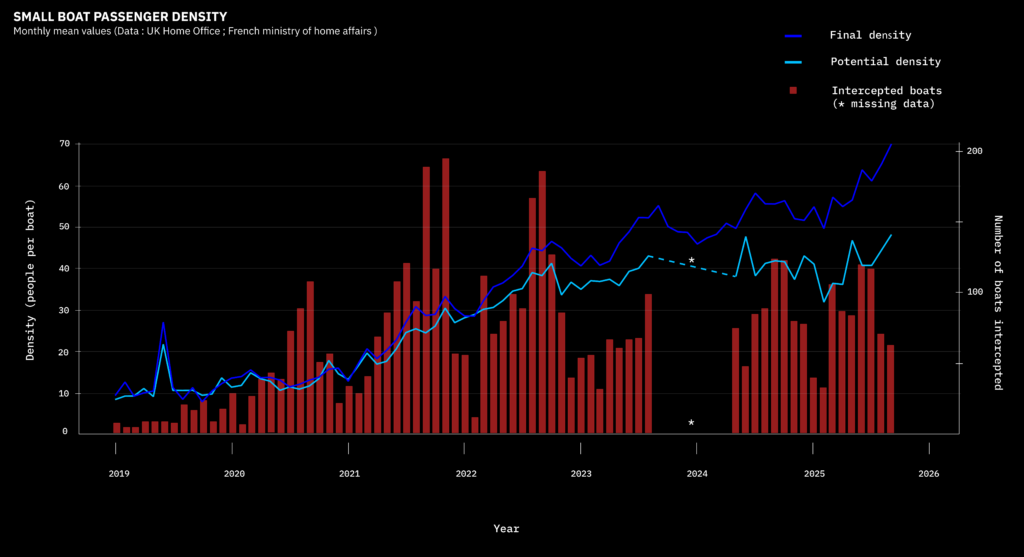
To better characterise overcrowding trends, three complementary density measures were derived from these combined datasets to produce figures in Section 2. Final density corresponds to the metric implicitly presented in the Home Office transparency data: it reflects the average number of people per boat based only on those who successfully arrived in the UK. While useful for describing outcomes, this measure underestimates the actual level of overcrowding at departure because it excludes individuals who did not complete the crossing. To demonstrate this inaccuracy, an initialdensity indicator was created using data from the French operational reporting system for coastguard rescue coordination centres (CROSS). These sources capture incidents in which people were rescued by French authorities or where crossings were only partially completed. As some passengers are removed during rescue operations or do not complete the journey, this initial density is systematically higher than the final density derived from the Home Office’s arrival statistics. A third indicator, referred to as potential density, was then estimated to account for the preventive actions of French law enforcement authorities on the beaches, particularly the seizure of boats prior to departure. This measure builds on the final density but also considers the number of boats intercepted or destroyed before they could be launched. The underlying assumption is that, had these boats not been seized, the same pool of people attempting to cross would have been distributed across a larger number of vessels. In other words, the availability of more boats would likely have reduced the number of passengers per boat. The potential density therefore represents the estimated occupancy in the absence of police preventions. Comparing these indicators suggests that the reduction in available boats due to police seizures increases the density of the vessels that do depart, a factor that appears to be associated with heightened risks and, potentially, with the rise in fatal incidents observed.
In addition to analysing the data voluntarily published by these state actors, multiple iterative requests were made under freedom of information laws. Not all were successful – including a request for information held by the UK on the French police’s activities preventing crossings at a granular level which was refused despite the Home Office having agreed a deal with the French to publish preventions data since 29 April 2024. Information obtained from the French Ministry of Interior by investigative journalist Alexandre Léchenet49Alexandre Léchenet and Esther Webber, ‘Helicopters, Riding Boots and Vacuum Cleaners: How French Border Force Spends UK Money’, POLITICO, 13 November 2023, https://www.politico.eu/article/helicopters-riding-boots-and-vacuum-cleaners-how-french-border-force-spends-uk-money/. following a court case provided a breakdown of the French police’s activities countering small boats between 2018 and 2023. States exert control over the flows of information regarding their migration policies50Travis Van Isacker and William Walters, ‘Rethinking Freedom of Information Research: Selective Flows of Information in Borders and Migration Studies’, Political Anthropological Research on International Social Sciences 5, no. 2 (2024): 189–210, https://doi.org/10.1163/25903276-bja10060. in a way this report challenges but has not been entirely able to subvert.
Fully understanding the trends and mechanisms underlying the rise in numbers of deaths in the Channel required augmenting state data with those collected by migrants’ rights associations, solidarity activists, and journalists documenting violence and death at the UK’s borders. Groups including Alarm Phone, Groupe Décès, Humans for Rights Network, Human Rights Observers, and Utopia 56 shared data they collect on police activities, distress calls from travellers at sea, and reports of people who have died or gone missing at the border. The additional analysis of their data, combined with what has been obtained from state actors, presented in this report complements these groups’ publications which centre people-on-the-move’s first-hand experiences of the violence and harm of the Franco-British border51Lily MacTaggart et al., You Can’t Stay but You Can’t Go – State Violence at the UK France Border (Humans for Rigths Network, 2025), https://static1.squarespace.com/static/5a69d94949fc2bad10754433/t/692f1b0f7ef338123aa38752/1764694799800/HfRN+-+Final+Report.pdf; Human Rights Observers, ‘HRO: Human Rights Observers – Reports’, HRO: Human Rights Observers, n.d., https://humanrightsobservers.org/reports/; Lily MacTaggart et al., We Want to Be Safe: The Impact of Violence against Children on the UK-France Border in 2024 (Project Play, 2025), https://www.project-play.org/_files/ugd/6fd156_8f08fe713f004cb69238ed232f539137.pdf; Katie Hall et al., ‘Nowhere Safe: The Impact of UK-Funded Border Violence against Children in Northern France’, Project Play, 28 February 2025, https://www.project-play.org/_files/ugd/6fd156_b06c3cdbce8545c99dd87cf031039e62.pdf. with a more structural account of the consequences of border policies. These organisations have been struggling for years to monitor, hold authorities to account, and ultimately put an end to the violence of the border, and this investigation not only depends upon, but aims to further, their ongoing work.
Investigating mechanisms
The three mechanisms of border policing—‘upstream’ anti-smuggling interventions, aerial surveillance, and policing the beaches—each required additional efforts to investigate.
To measure anti-smuggling activity by law enforcement, freedom of information requests were submitted to Europol for the number of messages exchanged via its Secure Information Exchange Network Application (SIENA). Although the messages themselves were refused, the message headers provided a way to measure by proxy the amount of Europol activity related to Channel anti-smuggling investigations.
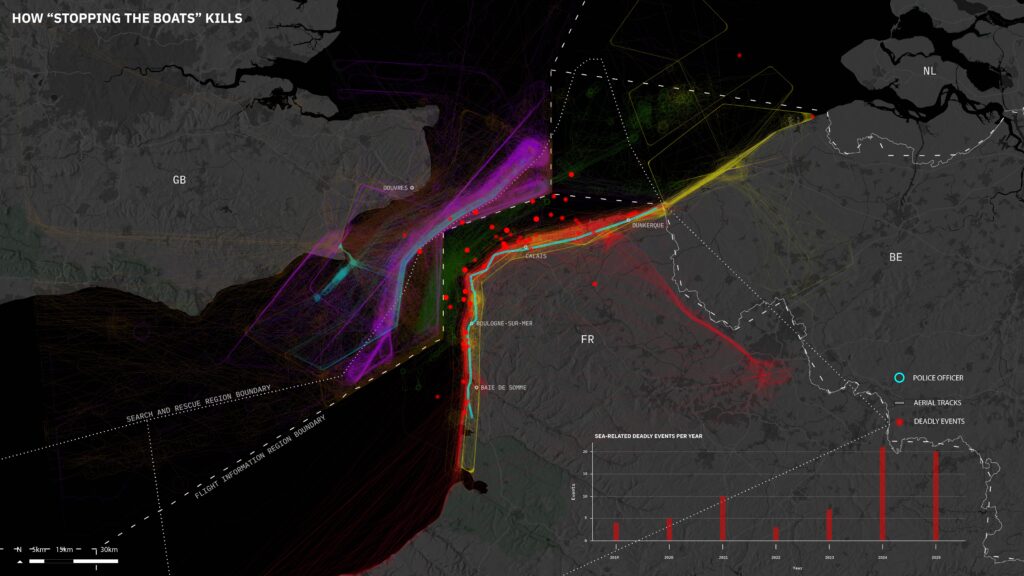
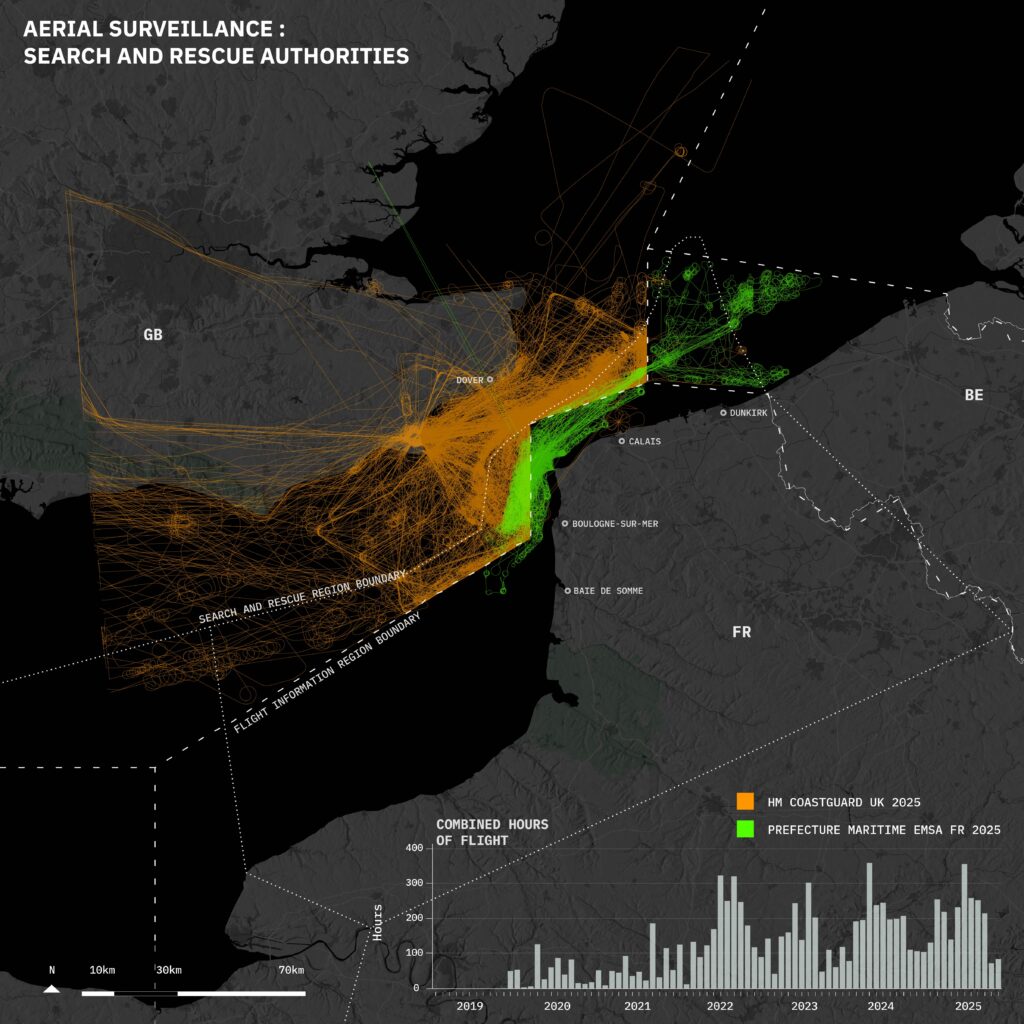
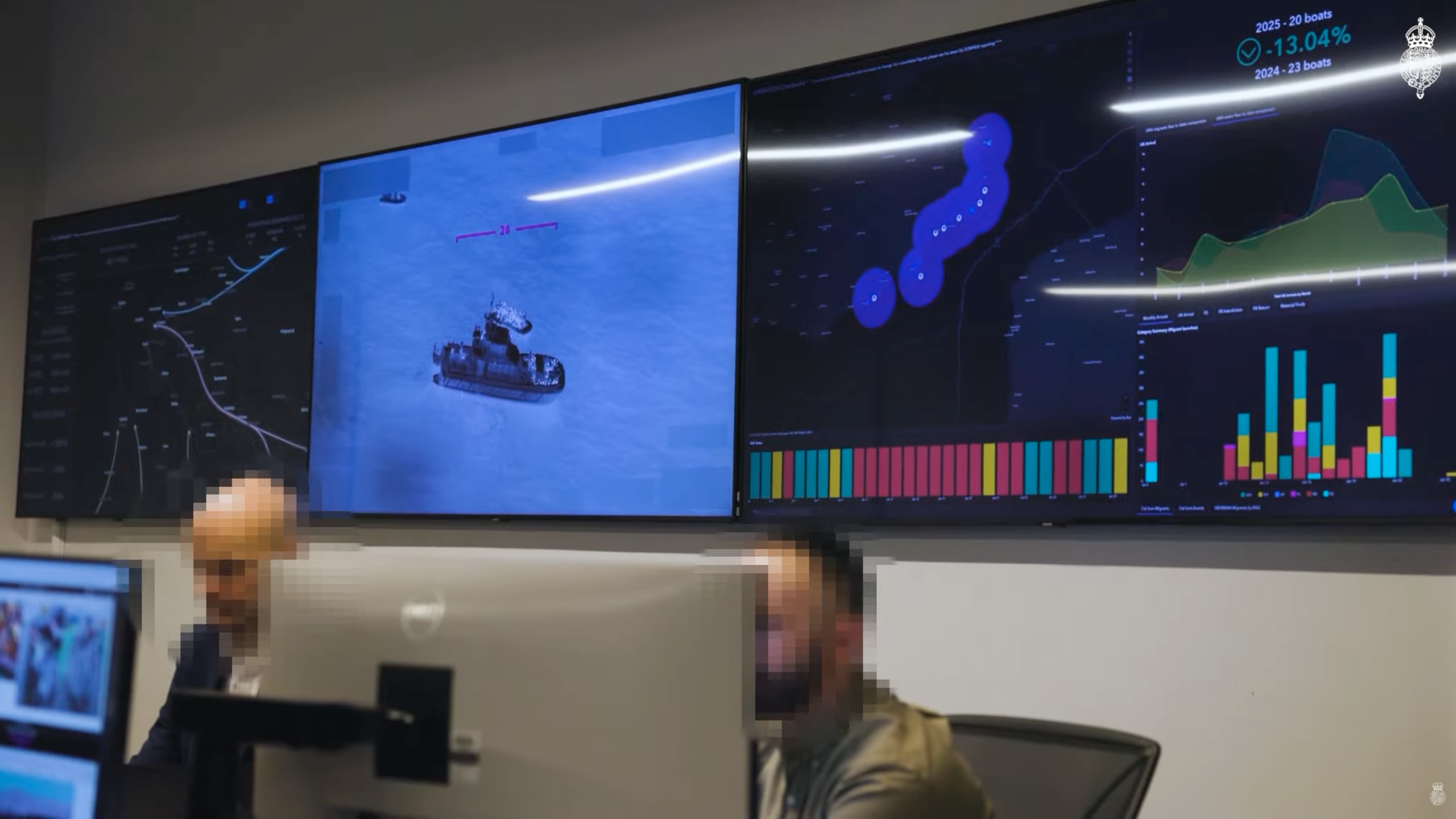
The most labour intensive mechanism to investigate was aerial surveillance. First, a list of aircraft involved in surveillance of the Channel was created by observing flight tracks on each of the days for which the UK’s Operation Deveran assessment of risk of small boat crossings52Met Office, ‘Op DEVERAN Weather Assessment’, Cranston Inquiry Evidence, 22 November 2021, https://cranston.independent-inquiry.uk/wp-content/uploads/cranston-evidence/INQ006332_20211122_Channel_Crossing_Assessment_OS.pdf. was at least likely.53A list of assessments for 2023 to 2025 were obtained from the Met Office through freedom of information requests. The aircraft were then classified according to the agency operating them. This categorisation made it possible to distinguish the different operational objectives—Intelligence, Surveillance, and Reconnaissance (ISR) for law enforcement, or Search and Rescue (SAR) to ensure safety of life at sea—of aerial surveillance at the border. For each category of operator, analysis of Automatic Dependent Surveillance–Broadcast (ADS-B) data signals allowed for establishing where aircraft tended to patrol, the types of flight patterns they followed, and the duration and intensity of their surveillance activity. By separating aircraft by institutional affiliation, the analysis highlights how different actors contribute to the monitoring of the border: some aircraft concentrate on coastal departure areas, others patrol the central Channel or shipping lanes, while others appear to conduct broader reconnaissance flights.
To reconstruct and visualise the aerial surveillance patrols presented in Section 3.2, flight tracks were collected using ADS-B signals. ADS-B is a system with which aircraft periodically broadcast their position, altitude, speed, and identification via radio signals. These signals are received by a distributed network of ground receivers operated by aviation enthusiasts and organisations worldwide, and aggregated on open platforms. By stacking the recorded tracks for the identified aircraft over the periods of time they were active in the Channel, it was possible to reconstruct their movements during surveillance missions.
The collected tracks were then processed and analysed using geographic information system (GIS) software. From these data, several indicators were computed, including the total number of flight hours conducted by each aircraft and operator, as well as the spatial distribution of their patrols. Mapping the tracks makes it possible to visualise surveillance corridors, repeated patrol loops, and areas of concentrated monitoring, thereby exposing patterns in how aerial surveillance is deployed along the border.
It is important to note that ADS-B coverage is not complete. Reception depends on the availability of ground receivers and on whether aircraft are broadcasting ADS-B signals during their missions. Some aircraft may disable or limit their transmissions, and signal reception can be weaker over open sea areas. As a result, the dataset presented in Section 3.2 should be understood as a minimum observable level of aerial surveillance activity: the flights captured represent those that were detectable through the ADS-B network, meaning that the true extent of surveillance activity in the Channel may be higher than what is shown.
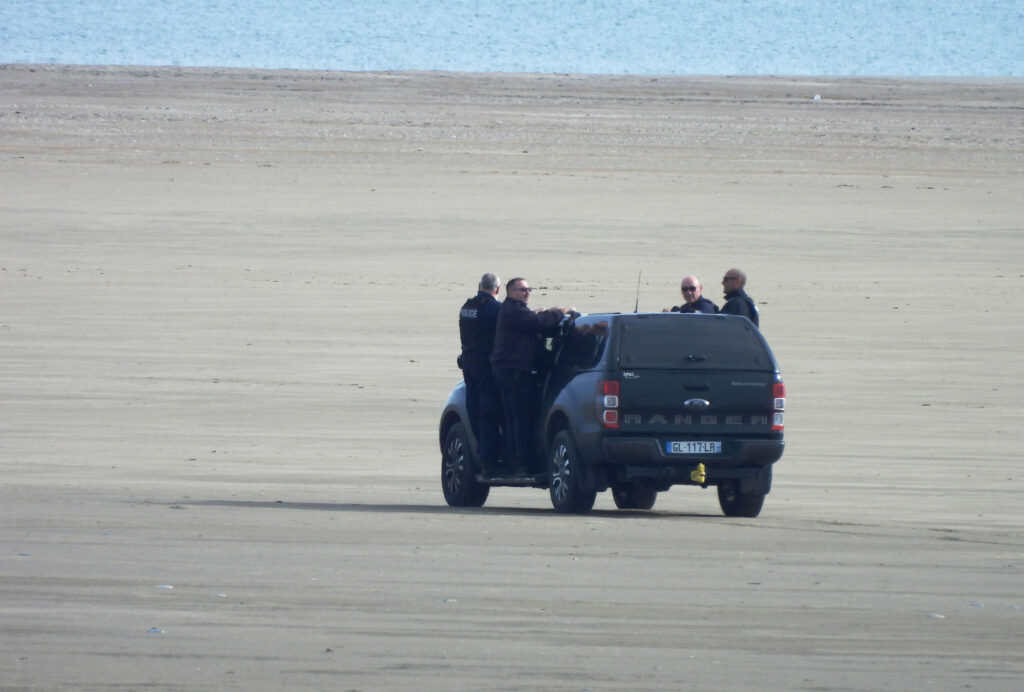
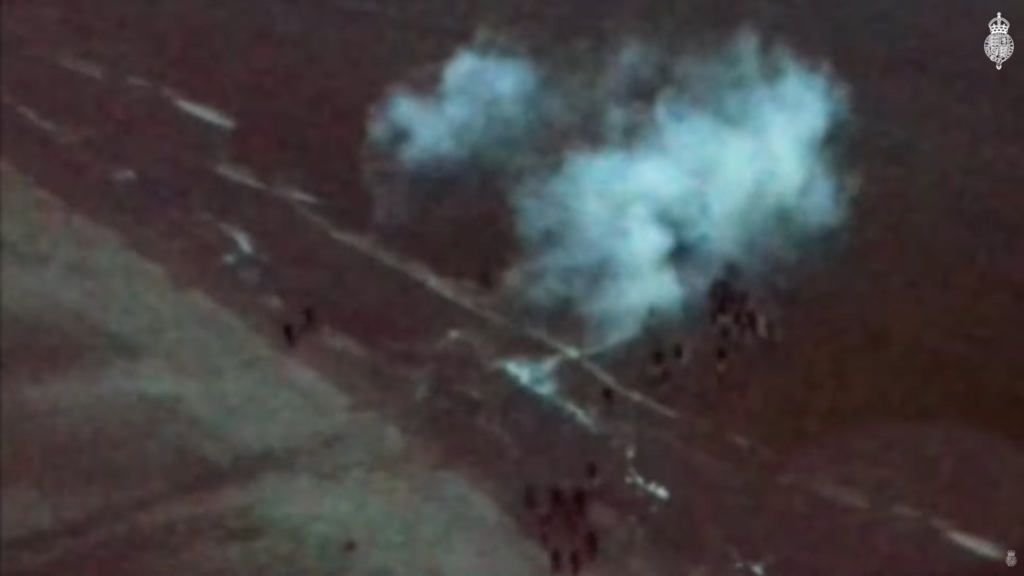
Investigating police actions on the beach required researchers to travel to France on multiple occasions over a more than one year period to observe the police first-hand. Additional videos and photographs collected and shared by the migrants’ rights and police monitoring organisations in northern France were also analysed and provided additional insights into police tactics, especially the use of tear gas and other riot control weapons to prevent departures.
Qualitative research and implications
To complement the quantitative data analysis and other investigative techniques described previously, significant qualitative and desk research was conducted to substantiate the findings. Interviews and focus group discussions were held with illegalised travellers, activists, search and rescue (SAR) volunteers, and a person facing smuggling charges during field-work in France to gain a first-hand understanding of the effects of intensifying border policing. Researchers also attended border security trade shows and spoke with Home Office civil servants and private sector contractors—including, among many others, representatives from 2Excel Aviation, Anduril, PAL Aerospace, Prevail Partners, and Tekever—working in border security and search and rescue in the Channel. Unfortunately, all formal interview requests were ignored or refused by this cohort, but the frank discussions in the trade show context provided invaluable insights into the otherwise opaque practices of border enforcement. And while they may not commit the same statements to the record, Border Force officers at these events did say they recognised the finding of this report that increased efforts by the French police to prevent crossings have led to more dangerous crossings in recent years.
A review of media reporting and grey literature—including government press releases, migration think tank reports, transcripts of parliamentary debates, and ministerial statements—on UK border security was also conducted. This review informed analysis on the sequence of funding agreements between France and the UK, and especially on the rationale of evolving policies to curb small boat crossings since 2019. Critical academic scholarship and think tank reports demonstrated a consensus view that crossings have become ‘much more dangerous’ as a result of ‘measures put in place by the UK and France to stop boats leaving French waters’,54Mixed Migration Centre, Beyond Restrictions: How Migration and Smuggling Adapt to Changing Policies across the Mediterranean, the Atlantic and the English Channel (2025), 28, https://mixedmigration.org/wp-content/uploads/2025/03/373_Beyond-Restrictions-Med-Atl-and-Eng-Channel-REPORT.pdf. and provided a foundation in the literature for the claims made here concerning the foreseeability of the effects of increased border policing. This report makes as much reference as possible to government documents and statements to make it additionally clear that they themselves are aware of the deadly consequences of their policies.
Section 1.
Fatal accords: funding an externalised border
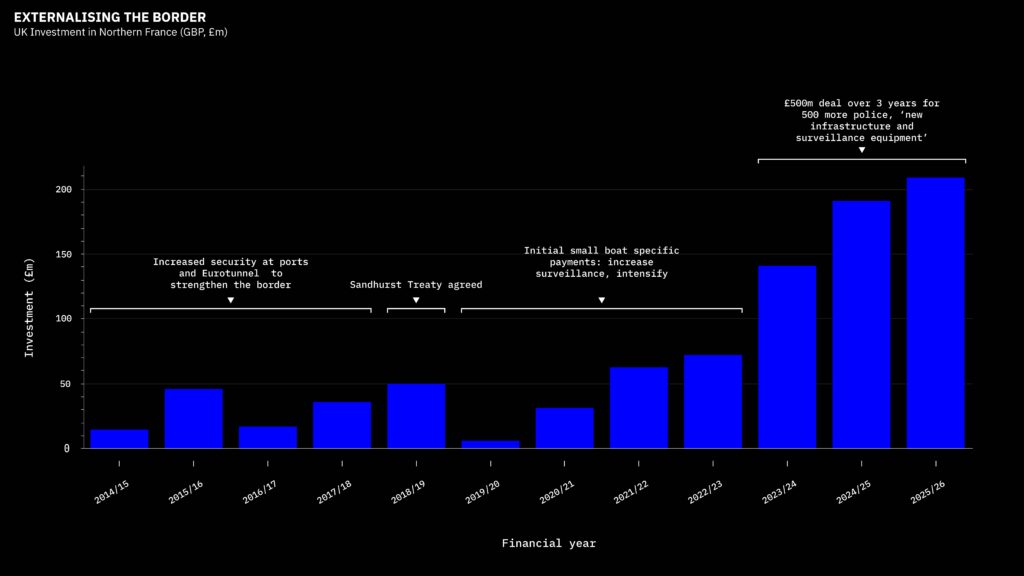
Alongside measures such as creating a domestic ‘hostile environment’ for illegalised migrants in Britain, ending visa free travel for European nationals following Brexit, and eroding the rights of asylum seekers and refugees, investing in border security in Calais and Dunkirk became seen as a way for ministers to appear ‘tough’ on migration and placate an increasingly anti-immigrant electorate. Since at least 2009, the British government has routinely paid the French to secure its juxtaposed border controls and police the population of illegalised migrants, the vast majority of whom will claim asylum in the UK,55Peter William Walsh and Mihnea V. Cuibus, ‘People Crossing the English Channel in Small Boats’, Migration Observatory, 30 January 2026, https://migrationobservatory.ox.ac.uk/resources/briefings/people-crossing-the-english-channel-in-small-boats/. blocked in northern France. Over the years these sums significantly increased commensurate with the UK government’s increasingly hostile approach to immigration.
The hundreds of millions of pounds invested in fortifying its borders in France did not stop illegalised migration to the UK. Instead, it displaced it from the ‘canalised routes’56Oral evidence: Border Security and irregular migration: The work of the Border Security Command: Hearing on HC 1321 before the Home Affairs Committee (2025), at 33, https://committees.parliament.uk/oralevidence/16519/pdf/. used in previous decades—trucks, trains, and ferries—to the open sea, where the dangers facing travellers have increased with each deal struck. By precipitating this shift to maritime journeys, increased investment in border security appears to have had the opposite effect to what was intended. According to the Oxford Migration Observatory, with the rise of small boat crossings ‘the number of people detected arriving in the UK without authorisation has increased sharply’;57Mihnea Cuibus and Peter William Walters, ‘Unauthorised Migration in the UK’, Migration Observatory, 21 January 2025, https://migrationobservatory.ox.ac.uk/resources/briefings/unauthorised-migration-in-the-uk/. ‘someone should have thought about displacement’ reflected one Border Force officer in a 2019 internal Home Office review.58Home Office, ‘Small Boats Response: Lessons Learned Review June 2019’, Cranston Inquiry Evidence, June 2019, 11, https://cranston.independent-inquiry.uk/wp-content/uploads/cranston-evidence/INQ006137_Small_Boats_Response__Lessons_Learned_Review_June_2019_Home_Office____06_2019.pdf.
This section presents a brief history of UK-France bilateral agreements and funding packages in the area of border security and migration control. While many of these agreements covered more general efforts to control illegalised migration towards the UK, particular attention is paid here to their small boat specific items such as providing funding for police patrols and the purchase of surveillance technology. This overview establishes the origins of the dangerous strategy to counter small boat crossings by preventing departures from France as the UK has failed to implement other policies, such as push-backs at sea or deporting arrivals to a third-country like Rwanda. It also highlights that the UK’s border security policies typically have unintended consequences. Just as security infrastructure in and around northern French ports led travellers and facilitators to adapt their methods and discover the UK’s border was more porous than perceived, recent emphasis on ‘smashing the gangs’ and ‘breaking their business model’ has fuelled demand for professionalised smugglers.59Chloe Sydney, How Smuggling Really Works: Drivers, Operations, and Impacts (Mixed Migration Centre, 2025), https://mixedmigration.org/wp-content/uploads/2025/12/405_How-smuggling-really-works-Drivers-Operations-and-Impacts-Final-For-Web_9Dec2025.pdf. And, as will be shown in later sections, increased border surveillance and policing claimed by officials to ‘save lives’ has led to more deaths.
History of UK funding for French policing of the Channel border
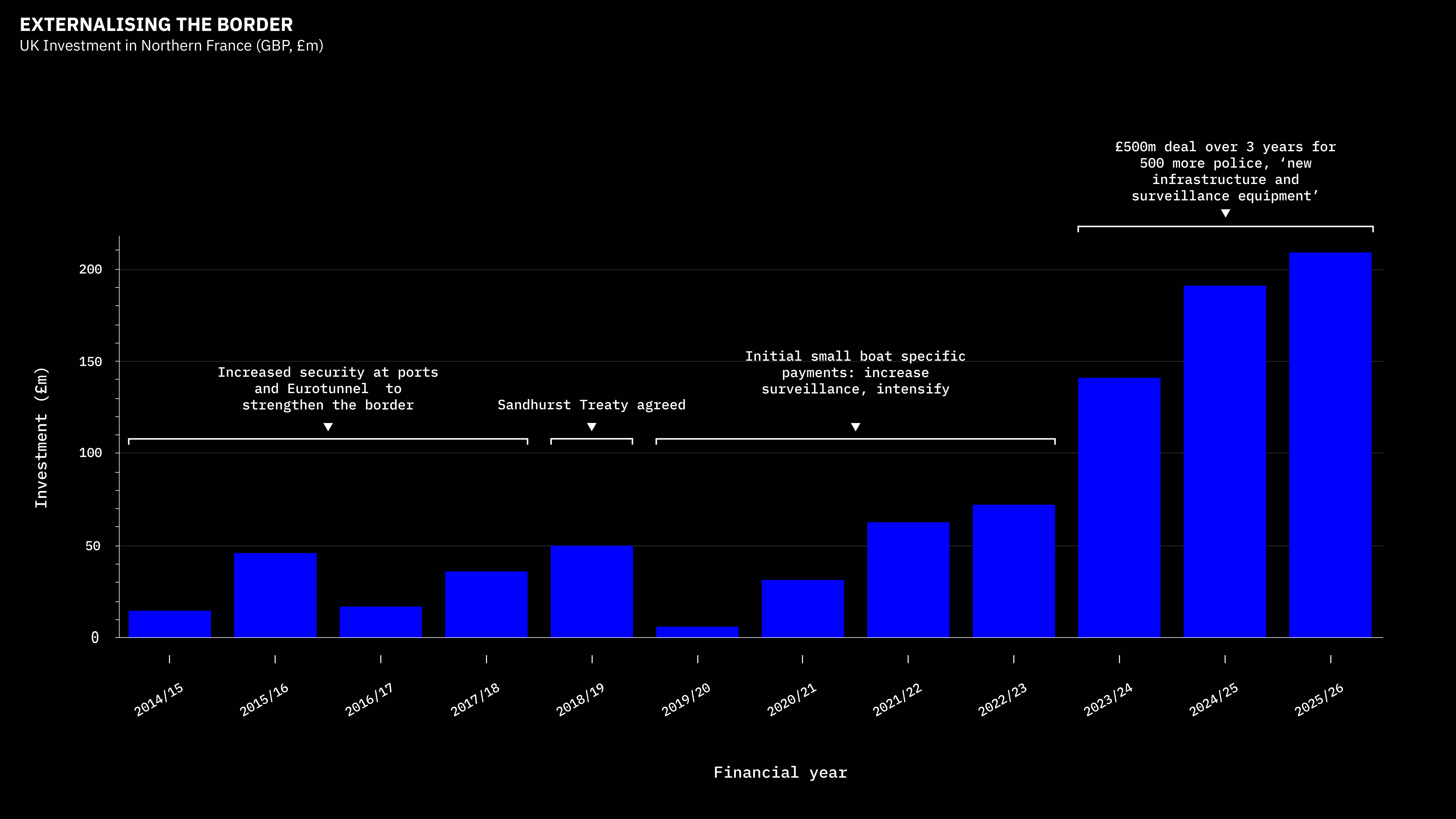
The modern history of the UK government’s increasing investment in its externalised border in France began in 2009. In Summer of that year an initial £15 million was provided for purchasing scanners and other technology to bolster security screening at juxtaposed controls for vehicle traffic heading to Britain.60Andrew Woodcock, ‘Britain Pledges £15m to Tighten Border Controls’, The Independent, 6 July 2009, https://www.independent.co.uk/news/uk/home-news/britain-pledges-pound-15m-to-tighten-border-controls-1734049.html. Shortly thereafter, the Pashtun Jungle, which had been home to hundreds of mostly Afghans trying to cross the UK, was evicted by French police.61Angelique Chrisafis, ‘“It Was Filthy, but It Was Our Only Hope”’, UK News, The Guardian, 22 September 2009, https://www.theguardian.com/uk/2009/sep/22/afghans-camps-calais-police. Between 2014-16, as the numbers of people coming to Calais rose during the so-called ‘long summer of migration’ and established the large Jungle by the port, the UK government provided an additional £113.66m for ‘security improvements’ such as fencing, surveillance cameras, and detection technology at the sea ports and Eurotunnel.62Baroness Williams of Trafford, ‘Asylum: English Channel – Question for the Home Office’, UK Parliament Written Questions, Answers and Statements, 18 September 2020, https://questions-statements.parliament.uk/written-questions/detail/2020-09-18/hl8269.
In January 2018, the UK and France signed the Sandhurst Treaty to ‘reduce the numbers of people’ attempting illegalised border crossings ‘at risk to safety and life’.63UK/France: Treaty Concerning the Reinforcement of Cooperation for the Coordinated Management of Their Shared Border, TS No.1/2018 (2018), https://assets.publishing.service.gov.uk/media/5a74ad7140f0b61df477795e/Treaty_Concerning_the_Reinforcement_Of_Cooperation_For_The_Coordinated_Management_Of_Their_Shared_Border.pdf. Under this agreement the UK gave France an initial £44.5m. One major project financed through the Sandhurst agreement was the establishment of a Joint Centre for Information and Coordination (CCIC) in Coquelles, France where British and French border police are co-located to facilitate real-time exchange of operational intelligence.64Sajid Javid, ‘Joint UK-France Centre Opens in Calais to Tackle Criminality at Border’, GOV.UK, 27 November 2018, https://www.gov.uk/government/news/joint-uk-france-centre-opens-in-calais-to-tackle-criminality-at-border.
When the first groups of predominantly Iranian nationals began making small boat journeys in the final months of 2018,65Robin Sykes, ‘English Channel Migrant Boat Crossings’, Library Briefing, House of Lords, 7 March 2019, 4, https://researchbriefings.files.parliament.uk/documents/LLN-2019-0029/LLN-2019-0029.pdf. then-Home Secretary Sajid Javid returned early from his Christmas holiday safari to declare a ‘Major Incident’. During his speech to the Commons he admitted sea crossings were beginning to emerge in response to heightened security at ports in northern France,66Sajid Javid, ‘Oral Statement to Parliament: Migrant Crossings’, GOV.UK, 7 January 2019, https://www.gov.uk/government/speeches/statement-migrant-crossings. a view shared by civil servants at the Home Office who believed the new maritime journeys were ‘a consequence of extensive investment… collaboration with the French authorities [and] strengthening security at and around the ports in northern France’.67David Bolt, An Inspection of the Border Force Operation to Deter and Detect Clandestine Entrants to the UK August 2024 – November 2024 (Independent Chief Inspector of Borders and Immigration, 2025), 36, https://assets.publishing.service.gov.uk/media/67e27002d8e313b503358d26/An_inspection_of_the_Border_Force_operation_to_deter_and_detect_clandestine_entrants_to_the_UK_August_2024___November_2024.pdf.
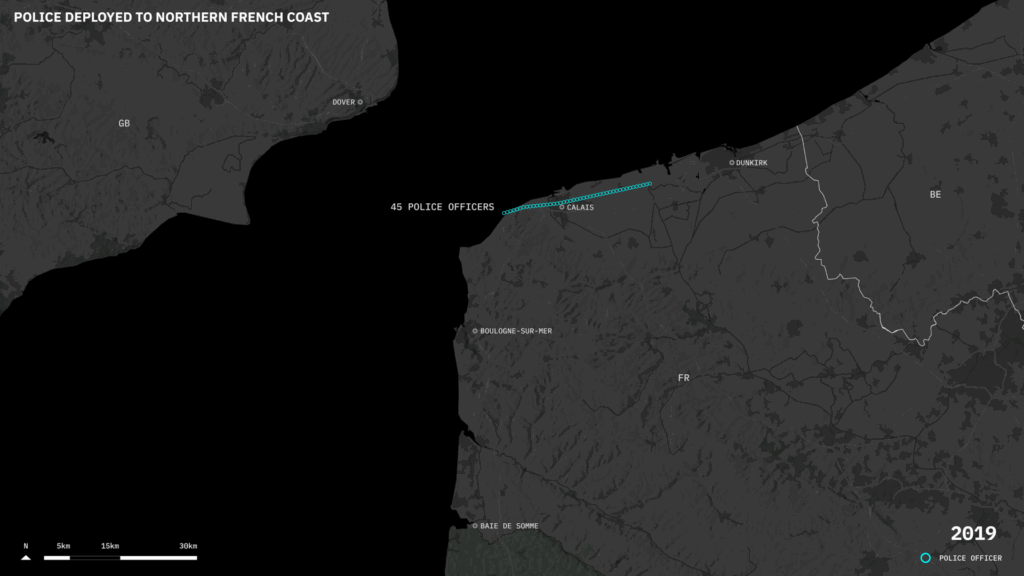
In January 2019, the first bilateral ‘Joint Action Plan’ specifically to police small boat crossings was announced. The UK pledged £3.25m of new funding on top of what was already agreed with the Sandhurst Treaty for ‘preventative security measures’ and equipment ‘such as CCTV, night goggles and number plate recognition’.68Christophe Castaner and Sajid Javid, ‘Joint Action Plan by the UK and France on Combatting Illegal Migration Involving Small Boats in the English Channel’, 24 January 2019, https://data.parliament.uk/DepositedPapers/Files/DEP2019-0107/Joint_Action_Plan_Small_Boats.pdf. Months later, a supplemental £2.25m was given to pay for a contingent of reservists from the French Gendarmerie nationale to reinforce police patrols on the beaches of Nord – Pas-de-Calais.69Melanie Gower, Unauthorised Migration: Timeline and Overview of UK-French Cooperation, Commons Library Research Briefing no. 9681 (House of Commons Library, 2025), https://researchbriefings.files.parliament.uk/documents/CBP-9681/CBP-9681.pdf.
This 2019 ‘Joint Action Plan’ established a key element of the government’s strategy to combat illegalised migration in small boats. As an internal Home Office document outlining ‘lessons learned’ from its initial response put it:
‘the most effective way to deal with the small boats modus operandi is to stop migrants launching boats into the channel’.70Home Office, ‘Small Boats Response: Lessons Learned Review June 2019’, 15.
That Home Office review also made clear that UK money and political pressure could directly influence how far the French would go to try and stop the boats:
‘Operational engagement and political intervention brought about significant step changes in the relationship with the French, continuously pushing the boundaries of what was acceptable and what the French would do in support of the effort to stop small boats leaving France.’71Home Office, ‘Small Boats Response: Lessons Learned Review June 2019’, 5.
What was not in place in 2019, but was identified as a ‘Key Lesson’ to be implemented from the review, was a ‘sustainable funding stream needed to support work [tackling small boats] going forward’.72Home Office, ‘Small Boats Response: Lessons Learned Review June 2019’, 17.
Since 2020, funding packages for the French government to stop small boat crossings have ballooned to over £620.3m.73Lord Sharpe of Epsom, ‘Undocumented Migrants: English Channel – Question for the Home Office’, UK Parliament Written Questions, Answers and Statements, 12 January 2024, https://questions-statements.parliament.uk/written-questions/detail/2023-12-13/HL1170. In 2020, £28.1m was given to ‘support France’s efforts against small boats in Boulogne and Dunkerque’, and in July 2021 a further £54m was committed for more technological surveillance and to deploy police patrols as far south as the Baie de Somme. The reason: previous ‘law enforcement changes’ prompted smugglers to launch boats ‘further from the ports of northern France’ which had become more heavily policed.74Home Affairs Committee, Channel Crossings, Migration and Asylum: First Report of Session 2022-23, HC 199 (House of Commons, 2022), 13, https://committees.parliament.uk/publications/30524/documents/180091/default/.
The effects of these interventions on numbers of small boat arrivals to the UK were negligible. Through Fall 2021 the numbers of people arriving continued to rise. In November an unprecedented 209 small boats crossed the Channel, still the record for the most in a single month in 2026.75The Cranston Inquiry, INQ010749 – Transcript of Day 16 – Family Impact Statements and Closing Statements, 27 March 2025, https://cranston.independent-inquiry.uk/transcript/transcript-of-day-16-thursday-27th-march-2025/. A report from the Home Affairs Select Committee stated that although there had been an increase in the number of interceptions by the French, assisted by UK intelligence and equipment, in 2021, then-Home Secretary Priti Patel still thought ‘stronger enforcement on the French side of the Channel was possible’.76Home Affairs Committee, Channel Crossings, Migration and Asylum: First Report of Session 2022-23, 13. She was reportedly ‘seeking a 75 per cent rate [of interception] if UK funding was to continue to be provided’.77Home Affairs Committee, Channel Crossings, Migration and Asylum: First Report of Session 2022-23, 13. The French perceived this, along with the Home Secretary’s threats to implement push-back tactics at sea if UK Border Force vessels could not disembark migrants rescued in French ports, as ‘financial blackmail’.78Steven Swinford et al., ‘France Accuses Priti Patel of Financial Blackmail over Migrant Crossings’, The Times, 9 September 2021, https://www.thetimes.com/uk/transport/article/french-anger-at-priti-patel-plan-to-block-channel-migrants-from-uk-waters-t8wspq9qr; Rajeev Syal et al., ‘France Accuses Patel of Blackmail in Row over Channel Migrants’, UK News, The Guardian, 9 September 2021, https://www.theguardian.com/uk-news/2021/sep/09/france-accuses-patel-of-blackmail-in-row-over-channel-migrants.
On 14 April 2022 the government quietly abandoned its push-back plan, called Operation Sommen,79Steve Whitton, ‘Combined SOP for Preventing Small Boats Progressing through UK Territorial Waters’, Border Force Maritime Command, 22 July 2021, https://cranston.independent-inquiry.uk/wp-content/uploads/cranston-evidence/INQ003287_Border_Force_Maritime_Command__BFMC____Combined_SOP_for_preventing_small_boats_progressing_through_UK_Territorial_Waters_provided_by_MCA_22_07_2021.pdf. while announcing that it would seek to remove those arriving on small boats to Rwanda instead. This deportation plan, ruled unlawful by the Supreme Court in November 2023,80R (on the Application of AAA and Others) v Secretary of State for the Home Department, [2023] UKSC 42 (The Supreme Court of the United Kingdom 15 November 2023), https://supremecourt.uk/cases/uksc-2023-0093. was hoped to deter further crossings despite no evidence that it would.81Matthew Rycroft, ‘Letter from Matthew Rycroft to Rt Hon Priti Patel: Migration and Economic Development Partnership’, 13 April 2022, https://www.gov.uk/government/publications/migration-and-economic-development-partnership-ministerial-direction/letter-from-matthew-rycroft-to-rt-hon-priti-patel-accessible. While the Rwanda policy was not formally abandoned until the Labour government took office in July 2024, it was legally blocked following the European Court of Human Rights’ injunction against the first scheduled flight on 14 June 2022.82Caroline Davies, ‘The Tortuous Journey of the UK Government’s Rwanda Plan’, World News, The Guardian, 22 April 2024, https://www.theguardian.com/world/2024/apr/22/uk-rwanda-scheme-courts-key-dates. The removal of Channel crossers to other European countries, especially France,83The Home Office’s 2019 Lessons Learned report reveals how ‘strategic interventions’ such as ‘face to face meetings between Home Secretary and his French counterpart’ allowed the UK to remove Channel crossers under Article 13.2 of the Dublin Regulation which had never been used and previously would not have been possible. This rule allowed for the removal of someone to another Dublin signatory country if they had been there ‘for over five months’, but thanks to the negotiations, the French were ‘interpreting this period of residence generously’. which was a key part of the initial government response to try and deter Channel crossers in 2020, was also no longer possible following the end of the Brexit transition period.84Corporate Watch, ‘The Home Office Deportation Drive against Channel-Crossing Migrants: A Balance Sheet’, Corporate Watch, 29 April 2021, https://corporatewatch.org/the-home-office-deportation-drive-against-channel-crossing-migrants-a-balance-sheet/. Unable to push Channel crossers back into French waters or remove those who arrived to a third country, the British government reinvested in its initial strategy of increased funding for French police to prevent departures. On 14 November 2022 another £62.2m was pledged by the Government to ‘intensify co-operation with a view to making the small boat route unviable’.85Bolt, An Inspection of the Border Force Operation to Deter and Detect Clandestine Entrants to the UK August 2024 – November 2024, 30.
Much of the money from these initial agreements to prevent small boat departures has gone towards funding larger deployments of police to patrol the French coastline and purchasing equipment to enhance their capabilities. POLITICO Journalist Alexandre Léchenet obtained official spreadsheets showing purchases made with the Sandhurst funds between 2021 and 2023.86Léchenet and Webber, ‘Helicopters, Riding Boots and Vacuum Cleaners’. Those documents showed that British funding went towards:
- binoculars, hunting cameras, flashlights, night vision scopes, and drones to improve French police foot patrols’ ability to detect people in the dunes;
- cars, trucks, all-terrain vehicles, dune buggies, and horses which allowed them to move faster off-road and on the beaches; and
- hundreds of flight hours for police helicopters and fixed-wing aeroplanes to conduct surveillance patrols.
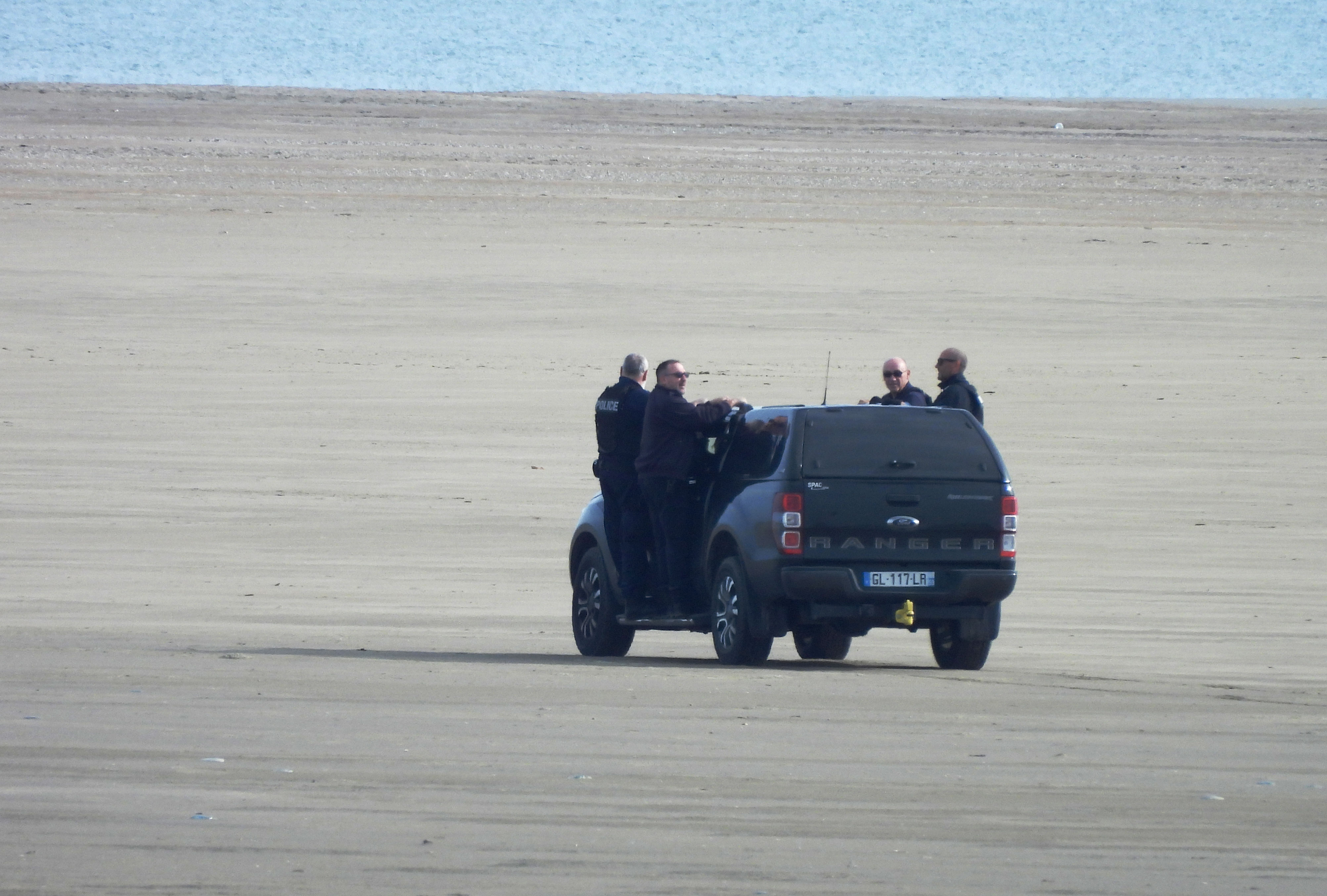
Despite these tools, and the police’s increased surveillance capabilities, the numbers of people who succeeded to cross the Channel also rose dramatically over these years:
- 8,462 in 2020,
- 25,526 in 2021,
- 45,755 in 2022.
Against the backdrop of this continued rise in the numbers of Channel crossings, and facing political pressure from voters, on 4 January 2023 Prime Minister Rishi Sunak announced his pledge to ‘Stop the Boats’. On 10 March he signed a new ‘Joint Leaders’ Declaration’ with French President Emmanuel Macron. As part of that agreement the UK promised France its largest package of funding so far: £476m over three years for the ‘fight against human trafficking, people smuggling and illegal migration… not to manage the problem but to break it’.87Prime Minister’s Office, ‘UK-France Joint Leaders’ Declaration’.
The French agreed to make their own ‘substantial and continuing contribution’, reportedly between three and fives times as much as the UK’s.88Gower, Unauthorised Migration: UK-France Border Cooperation, 4 & 7. The Declaration claimed the funds would ‘save lives and avoid further tragedies in the Channel’. ‘To this end’, the leaders stated, UK money would pay for another 500 French police officers on the coast, ‘new infrastructure and surveillance equipment to enable swifter detection of crossing attempts’, and ‘more drones, helicopters and aircraft in the sky’. There would also be greater intelligence cooperation between France and UK, and with other European Union member-states, to prosecute those organising the crossings and disrupt their supply-chains to ‘limit the availability of equipment in France’. Although many of the initiatives in the UK-France Joint Leaders’ Declaration were not new, it marked a turning point in the modus operandi of law enforcement. Monitoring organisations working in northern France explained that in Spring and Summer of 2023 the police became more efficient and aggressive in their interventions to prevent small boat departures.
This investigation demonstrates that following this Joint Leaders’ Declaration, and the hundreds of millions of pounds agreed for the French, there was a dramatic rise in deaths in the Channel. Between the Declaration and the end of 2025, 114 people are known to have lost their lives during attempts to cross the Channel, and as many as 15 people are still missing at sea.89Calais Migrant Solidarity, ‘Deaths at the Calais Border’, n.d. Three years on, and with more evidence available, it is now possible to more fully interrogate the relationship between these deaths and the border security policies emerging from Sunak’s ‘Stop the Boats’ pledge.
Section 2.
Key trends in migrant deaths in the Channel
This section provides an overview of where, how, and how many people have died during Channel crossing attempts. It also demonstrates the full extent to which dinghies are increasingly overcrowded, a ‘worrying trend’ which the Home Office acknowledges has led to increased fatalities in combination with the ‘deteriorating’ quality of the inflatable dinghies used.90Charles Hymas, ‘Watch: Moment Dozens of Migrants Rush to Board Boat to Cross the Channel’, The Telegraph, 4 September 2024, https://www.telegraph.co.uk/news/2024/09/04/dozens-migrants-dinghy-sank-france-channel-deaths/. The state bordering practices fuelling these trends are presented in detail in Section 3.
Numbers of deaths
Small boat deaths and arrivals (2019-2025)
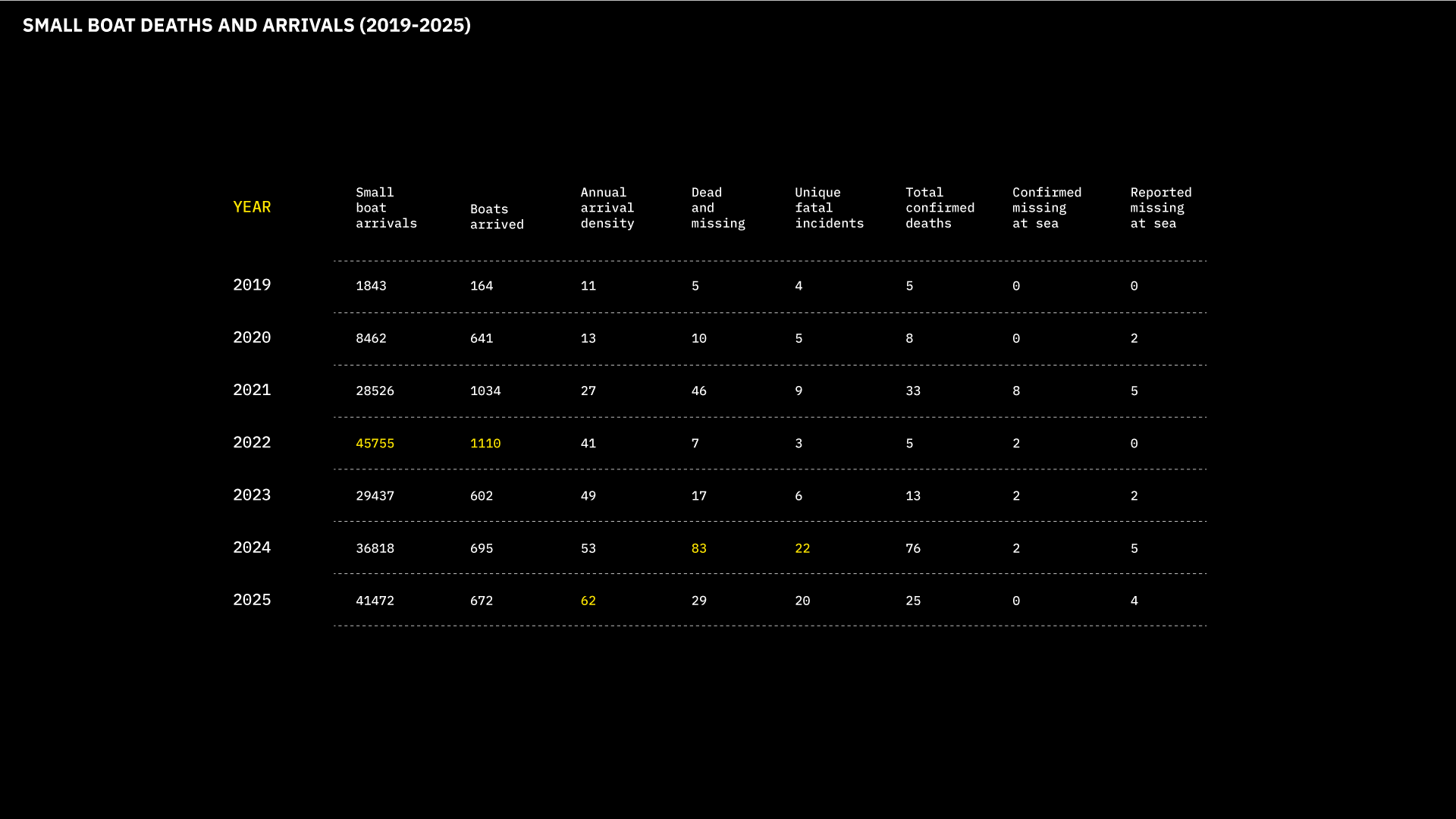
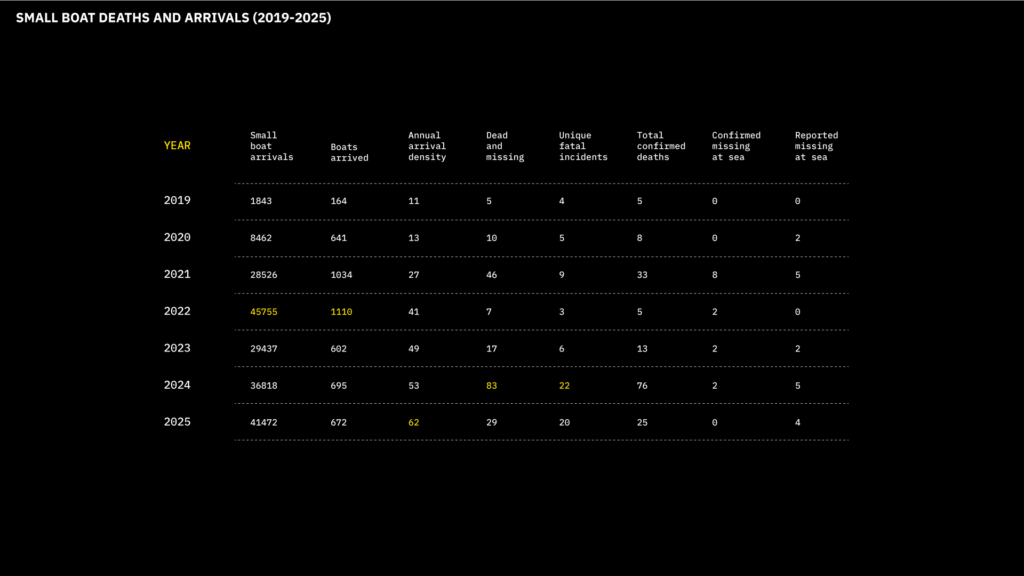
The figures of the total dead and missing from Channel crossing attempts each year must be read alongside the numbers of overall crossings and unique fatal incidents. More than 1,000 dinghies with tens of thousands of people succeeded in reaching the UK in 2021 and 2022, when there were only nine and three deadly incidents respectively. Of the 46 dead and missing in 2021, 31 were from a single incident: the shipwreck on the night of 23 to 24 November when the French and British coastguards failed to effectively coordinate a rescue for a sinking dinghy despite being aware of its distress and location for hours.91Travis Van Isacker, ‘“We Were Treated like Animals”: The Full Story of Britain’s Deadliest Small Boat Disaster’, The Conversation, 24 July 2025, https://doi.org/10.64628/AB.faad6d4gc. (The independent Cranston Inquiry recently found these people’s92Diane Taylor, ‘“They Were Humans”: Inquiry into Mass Channel Drowning Hears from Families’, UK News, The Guardian, 5 February 2026, https://www.theguardian.com/uk-news/2026/feb/05/cranston-inquiry-into-mass-channel-drowning-hears-from-families deaths to have been ‘avoidable’ and criticised ‘systemic failures’ at HM Coastguard before the incident which contributed to a flawed SAR response on the night.93Cranston, The Cranston Inquiry Report: Report of the Public Inquiry into the Events of 23 to 24 November 2021, When over 30 People Died Attempting to Cross the English Channel in a Small Boat.) In 2022, record numbers of people and dinghies crossed the Channel, but there were only three fatal incidents with seven people dead and missing. The high numbers of successful crossings and relatively low numbers of fatalities in these two years undermine arguments that small boat crossings are inherently deadly, and that each dinghy, while clearly unseaworthy, is itself a ‘death trap’.94Charles Hymas and Ollie Corfe, ‘“Death Trap” Boats Overloaded with Migrants Surge under Starmer’, The Telegraph, 3 June 2025, https://www.telegraph.co.uk/news/2025/06/03/death-trap-boats-channel-migrants-surge-keir-starmer/.
Towards the end of 2023, something changed. Although there were no deaths during Channel crossing attempts prior to August, in the final four months of the year, 17 people died or went missing in six fatal incidents. This sudden rise came despite a simultaneous drop in the numbers of people and vessels making the crossing: Home Office statistics recorded 13,397 small boat arrivals in Q3 2023 but only 4,607 in the final three months of the year.95Home Office, ‘Immigration System Statistics Data Tables’, GOV.UK, 27 November 2025, https://www.gov.uk/government/statistical-data-sets/immigration-system-statistics-data-tables.
Since the end of 2023 to the end of 2025, 112 people are confirmed dead or missing from Channel crossing attempts, and another nine have been reported missing. In 2024 alone there were 76 confirmed deaths, more than previous years combined. This was despite 9,000 fewer people making the journey in 415 fewer dinghies in 2024 than 2022.
Increased overcrowding
The numbers of boats which made the journey are also crucial to note in the second column of the previous table. Again there is a significant change visible in 2023: the trend of gradually increasing numbers of crossings reverses, with 500 fewer arriving that year than in 2022. Despite fewer vessels, the number of arrivals nevertheless remained high. The inflatable dinghies used for the crossings have grown over the years – from approximately 3 metres in 2020 to 8 metres in 2022,96Emma Yeomans, ‘How Migrant Crisis Grew from Small Boats to Bigger, Deadlier Crossings’, The Times, 14 October 2025, https://the-times.shorthandstories.com/how-migrant-crisis-grew-from-small-boats-to-bigger-deadlier-crossings/. and there have been a few 12 metre ‘super dinghies’ observed in 2025.97Charles Hymas, ‘“Super Dinghy” Brings Almost 100 Migrants across Channel to Britain’, The Telegraph, 30 September 2025, https://www.telegraph.co.uk/news/2025/09/30/almost-100-migrants-cross-english-channel-in-super-dinghy/. However, larger vessels only partially explains the increased numbers. Most of the dinghies which have been used since 2022 have remained approximately 8 metres, but have each carried consistently more passengers.
The Home Office, publishing its statistics on irregular arrivals, has stated that ‘the average number of people per boat has increased year98Home Office, ‘How Many People Come to the UK Irregularly?’, GOV.UK, 27 November 2025, https://www.gov.uk/government/statistics/immigration-system-statistics-year-ending-september-2025/how-many-people-come-to-the-uk-irregularly. on year’ and journalists note that the average has ‘more than doubled since 2021’.99BBC News, ‘Tracking UK Migration: Small Boats, Asylum Hotels and Visas’, BBC News, 27 November 2025, https://www.bbc.co.uk/news/articles/c70989jrdweo. In September 2025 there was a recorded average of 71 people per boat, and similar arrivals figures to the same month in 2022 despite 30% fewer crossings.
These averages, however, do not adequately represent the increasing density of dinghies over the years. They are mean values computed by dividing the number of people per boat on a daily, weekly, monthly, or yearly basis, which does not capture the wide range in numbers of people per boat and the severe overcrowding of many of them. For example, on 18 July 2024 there were six crossings with 9, 34, 43, 64, 83, and 84 people.100Figures for the numbers of people involved in each individual small boat event were obtained from the Home Office for this investigation through Freedom of Information requests. The rounded average of 53 for the day was significantly skewed by the single boat with 9 inside, despite three dinghies holding more than 60 passengers, and two more than 80.
As discussed in the Methodology section, these statistics are also based on the Home Office’s ‘Arrivals’ data101Home Office, ‘Transparency Data: Small Boat Arrivals and Preventions – Last 7 Days’, GOV.UK, n.d., https://www.gov.uk/government/publications/migrants-detected-crossing-the-english-channel-in-small-boats/migrants-detected-crossing-the-english-channel-in-small-boats-last-7-days. which only counts the people and vessels who succeed in reaching UK territorial waters. Many journeys, some of the most overcrowded, do not succeed and thus do not appear in UK statistics. It is not unusual for the French coastguard to rescue some, but not all, of the passengers from an overloaded dinghy which then continues its journey to the UK. In one case, there were reportedly 112 people on one dinghy, two of whom fell overboard and drowned while another three lost their lives inside, crushed under the weight of other passengers.102Premar Manche et Mer du Nord, ‘Décès de Cinq Personnes En Mer à Bord d’une Embarcation de Migrants à Proximité de La Plage de Wimereux (62)’, Préfecture Maritime de La Manche et de La Mer Du Nord, 23 April 2024, https://www.premar-manche.gouv.fr/communiques-presse/deces-de-cinq-personnes-en-mer-a-bord-d-une-embarcation-de-migrants-a-proximite-de-la-plage-de-wimereux-62. The French coastguard rescued 49 of the travellers before the dinghy continued towards the UK with the remaining 58. This final number is the only one recorded in UK figures and does not faithfully represent the number of people onboard during the deadly moment of departure.
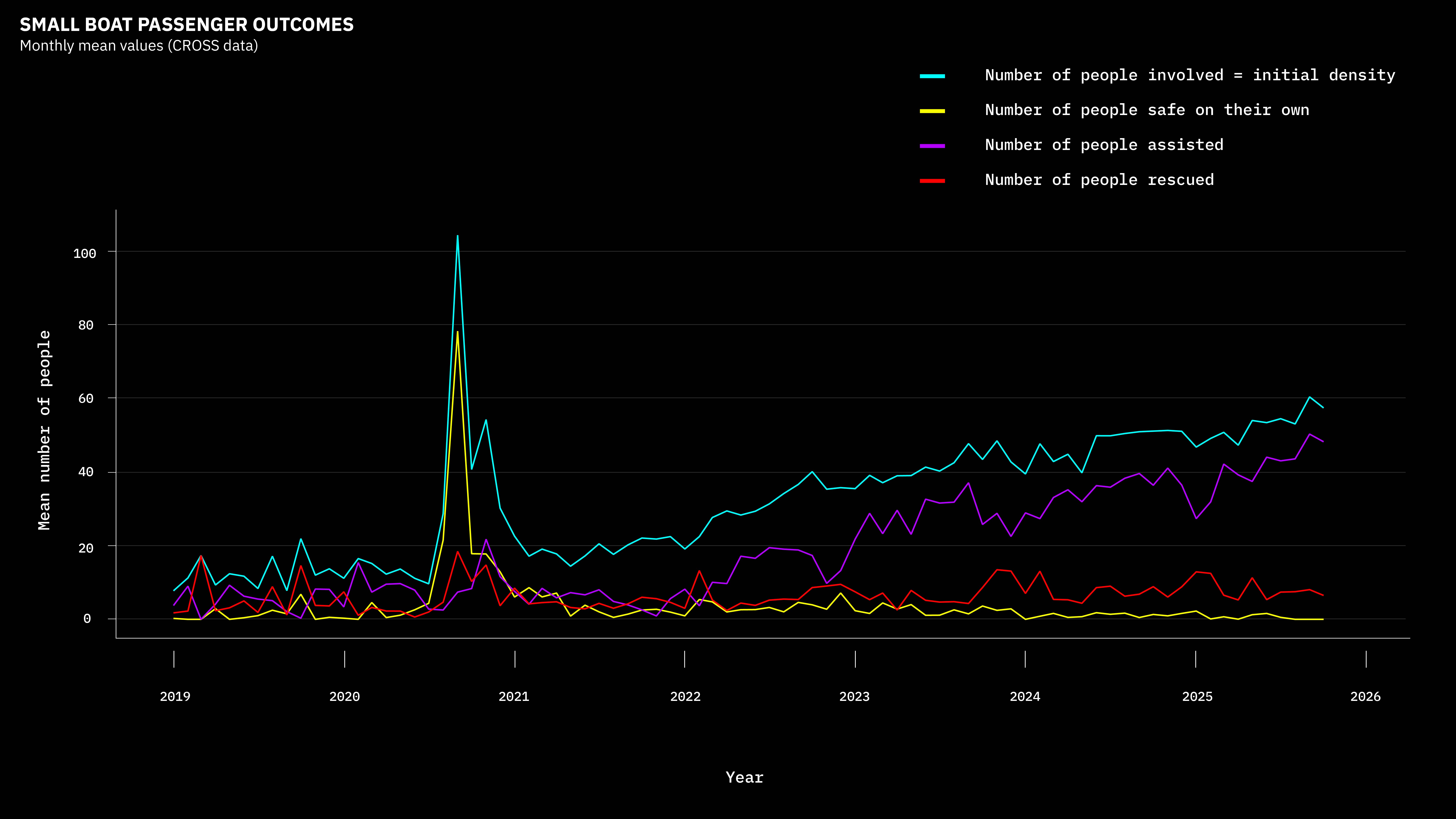
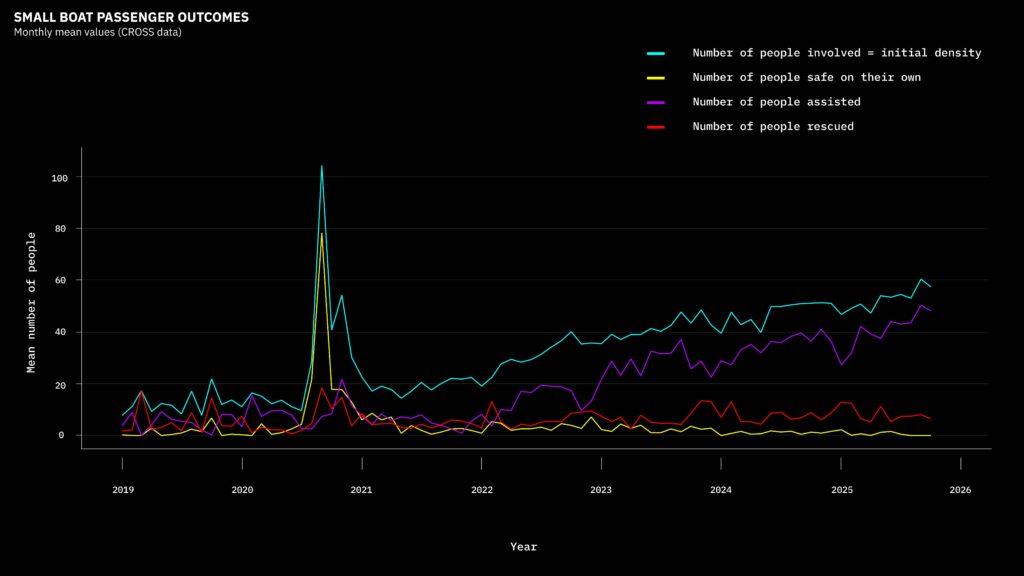
The boat passenger outcomes graph above presents the outcomes of crossing incidents recorded in operational data from the French coastguard’s maritime rescue coordination centres.103Ministère de la Transition écologique, ‘Opérations Coordonnées Par Les CROSS’. It shows the number of people initially involved in crossing events alongside those who were rescued, assisted, or who reached safety on their own. The total number of people involved represents the initial density of passengers at the moment the crossing attempt began. Because some passengers are rescued or intercepted before reaching the UK, the number ultimately recorded in the Home Office arrivals statistics—the final density—can differ from the number originally onboard. This illustrates one of the key limitations of Home Office decision making relying solely on its own arrivals data:104Home Office, ‘Border Security, Asylum and Immigration Bill 2025: Overarching Impact Assessment (Accessible)’, GOV.UK, 2 December 2025, https://www.gov.uk/government/publications/border-security-asylum-and-immigration-bill-2025-impact-assessment/border-security-asylum-and-immigration-bill-2025-impact-assessment-accessible. it does not fully capture the level of overcrowding during the most dangerous stage of the journey.
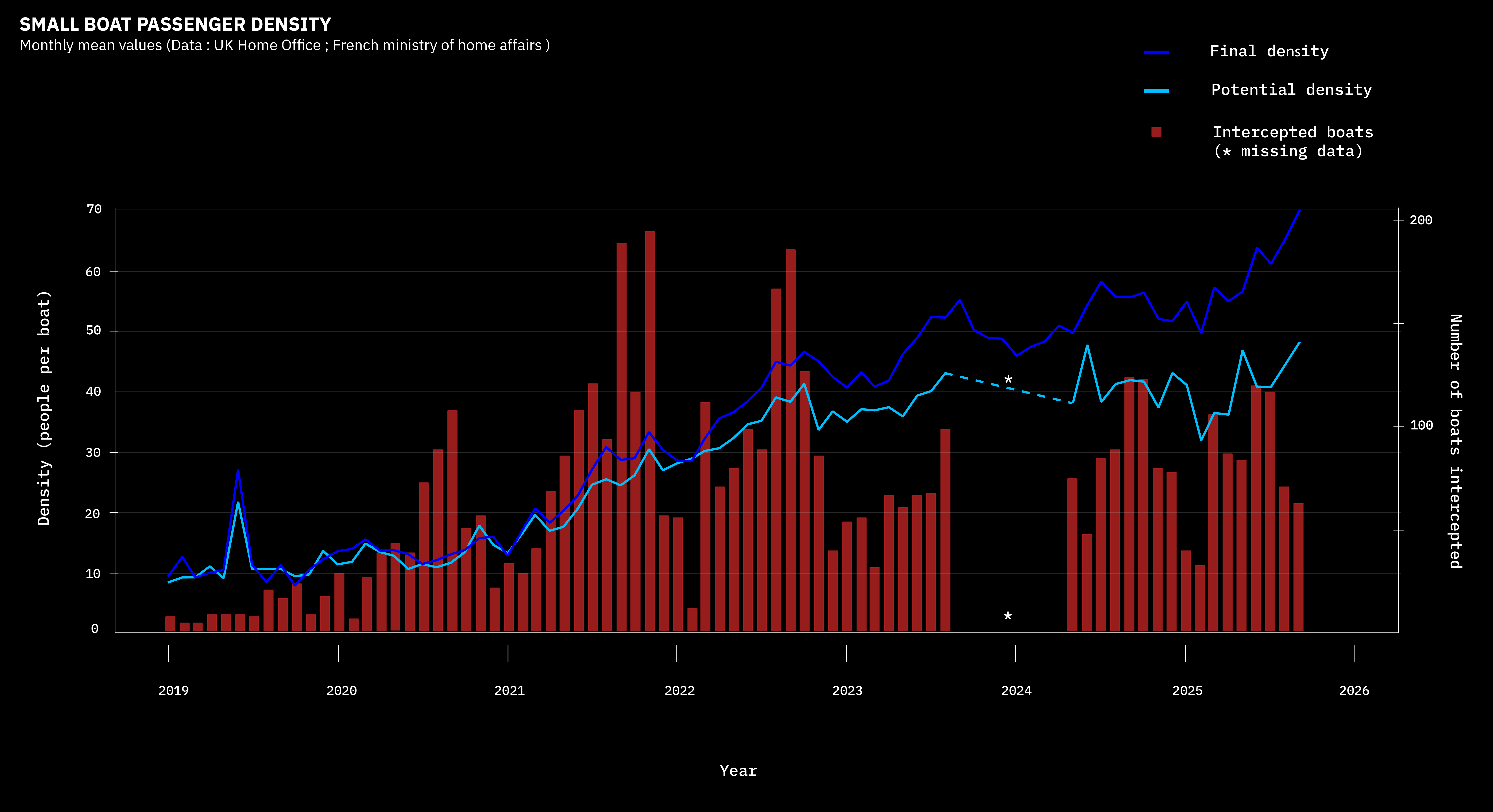
To provide a more accurate understanding of the evolution of the overcrowding phenomenon, the graph above plots the final arrival density against what we termed as ‘potential’ density, while the red bars show the monthly number of boats intercepted by the French authorities. The potential density is an approximation of the reduced number of people per dinghy achievable had the number of ‘boats intercepted’ by the French police105Home Office, ‘Weekly Summary of Small Boat Arrivals and Preventions’, GOV.UK, n.d., https://www.gov.uk/government/publications/migrants-detected-crossing-the-english-channel-in-small-boats/weekly-summary-of-small-boat-arrivals-and-preventions. each took an equal share of the successful travellers. It is important to remember that the French prevention figures represent people who may have been stopped from attempting one crossing one day, but will then continue to make multiple further attempts—sometimes ten or more—until succeeding.106MacTaggart et al., You Can’t Stay but You Can’t Go – State Violence at the UK France Border, 116–17. Thus, one observable effect of preventing departures is that, while total arrivals do not fall proportionally, the passenger density increases among the boats which do depart. The increasing divergence between the final and potential density curves, particularly during periods when interceptions rise, shows how enforcement activity may concentrate travellers into fewer vessels, increasing the density of the boats that do make the journey.
Taken together, this evidence suggests that increased overcrowding is not simply a natural evolution of crossings but is partly produced by the enforcement environment in which crossings occur. Interception and seizure activity correlate with increased boat density, and these same indicators are also associated with deadly incidents, particularly when viewed across annual trends. Although correlation alone cannot establish causation, the consistency of these associations supports the view that policing tactics on the French shore may increase the risk of fatalities by concentrating travellers onto fewer and more heavily overloaded vessels.
Deaths closer to shore
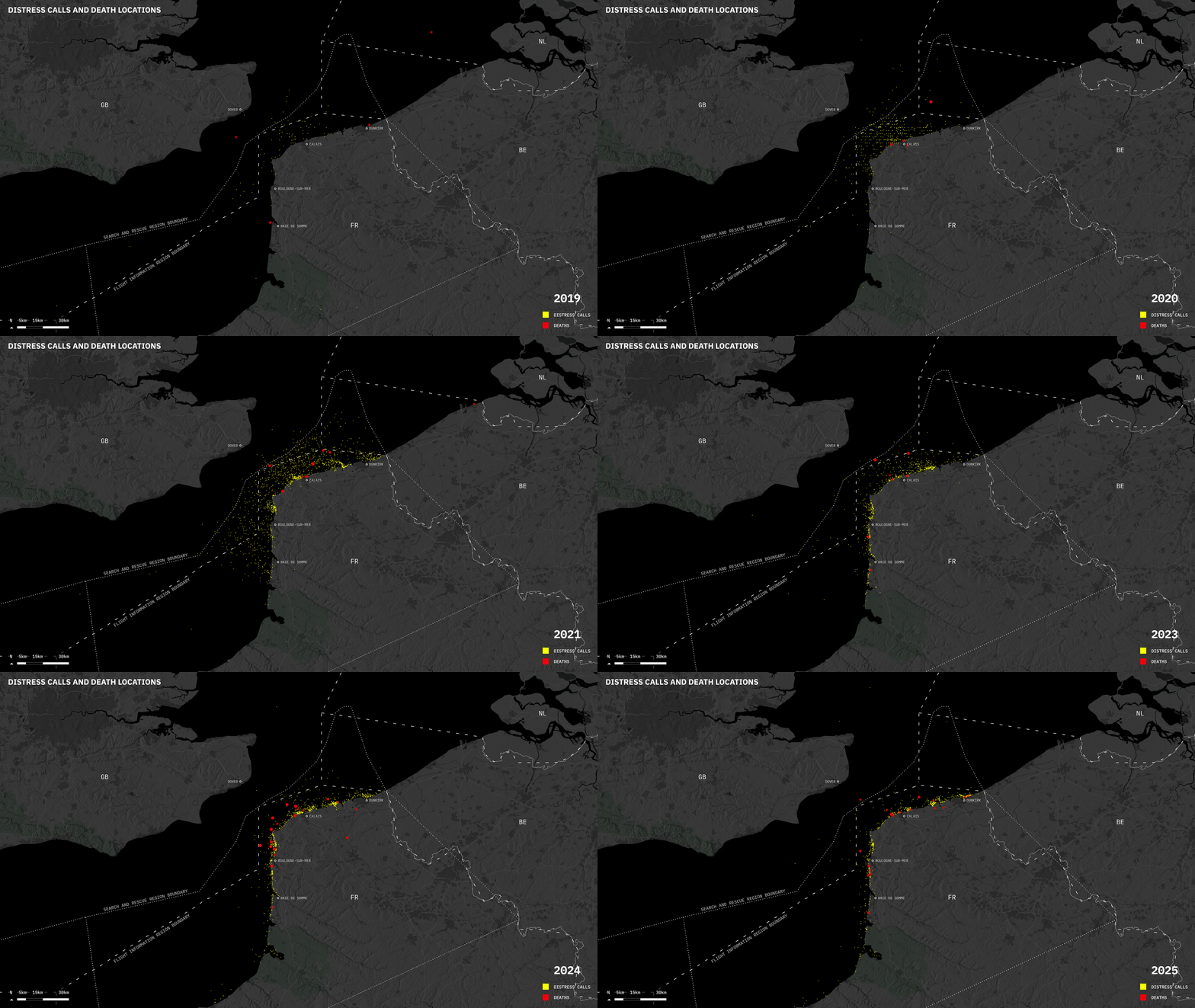
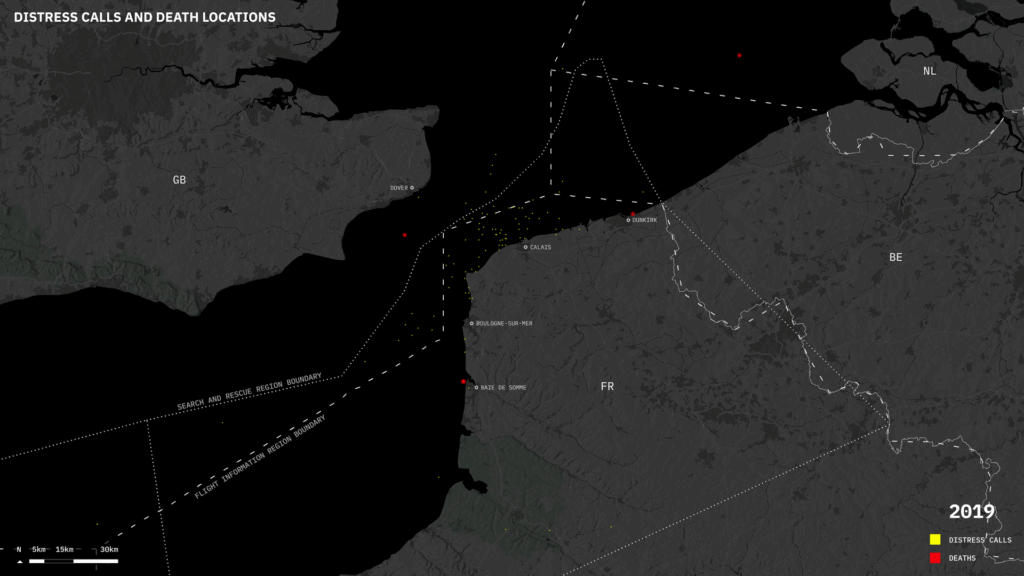
The final trend to highlight is not in the numbers of people per crossing nor number of lives lost, but the locations where deaths have occurred. The maps in this section depict deadly incidents (red dots) alongside where the French coastguard was first alerted to a suspected small boat incident (yellow dots). Over the years both have moved closer to the French shore. The deadly-incident data was compiled by cross-referencing the locations of recorded deaths in the International Organization for Migration’s Missing (IOM) Migrants Project database107IOM Missing Migrants Project, ‘Download Missing Migrants Project Data’, n.d., https://missingmigrants.iom.int/downloads?xls=1751804554. with the Observatoire des Migrants Morts à Calais108Lambert and Galisson, ‘A Calais La Frontière Tue!’ maintained by Nicolas Lambert and Maël Galisson. In cases where a cross-check was not possible, we used the incident description to assign the most likely location of death.
The alert positions moving closer to the coast over time reflects the improved aerial surveillance and increased numbers of police patrols on the beaches which are able to spot and report the dinghies to the coastguard immediately after, or potentially even before, they launch. From the images it appears that only a few dinghies were detected more than five kilometres from the French shore in 2024 in 2025. This is in contrast to the earlier years, especially 2020 and 2021, when coastguards were often unaware of small boat departures until the passengers called from the Channel during transit, often when they were already in distress. This was the case with the fatal shipwrecks of 27 October 2020, 23 November 2021, and 14 December 2022. Improved awareness of small boats departing France has allowed the coastguards to become more proactive in tasking search and rescue vessels rather than waiting to react once things have gone wrong. However, this greater awareness and the ability for proactively positioned SAR assets to intervene earlier has not prevented deaths from climbing in the past three years.
The deaths which have occurred since 2023 have happened closer to French shores and often just off the beaches. Because dinghies are more overcrowded they tend to fail earlier in the journey. For example, on 12 July 2024 a dinghy shipwrecked close to the Cap Gris-Nez just an hour into its journey. The large numbers of people onboard meant that even though the French rescue ship witnessed the tube deflating and people entering the water, four drowned and another four went missing before 56 could be rescued.109Préfecture maritime de la Manche et de la mer du Nord, ‘Naufrage d’une Embarcation de Migrants Dans La Manche – Bilan Consolidé : 56 Personnes Secourues et Malheureusement 4 Personnes Décédées.’, 12 July 2024, https://www.premar-manche.gouv.fr/communiques-presse/naufrage-d-une-embarcation-de-migrants-dans-la-manche-bilan-consolide-56-personnes-secourues-et-malheureusement-4-personnes-decedees.
Most deaths since 2023, however, have not happened in the open sea when dinghies have failed, but close to the shore. Volunteers from Utopia 56 stated in 2025 that ‘in the last two years 65 people have died less than 300 metres from the beach’.110MacTaggart et al., You Can’t Stay but You Can’t Go – State Violence at the UK France Border, 103. It is more difficult for the larger rescue ships used by the French to intervene in such shallow water, although their small and fast rigid hull inflatables are used in rescue operations. However, in some cases even the presence of rescue boats could not prevent deaths.
In August 2024 the French officials noted ‘a phenomenon that we had not observed before… during at least three rescue operations, the unconscious people were extracted directly from the boats’ having been crushed inside rather than drowned in the sea.111Molly Blackall, ‘Channel Smugglers Cram More Migrants onto Overcrowded Boats to Beat Extra Patrols’, The i Paper, 12 August 2024, https://inews.co.uk/news/channel-smugglers-migrants-overcrowding-boats-3223770. These crushes are directly attributable not only to the numbers of people in the dinghies but to ‘violence in moments of departure’ as people rushed to get on to dinghies for which there was not enough space for everyone.112MacTaggart et al., You Can’t Stay but You Can’t Go – State Violence at the UK France Border, 103.
The following section unpacks the state policies and practices which have driven the observable trends of more small boat deaths, closer to the French coast and created the circumstances which lead to people—mostly women and children—being crushed insideovercrowded dinghies. Before unpacking this relationship, it must be emphasised that there is no clear correlation between the numbers of deaths and the number of arrivals each year, even though monthly figures show that higher numbers of people arriving are associated with more deaths. This monthly association partly reflects the fact that periods of higher arrivals also tend to involve more overcrowded dinghies since density itself increases alongside crossing activity. However, overcrowding appears to be a more powerful indicator of the severity of incidents: deadly events are more closely associated with density than with the number of boats arriving, both monthly and annually. This helps explain why 2023 and 2024 saw a sharp drop in the numbers of small boats and people arriving while both deaths and deadly incidents increased. Although there were fewer deaths in 2025, the number of deadly incidents remained high (20) as the dinghies became even more overcrowded.
Section 3.
Border policing practices driving lethal crossings
Having established the trends seen in deadly Channel crossing related incidents since 2019, this section details the policies and policing practices behind them. It unfolds over three subsections which narrow the analysis over temporal, geographical, and operational scales, moving ever closer to the place and moment of departure.
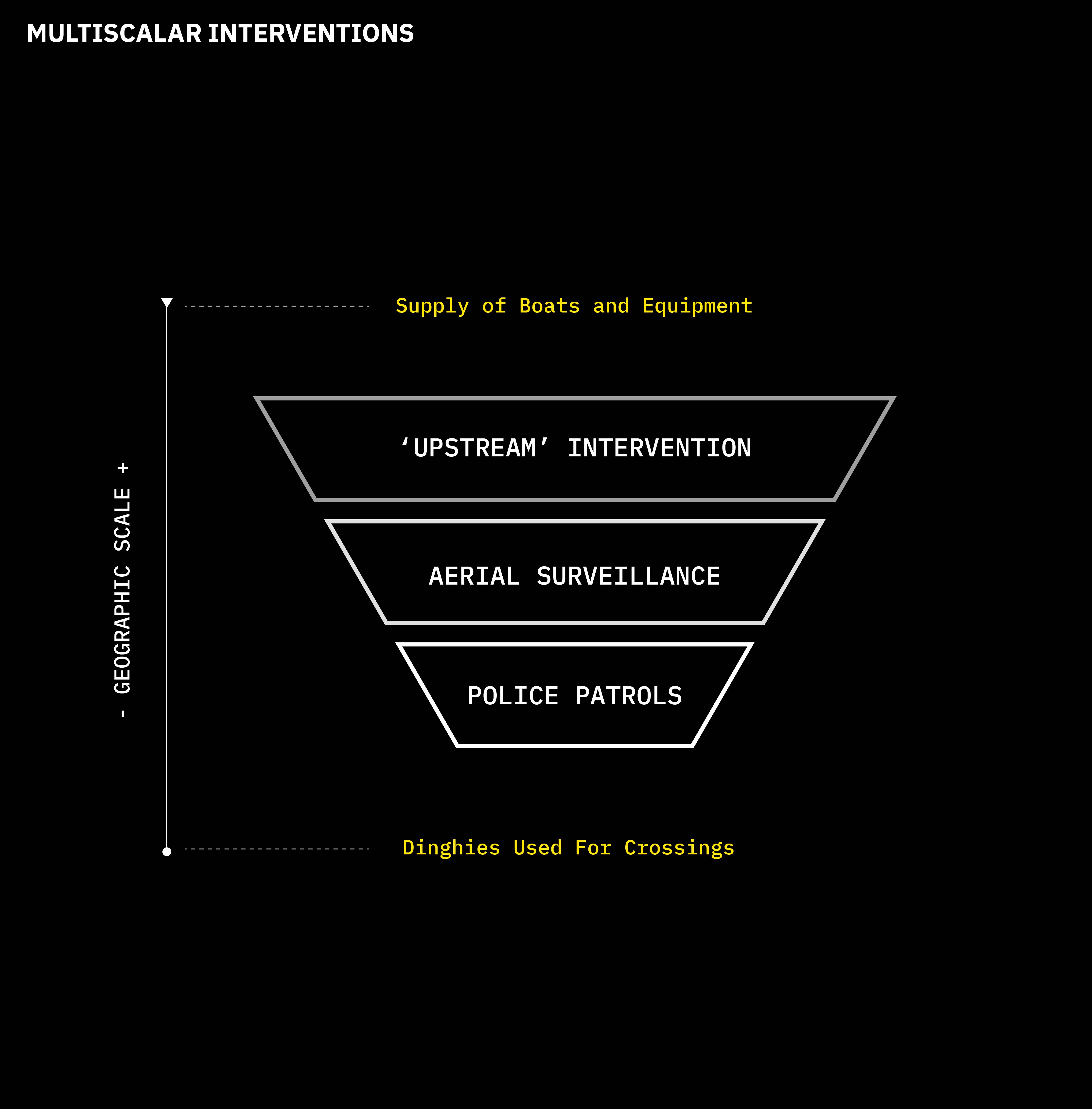
Subsection 3.1 begins by considering the effects of ‘upstream’ interventions to disrupt smugglers and their supply chains throughout Europe and abroad, 3.2 looks at the increased aerial surveillance along the French coast, and 3.3 focuses on the effects of increased French police patrols on the beaches to try to prevent small boat departures. Together, these practices have not only created the structural conditions in which small boat crossings have become more deadly, mostly by increasing overcrowding and prompting the advent of the ‘taxi boat’ tactic, but have also directly endangered people in specific cases. Evidence presented in this section discredits state authorities’ claims that border policing has nothing to do with the professionalisation of smuggling organisations nor influences their tactics, and that more police ‘save lives’ by preventing more crossings.
Subsection 3.1. Anti-smuggling and disrupting supply-chains
Efforts to ‘stop the boats’ do not begin on French beaches but extend ‘upstream’ to countries of transit in and beyond Europe. In recent years, the UK has intensified its efforts to work with international partners on implementing anti-smuggling measures targeting facilitators and their ‘business model’. Initiatives have included transnational investigations to arrest and prosecute members of smuggling organisations, criminalising the use of social media to promote Channel crossings, and deterrence campaigns in the countries people leave from.113Home Office, ‘Policy Paper: Calais Group Priority Plan on Countering Migrant Smuggling for 2025’, GOV.UK, 10 December 2024, https://www.gov.uk/government/publications/calais-group-priority-plan/calais-group-priority-plan-on-countering-migrant-smuggling-for-2025. The tactic which has most directly impacted the dangers facing travellers has been the disruption of the supply chains of equipment for small boat crossings.

Targeting supply chains is an attractive strategy for authorities. By intercepting materials ‘upstream’—while they are being imported or stored before being brought to the French coast—police can ‘stop the boats’ without engaging directly with large groups of people that might resist them, or executing dangerous and illegal tactics at sea to ‘push-’ or ‘pull-back’ small boats by force. It is also logical to assume that without dinghies, engines, fuel, and safety equipment there would be no opportunity for people to risk their lives in crossing attempts. It is not logical to assume, however, that the police can stop all the materials used for crossings. Unlike drugs, the manufacture and sale of maritime equipment is not in itself illegal, and materials used in crossings are often transported in legitimate commercial supply chains. When the operations of some suppliers are shut down, others inevitably step in. In the Mediterranean, choking the supply of purpose-built vessels led travellers fleeing Libya to resort to unseaworthy rubber inflatables,114Forensic Oceanography, Blaming the Rescuers: Crimanalising Solidarity, Re-Enforcing Deterrence (Forensic Architecture, 2017), 35, https://content.forensic-architecture.org/wp-content/uploads/2023/04/2017_Report_Blaming-The-Rescuers.pdf. and, on the Tunisian route, the use of extremely dangerous artisanal boats made of thin sheets of iron welded together.115Driss Rejichi, ‘A New Risk For Migrants Crossing The Mediterranean: Cheap Metal Boats’, Worldcrunch, 20 April 2025, https://worldcrunch.com/focus/migrant-lives/metal-boats-migrants-tunisia/. Thus, rather than crossing attempts ceasing, there is an established history of inferior products being used for illegalised journeys when the usual materials are unavailable.
Attacks on the supply chain do affect the number of dinghies which can reach the French coast. However, fewer boats does not reduce overall demand for crossings, it increases demand relative to the supply. And with less crossings available, the number of persons per dinghy has gone up. As Home Office Parliamentary Under-Secretary for Migration and Citizenship Mike Tapp put it recently: ‘We’re having success upstream in intercepting the actual procurement of boat parts, which is why they’re using bigger ones.’116Colin Freeman, ‘The Chinese “Super Dinghies” Smuggling More Migrants into Britain than Ever Before’, The Telegraph, 1 October 2025, https://www.telegraph.co.uk/news/2025/10/01/chinese-super-dinghies-small-boats-migrants-britain/.
International cooperation
Targeting upstream supply chains has been a key part of the strategy to prevent small boat crossings since at least 2021 when the National Crime Agency (NCA) issued an ‘Amber Alert’. This curiously asked Britain’s maritime industry to report ‘suspicious activity relating to the purchase of boat equipment’ despite materials being sourced from Europe and further east.117National Crime Agency, ‘NCA Issues Warning to Maritime Industry over Organised Crime Links to Small Boats’, 29 April 2021, https://www.nationalcrimeagency.gov.uk/news/nca-issues-warning-to-maritime-industry-over-organised-crime-links-to-small-boats. Over time, disrupting supply chains has become an area of intensifying cooperation between the UK, European Union member-states, and Europol.
Europol has coordinated two Operational Task Forces (OTF) targeting small boat facilitators and materials in Europe. The first, codenamed Dune, began in 2022 and resulted in the arrest of 39 people and the seizure of 1,200 lifejackets, approximately 150 rubber dinghies, and nearly 50 engines from a storehouse in Germany during raids in July of that year.118Europol, ‘39 Arrests in Cross-Border Operation against Migrant Smuggling in Small Boats across English Channel’, 6 July 2022, https://www.europol.europa.eu/media-press/newsroom/news/39-arrests-in-cross-border-operation-against-migrant-smuggling-in-small-boats-across-english-channel.In December 2022, a meeting of the so-called Calais Group of interior ministers of Belgium, France, Germany, the Netherlands, and the UK, alongside European agencies Europol and Frontex, decided to ‘bolster cooperation between them to target supply chains facilitating irregular migration and migrant smuggling, including upstream’.119Home Office, ‘Policy Paper: Joint Statement on Migration Issues’, GOV.UK, 8 December 2022, https://www.gov.uk/government/publications/interior-ministers-joint-statement-on-migration/joint-statement-on-migration-issues.
Information obtained for this investigation from Europol under a freedom of information request revealed a sharp rise in European law enforcement activity against facilitators of Channel crossings in 2023. A list of messages exchanged over Europol’s Secure Information Exchange Network Application (SIENA) showed that while 97 Europol Intelligence Notifications and Investigation Initiation Documents regarding organised criminal smuggling networks in the Channel were issued with a reference beginning 22, 394 and 229 held references beginning with 23 and 24 respectively. Although access to the contents of the documents was refused, these figures are a useful proxy for the activity of Europe-wide law enforcement activity countering smuggling in the Channel. Assuming that the first two digits of the reference refer to the year the investigation was initiated, there were more than four times as many Intelligence Notifications and Investigation Initiations in 2023 compared to 2022, and more than twice as many in 2024.
In February120Europol, ‘Five High Value Targets Arrested as One of the Largest Networks Smuggling Migrants across the English Channel Halted’, 22 February 2024, https://www.europol.europa.eu/media-press/newsroom/news/five-high-value-targets-arrested-one-of-largest-networks-smuggling-migrants-across-english-channel-halted. and again in December121Europol, ‘21 Boats Confiscated and 13 Arrested in Hit against Migrant Smuggling across the English Channel’, 5 December 2024, https://www.europol.europa.eu/media-press/newsroom/news/21-boats-confiscated-and-13-arrested-in-hit-against-migrant-smuggling-across-english-channel. 2024, Europol published additional notices of arrests and seizures of materials such as inflatable dinghies, life vests, children’s flotation devices, air pumps, and engines resulting from OTF Wave, Dune’s successor. Those press releases celebrated law enforcement work as ‘significantly reducing’ smuggling activity but acknowledged that smuggling networks were responding by becoming ‘increasingly violent, and exceptionally adaptive, regularly employing new techniques for crossings’.122Europol, ‘21 Boats Confiscated and 13 Arrested in Hit against Migrant Smuggling across the English Channel’.
These Europol coordinated operations were mostly on storerooms in Germany where materials used in Channel crossings were being kept before being brought to the French coast. The UK has also sought to disrupt supply chains further upstream. France and the UK’s ‘Joint Leaders Declaration’ announced ‘a new initiative that brings together a coalition of states who will work together, using customs powers and intelligence capabilities, to identify and disrupt supply chains and limit the availability of equipment in France.’123Prime Minister’s Office, ‘UK-France Joint Leaders’ Declaration’. In August 2023 the UK entered into a partnership with Turkey to cooperate on ‘disrupt[ing] the supply chain of boat parts and other materials used as part of illegal migration journeys’.124Robert Jenrick, ‘UK and Türkiye Strengthen Partnership to Help Tackle Illegal Migration’, GOV.UK, 9 August 2023, https://www.gov.uk/government/news/uk-and-turkiye-strengthen-partnership-to-help-tackle-illegal-migration. A new memorandum of understanding allowed for sharing intelligence and customs data to allow the Turkish authorities to intercept shipments of dinghies manufactured in China entering the country. In September 2023 it was reported that the UK provided Bulgaria with scanners and two sniffer dogs trained by the NCA to locate the scent of rubber dinghies and intercept shipments entering the EU at Bulgaria’s land border with Turkey.125Charles Hymas, ‘Dogs Trained to Sniff out Migrant Dinghies Smuggled to the Channel’, The Telegraph, 14 November 2023, https://www.telegraph.co.uk/news/2023/11/14/dogs-sniff-out-people-smuggler-dinghies-france-channel/. In April 2025, the NCA claimed it had ‘worked with partners to seize more than 600 boats and engines’ since October 2023.126National Crime Agency, ‘NCA and BPOL Target Channel Small Boat Suppliers’, 17 April 2025, https://www.nationalcrimeagency.gov.uk/news/nca-and-bpol-target-channel-small-boat-suppliers.
These interventions in the latter third of 2023 forced facilitators to find new materials and suppliers. The effects were noticed almost immediately in the Channel. HM Coastguard’s Small Boats Crossing SAR tactical commander opened a December 2023 meeting of British and French organisations involved in maritime SAR by stating ‘vessels used for migrant crossings are getting bigger and they are also of a reduced quality. Because of this they are very prone to collapse.’127HM Coastguard, ‘MRCC Dover & CROSS Gris Nez Small Boat Crossing (SBC) Operations Meeting Notes’, Cranston Inquiry Evidence, 7 December 2023, https://cranston.independent-inquiry.uk/wp-content/uploads/cranston-evidence/INQ005148_MRCC_Dover___CROSS_Gris_Nez_Small_Boat_Crossing__SBC__operations_MRCC_Dover__Conference_Room_HM_Coastguard_07_12_2023.pdf. Although there were no fatal incidents in 2023 before August, by the end of the year 16 people drowned or went missing at sea from five incidents of dinghy deflations or collapses.128Alarm Phone, ‘The Deadly Consequences of the New Deal to “Stop the Boats”’, Alarm Phone, 28 January 2024, https://alarmphone.org/en/2024/01/28/the-deadly-consequences-of-the-new-deal-to-stop-the-boats/. The other death in 2023 was of Wudase, a 24-year-old woman from Eritrea, who was the first person killed inside of a dinghy, crushed under the weight of the other passengers.
Creating crushes
Wudase was killed in the morning on 26 September 2023, when approximately 80 people attempted to board a dinghy departing from Bleriot-Plage, close to Calais.129Antoine Barège, ‘Une migrante de 24 ans retrouvée morte à Blériot-Plage’, ICI, le média de la vie locale, 26 September 2023, https://www.francebleu.fr/infos/faits-divers-justice/une-migrante-de-24-ans-retrouvee-morte-a-bleriot-plage-6036598. Many of those were alleged not to have arranged with smugglers and paid for a place beforehand. Wudase, who had gotten on in the beginning and was placed in the middle of the dinghy, was asphyxiated as more and more people climbed in. Realising she was unconscious she was taken out of the dinghy and left with her boyfriend on the beach before the rest of the people departed to the UK. ADS-B data shows one surveillance aircraft from the French police, one from the Home Office, and one Unmanned Aerial System (UAS) from HM Coastguard were all active over the Channel in the region of Calais early that morning. Two other dinghies were also reported to have left early that morning with approximately 40 and 50 persons on board.130Barège, ‘Une migrante de 24 ans retrouvée morte à Blériot-Plage’.
The fact people die through asphyxiation or being crushed under the weight of fellow travellers is one of the dire consequences of the extreme overcrowding of small boats since 2023. UK authorities have given contradictory explanations for what leads to fatal crushing. While most often attributing severe overcrowding to the greed of the smugglers ‘cramming more and more people into bigger boats’,131Francis Elliot, ‘Yvette Cooper: Migrant Boats Are More Crammed and Dangerous Because of Greed’, The i Paper, 25 September 2024, https://inews.co.uk/news/politics/yvette-cooper-migrant-boats-crammed-dangerous-greed-3293836. they have also undermined their own assertions of how much power facilitators have to determine the numbers of people travelling on the dinghies they provide.
The UK’s Border Security Commander, Martin Hewitt, recently stated in evidence to the Home Affairs Select Committee that ‘the horrific period in which the number of fatalities rose quite significantly [in Autumn and Winter 2024]… was because, in a sense, for a period the smugglers lost a bit of control of the process that they were running.’132Border Security Commander Martin Hewitt, Oral Evidence: Border Security and Irregular Migration: The Work of the Border Security Command, 2025, 10. At the same hearing, Rob Jones, Director General at the NCA, also questioned the ability of facilitators to control numbers of travellers. Jones insisted that ‘violent, uncontrolled and unstructured’ behaviour from migrants who were unable to pay and were therefore ‘storming the vessels’ was to blame for overcrowding and crush deaths.133Oral Evidence: Border Security and Irregular Migration: The Work of the Border Security Command, 2025, 10. He attributed this ‘violent behaviour’ specifically to the ‘Horn of Africa cohort’, reproducing a racist trope vilifying Black people as violent whilst implicitly blaming migrants for their own deaths. However, not all crushing deaths have involved people who had not paid trying to board at the last minute or violent conflicts, such as one incident from 5 October 2024 in which two men from Ethiopia and one from Vietnam were found unconscious in the bottom of the dinghy holding 71 people when French rescuers arrived.134Premar Manche et Mer du Nord, ‘Bilan Des Opérations de Recherche et de Sauvetage Dans Le Détroit Du Pas de Calais – Préfecture Maritime de La Manche et de La Mer Du Nord’, Préfecture Maritime de La Manche et de La Mer Du Nord, 5 October 2024, https://www.premar-manche.gouv.fr/communiques-presse/bilan-des-operations-de-recherche-et-de-sauvetage-dans-le-detroit-du-pas-de-calais.
Authorities’ focus on the behavior of small boat travellers fails to consider why so many people may need to try and force their way onto dinghies and, in doing so, writes out the effects of authorities’ arguably ‘successful’, if misguided, anti-smuggling policies. The phenomenon of migrants ‘storming and getting onto boats’135Oral Evidence: Border Security and Irregular Migration: The Work of the Border Security Command, 2025, 10. has been particularly associated with the Sudanese, most of whom cannot afford to pay smugglers.136Mixed Migration Centre, Beyond Restrictions: How Migration and Smuggling Adapt to Changing Policies across the Mediterranean, the Atlantic and the English Channel, 27. In earlier years Sudanese people had often attempted to cross the Channel in autonomous groups self-organising their own small dinghies, inflatable kayaks,137Jacob Berkson, ‘First Witness Statement of Dr Jacob Berkson of Alarm Phone’, Cranston Inquiry Evidence, 18 November 2024, 8, https://cranston.independent-inquiry.uk/wp-content/uploads/cranston-evidence/INQ010093_Witness_Statement_of_Dr_Jacob_Berkson__Alarm_Phone__provided_by_Duncan_Lewis_18_11_2024_.pdf. or even rafts or pedalos stolen along the beach.138Julien Goudichaud and Daisy Walsh, ‘Risking Death Trying to Get to England in a Pedalo’, BBC News, n.d., accessed 2 March 2026, https://www.bbc.co.uk/news/av/world-58789567. French coastguard data shows that in 2019 there were two suspected small boat incidents involving canoes or kayaks, then 47 in 2020, 21 in 2021, and finally six in 2022. There were then no canoes or kayaks in 2023-24, but another two again in 2025. Data obtained via a freedom of information request from the Home Office showed there were 27 boats which arrived in the UK with a single-digit number of passengers in 2022, compared to nine in 2023 and ten in 2024. Of those, 12 had three or fewer passengers in 2022, compared with one and zero the following years.
These data bear out the findings of the Mixed Migration Centre that independent journeys were ‘quite common until 2023’ but in 2024 became much harder as it had ‘become extremely difficult to purchase small boats’.139Mixed Migration Centre, Beyond Restrictions: How Migration and Smuggling Adapt to Changing Policies across the Mediterranean, the Atlantic and the English Channel, 33. Additional restrictions on purchasing fuel and inflatable kayaks, as well as increased police patrols in the dunes where migrants would hide their equipment ahead of a crossing attempt, made it near impossible for under-resourced groups to attempt their own crossings autonomously. As a result, today only professionalised smugglers have the financial and logistical resources for ‘bringing boats from further afield, including the Netherlands and Germany’ by stashing them in the trunks of cars and rears of delivery vans.140Mixed Migration Centre, Beyond Restrictions: How Migration and Smuggling Adapt to Changing Policies across the Mediterranean, the Atlantic and the English Channel, 33. The greater logistical efforts required to organise materials and launch dinghies has increased reliance on for-profit smuggling organisations, and also prompted the Sudanese and other under-resourced cohorts to resort ‘to “pirating” the boats of smugglers by jumping on them at the last minute’.141Mixed Migration Centre, Beyond Restrictions: How Migration and Smuggling Adapt to Changing Policies across the Mediterranean, the Atlantic and the English Channel, 29.
The tactic of migrants boarding dinghies without smugglers’ permission has not been without reprisals. Among those not included in the list of Channel crossing related deaths in Section 2 was a young Sudanese man shot and killed in the Loon-Plage camp (five others were injured by gunfire in the same incident),142Mélaine Richard, ‘Loon-Plage : un mort et cinq blessés lors d’échanges de coups de feu dans le camp de migrants’, La Voix du Nord, 14 June 2025, https://www.lavoixdunord.fr/1595910/article/2025-06-14/loon-plage-cinq-blesses-lors-d-echanges-de-coup-de-feu-dans-le-camp-de-migrants. and two other young Sudanese men shot and injured in the dunes.143MacTaggart et al., You Can’t Stay but You Can’t Go – State Violence at the UK France Border, 157. Associations believe these to have been targeted attacks by smugglers to dissuade the Sudanese from continuing to attempt to force their way onto dinghies for which they had not paid. Rob Jones of the NCA stated in 2025 that he believed the professionalised smugglers had since reached agreements with the Sudanese community and others unable to afford crossings for cheaper rates and a ‘controlled loading of these people’,144Oral evidence: Border Security and irregular migration: The work of the Border Security Command: Hearing on HC 1321 before the Home Affairs Committee (2025), at 14, https://committees.parliament.uk/oralevidence/16519/pdf/. showing that it is also in the business interests of facilitators to reduce risks to customers.
Destabilising effects of ‘smashing the gangs’
While fleetingly acknowledging that border policing impacts ‘the ways the smugglers have shifted their methods’,145Border Security Commander Martin Hewitt, Oral Evidence: Border Security and Irregular Migration: The Work of the Border Security Command, 2025, 5. authorities’ focus on the actions of criminal organisations deflects from their own role in structuring the material circumstances in which small boat crossings take place.
The Labour Government made anti-smuggling its priority, substituting the Conservative’s ‘Stop the Boats’ slogan for ‘Smash the Gangs’ after taking office in July 2024. However, ‘simplistic narratives about “disrupting the business model of smugglers” or “smashing the gangs” fail to account for the supply-and-demand dynamics driving the smuggling market’ according to a Mixed Migration Centre report.146Mixed Migration Centre, Beyond Restrictions: How Migration and Smuggling Adapt to Changing Policies across the Mediterranean, the Atlantic and the English Channel, 35. With people ready and willing to take the risks of an illegalised journey, the efforts of France and the UK to ‘secure the Channel against irregular migration’ have only ‘tighten[ed] the grip of those “ruthless organised criminals” blamed for all the violence and death which occur during crossing attempts.’147Global Iniative Against Transnational Organized Crime, Small Boats, Big Business: The Industrialization of Cross-Channel Migrant Smuggling (2024), 5, https://globalinitiative.net/wp-content/uploads/2024/02/Small-boats-big-business-The-industrialization-of-cross-channel-migrant-smuggling-GI-TOC.Feb-2024.pdf. In an apparent acknowledgement of the gathering power of professionalised facilitators in the face of redoubled anti-smuggling efforts, the Home Office added a new critical risk to its annual report and accounts from 2024-25:148Home Office, Annual Report and Accounts 2024-2025, HC 1133 (2025), https://assets.publishing.service.gov.uk/media/688c9785a34b939141463e37/HO_ARA_2024-25_Book_WEB_Final_v3+CorrSlip.pdf. ‘continued growth in the strength of [organised immigration crime] gangs who facilitate arrivals to the UK via Small Boats’.
The recent anti-smuggling strategy has also destabilised the networks of facilitators operating in the Channel. In October 2025, a smuggling expert was quoted as saying that, whilst the route had previously been dominated by five large groups, there had recently been ‘more fragmentation due to law enforcement from both the UK and France, leading to smaller actors stepping in’.149Freeman, ‘The Chinese “Super Dinghies” Smuggling More Migrants into Britain than Ever Before’. In a phenomenon which has been well-documented following the targeting of so-called ‘kingpins’ in ‘the war on drugs’ and counter-insurgencies in the Middle East,150Andrew Cockburn, Kill Chain: The Rise of the High-Tech Assassins (Verso, 2015). this fragmentation created vacuums and competitions amongst the remaining smaller groups which have led to new tactics as well as ‘more violence, with gangs increasingly using weapons and even engaged in firefights’.151Freeman, ‘The Chinese “Super Dinghies” Smuggling More Migrants into Britain than Ever Before’.
Rather than only scapegoating facilitators and travellers, policy-makers would do well to critically reflect on how their anti-smuggling strategies created a market and powerful incentive for facilitators to enter, while reducing the overall supply of dinghies leading to deadly overcrowding and greater competition for a place onboard.
Subsection 3.2. Aerial surveillance
Narrowing down from the ‘upstream’ interventions against supply-chains and international anti-smuggling operations, aerial surveillance is the next mechanism of border policing which authorities have invested heavily in to try and ‘stop the boats’. This section shows how most surveillance is focused on preventing departures from French beaches, and thereby contributes to overcrowding, violent police interventions, and the adoption of more dangerous tactics by facilitators and travellers. Nevertheless, it continues to be justified in terms of saving lives at sea. This justification depends upon authorities’ ‘fewer crossings equals less deaths’ claim which the trends data from Section 2 have shown does not hold.
Hundreds of millions of pounds have been spent by multiple agencies on developing a multi-layered surveillance system operating to detect small boats departing from the French coast. Different aerial assets are contracted by British and European coastguards and border policing agencies for both Intelligence, Surveillance, and Reconnaissance (ISR) and Search and Rescue (SAR) missions. On the UK side there is a formal separation in taskings under two Operations: Operation Altair, the government’s multi-agency response to small boat crossings with the stated intention to ‘end the viability’ of the route, and Operation Eos under which HM Coastguard proactively deploys reconnaissance planes for SAR purposes.152Cranston, The Cranston Inquiry Report: Report of the Public Inquiry into the Events of 23 to 24 November 2021, When over 30 People Died Attempting to Cross the English Channel in a Small Boat, 406 & 399. However, once airborne, there can be an element of mission creep as SAR assets provide information and imagery for law enforcement purposes while, in cases of acute distress, law enforcement assets can adapt their mission profile to prioritise search and rescue operations over evidence gathering.
Before examining more closely the role of different types of aerial surveillance and the different agencies involved, it is worth recognising that the well-resourced and highly choreographed deployment of aerial surveillance in the Channel today was not always present. In earlier years assets were mostly tasked reactively in response to people in distress at sea. However, the 24 November shipwreck in 2021, in which a lack of aerial surveillance in poor weather conditions was cited as a contributing factor by the Maritime and Coastguard Agency,153Maritime and Coastguard Agency, ‘Closing Statement of the Maritime and Coastguard Agency’, The Cranston Inquiry, 17 April 2025, 39, https://cranston.independent-inquiry.uk/wp-content/uploads/2025/04/MCA-Closing-Statement-17-4-2025.pdf. prompted a step change from authorities. In the immediate aftermath the European Border and Coast Guard Agency (Frontex) initiated its Joint Operation Opal Coast to provide aerial surveillance over France and Belgium,154Travis Van Isacker, ‘Frontex Flights and Fatalities in the Channel’, Statewatch, 13 September 2024, https://www.statewatch.org/news/2024/september/frontex-flights-and-fatalities-in-the-channel/. and HM Coastguard’s Operation Caesar delivered two additional aeroplanes and four rotary-wing UAS in 2022 specifically for small boat search and rescue.155The Cranston Inquiry, INQ010746 – Transcript of Day 13 – Monday, 24th March 2025, 24 March 2025, https://cranston.independent-inquiry.uk/transcript/transcript-of-day-13-monday-24th-march-2025/.
Additional surveillance has provided coastguards with improved situational awareness which has helped reduce deaths by drowning and, according to the previous Clandestine Channel Threat Commander, been a ‘game-changer in terms of controlling the maritime environment’.156The Cranston Inquiry, INQ010742 – Transcript of Day 12 – Stephen Whitton OBE (Head of Border Force Maritime Command, Home Office) and Daniel O’Mahoney (Director, Clandestine Channel Threat Command, Home Office), 20 March 2025, https://cranston.independent-inquiry.uk/transcript/transcript-of-day-11-thursday-20th-march-2025/. However, more aircraft have not prevented greater numbers of deaths in the Channel overall. And for surveillance concentrated on the French shore for the purpose of preventing departures, the argument could be made that it has contributed to increased fatalities by fueling overcrowding and violent confrontations by directing French police to where materials for crossings might be stashed and where to intercept groups as they launch dinghies into the sea.
The following subsections pick apart this densely overlapping aerial surveillance regime operating over the Channel by analysing the assets and agencies operating the night before and during a typical ‘Red Day’157Met Office, ‘Op DEVERAN Weather Assessment’. – a day which, due to the weather and an expectation for calm seas, Channel crossing attempts are considered likely.
Advanced reconnaissance: Frontex’s Joint Operation Opal Coast and UK Home Office’s Phoenix
Surveillance of Channel crossings begins long before any dinghies or people enter the water. ISR missions are flown by Frontex and the Home Office on the nights small boat crossings are considered likely based on weather forecasts.158Gary Ferguson, ‘Witness Statement of Gary Ferguson’, The Cranston Inquiry, 17 November 2024, 7, https://cranston.independent-inquiry.uk/wp-content/uploads/cranston-evidence/INQ010102_Witness_Statement_Gary_Ferguson_RVL_Aviation_17_11_2024.pdf.
The Frontex aircraft, currently contracted from North Sea Aviation Services,159Frontex, ‘NSAS and Frontex Contracts’, Public Register of Documents, 24 April 2025, https://prd.frontex.europa.eu/document/nsas-and-frontex-contracts/. Other organisations which provided assets for Frontex’s JO Opal Coast include: Danish Air Force (2021), French Douanes (2022), Italian Guardia di Finanza (2022), French Sécurité Civile (2022), Icelandic Coast Guard (2022), and the Dutch contractor Executive Airborne Systems & Platforms (EASP AIR) (2023). takes off from Oostende, Belgium in the afternoon to early evening. It patrols the dunes and known migrant camps along the French coast observing if there are any groups staging ahead of a crossing attempt late at night or early in the morning.160The Frontex aircraft also patrol at sea off the coast of Belgium, but not France, further evidencing the hypothesis that the territorial sea of France is notpart of the Operational Area of JO Opal Coast. A news report from one of the first Frontex flights in 2021 gave some insight into how these surveillance flights operated at that time.161Charles Hymas and Joe Barnes, ‘On Board the EU Spy Planes Helping to Stem the Tide of Channel Migrants’, The Telegraph, December 2021, https://www.telegraph.co.uk/news/2021/12/16/paramedics-winched-onto-lifeboat-treat-injured-woman-60-migrants/. Officers on board boasted about tipping-off local police to where some people were pumping up an inflatable raft. They also located people at sea attempting to cross in kayaks, and tracked a person who had dropped a boat at the coast, following him along the highways to an apartment where police arrested him. Based on the more recent flight profiles of the Frontex assets, however, it seems likely that Frontex surveillance flights today primarily collect advanced information which contributes to the French police’s risk assessment issued at 23:00. This report provides a first overview of where groups of potential Channel crossers are located and helps to better arrange police resources on the ground, and rescue ships which wait just off the coast, to be in place for any departure attempts.
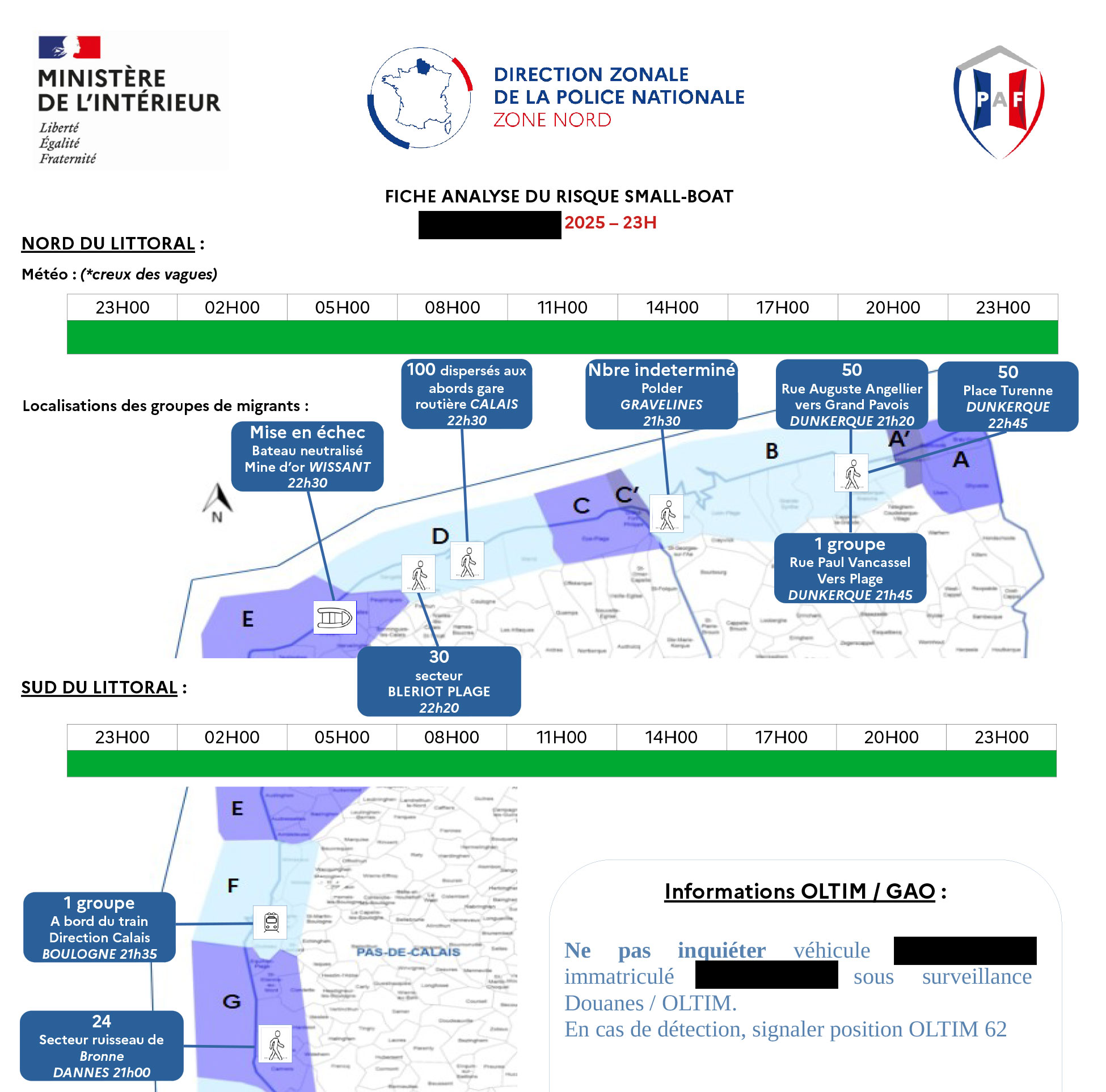
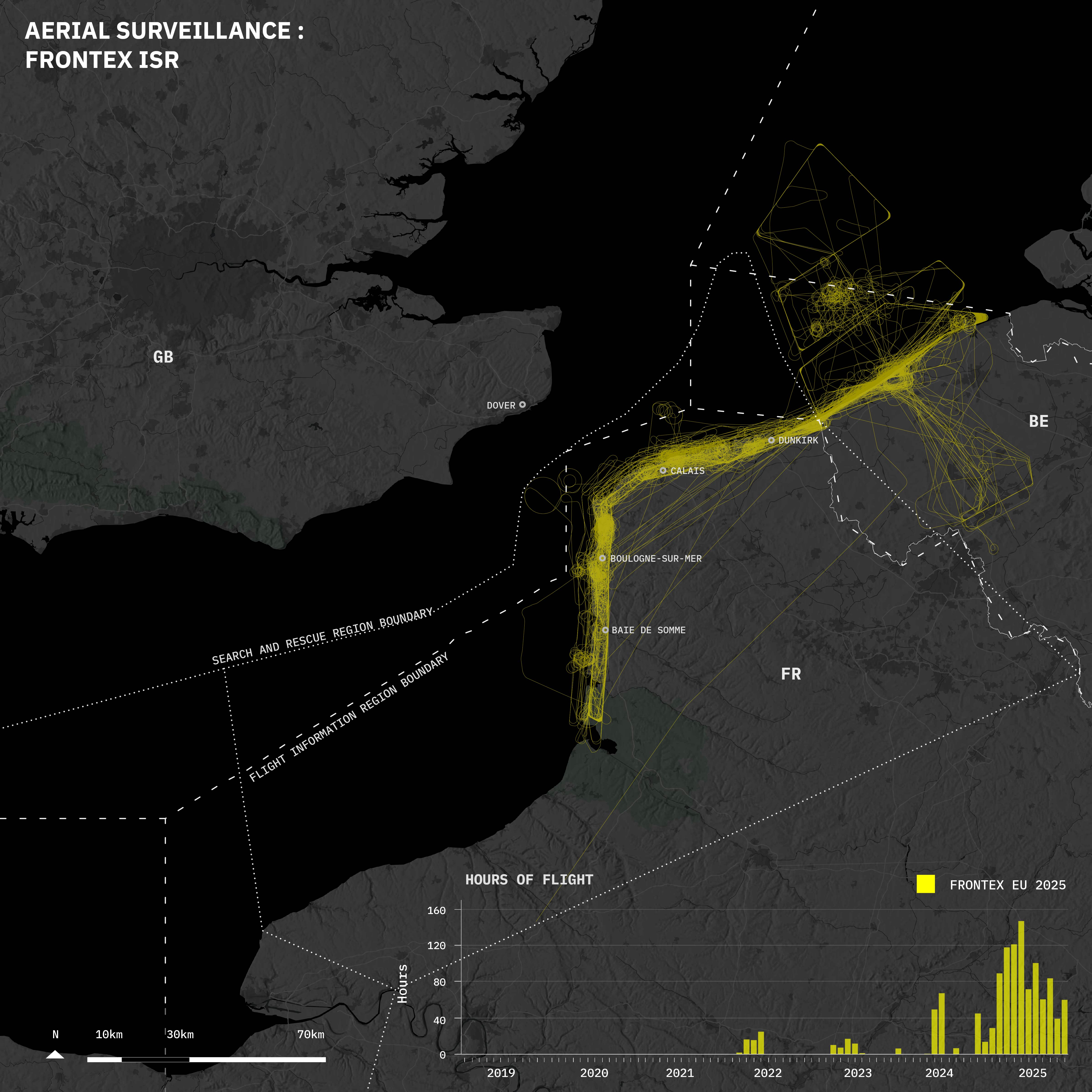
Although France’s then-Interior Minister Gérald Darmanin stated ‘we cannot accept that any more people die’ when Frontex’s surveillance mission was first announced in 2021,162Van Isacker, ‘Frontex Flights and Fatalities in the Channel’. internal documents from the agency revealed that JO Opal Coast is not primarily a search and rescue mission. Frontex listed ‘support[ing] SAR’ last in its order of operational aims for JO Opal Coast, and it is apparent that the territorial sea of France, where almost all small boat related deaths occur, is not included in JO Opal Coast’s Operational Area. Analysis of flight tracks of aircraft participating in Frontex’s JO Opal Coast from 2022 until 2026 demonstrated that patrols are concentrated overland along the French coast, with aircraft flying only a few orbits over France’s territorial sea. That the French sea is not included in Frontex’s surveillance mission is also suggested by Frontex’s Fundamental Rights Officer 2024 report which acknowledged that ‘the overwhelming majority of SAR cases occurred outside the operational area’ before recommending that the operational area be expanded beyond the French coast and territorial sea of Belgium.163The area to which the operation should be expanded was redacted from the document obtained for this investigation: ‘Observations to the Frontex Evaluation Report by the Fundamental Rights Officer JO Opal Coast 2024’, 4, in Frontex, ‘Documents Regarding JO OPAL COAST’, Public Register of Documents, 3 October 2025, https://prd.frontex.europa.eu/document/documents-regarding-jo-opal-coast/.
Later on the nights before crossings are expected the UK Home Office’s ISR aircraft, codenamed Phoenix, takes off from the South East of England to begin its patrol. Although flight tracks show that the aircraft typically remains within the UK’s airspace patrolling the boundary line of the UK’s territorial waters or Flight Information Region (which extends beyond the UK’s maritime border into French waters) its sensors are trained on the French coast for signs of crossing attempts.
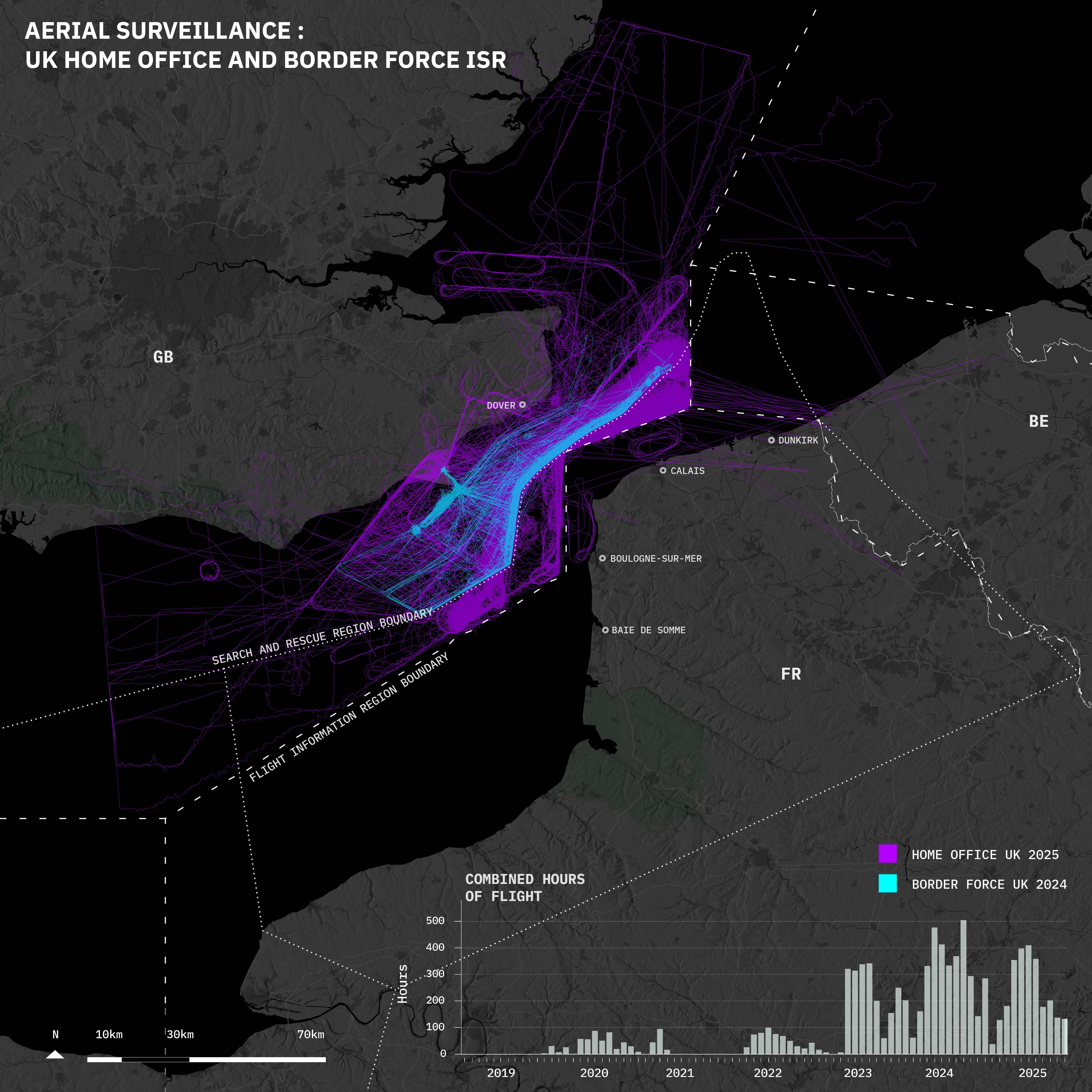
Border Force officers are cagey about the ‘advanced surveillance technology164Neil Honeyman, ‘Written Statement of Neil Honeyman’, The Cranston Inquiry, 15 January 2025, 7, https://cranston.independent-inquiry.uk/wp-content/uploads/cranston-evidence/INQ010409_Witness_Statement_of_Neil_Honeyman__CTO__SBOC__provided_by_Home_Office_15_01_2025.pdf. onboard Phoenix. However, a clip from a Home Office publicity video165The Fight to Tackle People-Smugglers: Inside Border Security Command, directed by Home Office, 2025, 3:45-3:50, 5:40, https://www.youtube.com/watch?v=HWRJOy6_qsQ. demonstrates at least some of this aircraft’s capabilities.166Sensors onboard PAL Aerospace’s Dash 8 ‘Force Multiplier’ include a L3Harris WESCAM MX-15 imaging system with electro-optic and infrared modes, Hensoldt PrecISR 1000 Radar, and a Smith Myers ARTEMIS system to detect and track mobile telephones. In the top right hand corner of the figure below is an image captured on 6 August 2024 by the Home Office’s Phoenix aircraft. In the red boxes are the aircraft’s and target’s GPS locations, as well as range of the camera: 10.5 nautical miles.
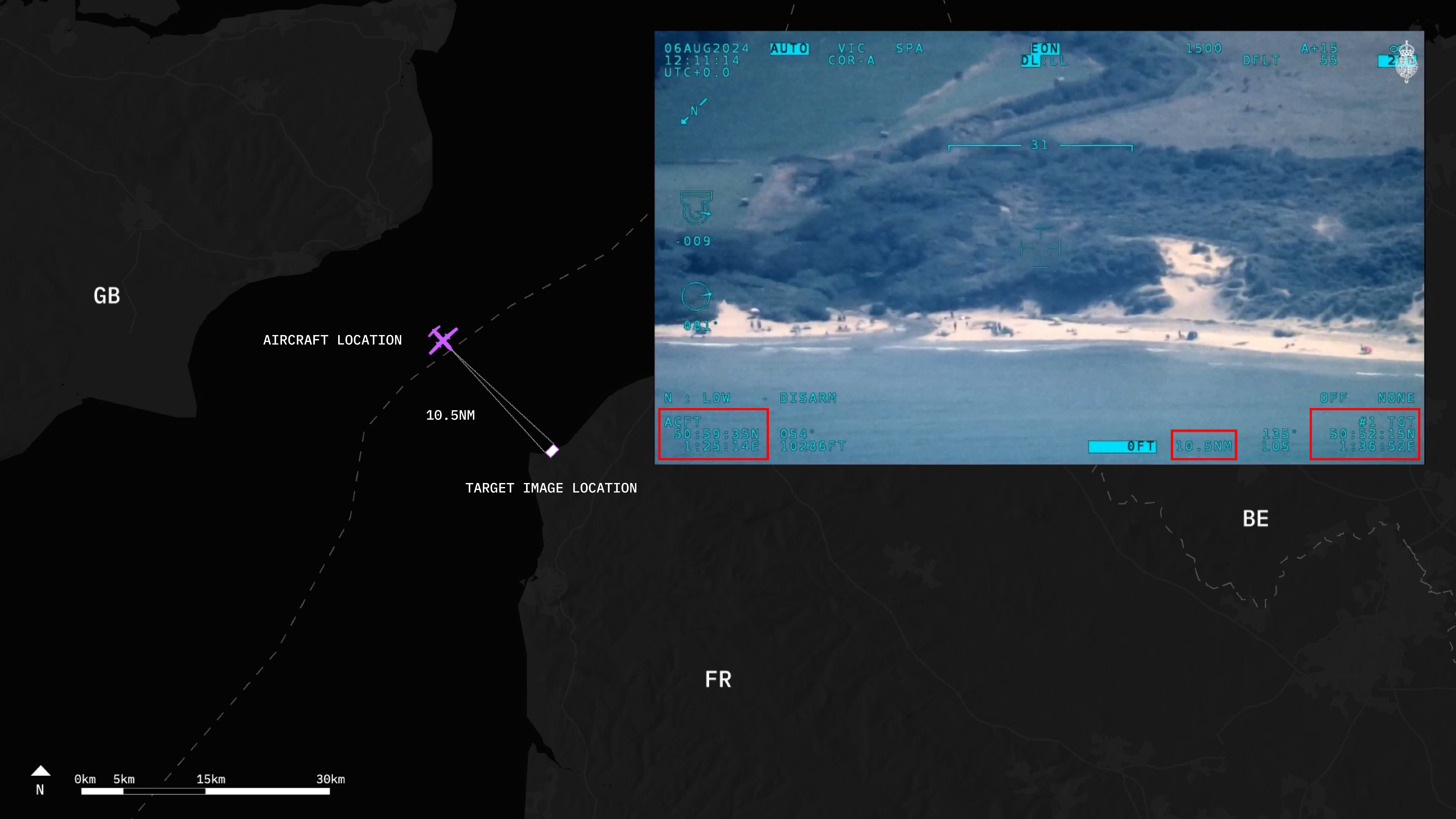
Documentation of Project Reveal, the predecessor to the Home Office’s Phoenix programme which began in June 2023,167Ben Riley-Smith, ‘Channel Plane to Fly Non-Stop in Hunt for Small-Boat People Smugglers’, The Telegraph, 16 June 2023, https://www.telegraph.co.uk/news/2023/06/16/non-stop-flight-over-channel-to-catch-small-boat-smugglers/. also confirmed that British law enforcement surveillance is not primarily directed at search and rescue of small boats at sea. The ISR tasking of Reveal in 2021 was to gather evidence to investigate and prosecute facilitators and therefore required the aircraft to ‘fly a different flight profile’ than Operation Eos SAR flights during which ‘the aircraft is operated at lower altitude for the purpose of detecting, assessing, and tracking small boats at sea visually’.168Ferguson, ‘Witness Statement of Gary Ferguson’, 8. Although the Reveal aircraft was patrolling above the same area of the Channel in which the dinghy sank on the night of 23-24 November 2021 ‘the sea beneath the aircraft was not being observed’.169Ferguson, ‘Witness Statement of Gary Ferguson’, 13.
Promotional material from Canadian contractor PAL Aerospace,170The Home Office recently contracted a second aircraft from PAL Aerospace to allow for 24 hour coverage of the Channel. The first contract was valued at £33.91m. Dominic Sipinksi, ‘UK Home Office to Double Dash 8 Patrol Fleet’, Ch-Aviation, 3 December 2024, https://www.ch-aviation.com/news/147623-uk-home-office-to-double-dash-8-patrol-fleet. which now operates the Phoenix aircraft for the Home Office as part of its ‘Force Multiplier’ service,171PAL Aerospace, ‘Force Multiplier: Contracted Airborne ISR’, PAL Aerospace, accessed 12 January 2026, https://palaerospace.com/force-multiplier/. describes its task as ‘surveillance of maritime activity in support of the UK’s ongoing fight against illegal migration and small boat crossings of the English Channel’. Although the aeroplane, flight crew, and sensor operators are provided by PAL Aerospace, Immigration Enforcement and Border Force officers are onboard to gather evidence and write witness statements for use in criminal prosecutions of facilitators and dinghy pilots.172PAL Aerospace, ‘PAL Aerospace to Provide Airborne Intelligence, Surveillance and Reconnaissance Support for the UK Home Office to Address Illegal Migration and Small Boat Crossings’, PAL Aerospace, 19 June 2023, https://palaerospace.com/pal-aerospace-provide-airborne-intelligence-surveillance-and-reconnaissance-support-uk-home-office/.
Complementing the Phoenix aircraft, which as a large crewed asset allows for a longer mission endurance and greater operational autonomy, are a number of Unmanned Aerial Systems (UAS), commonly known as drones, contracted from Portuguese company Tekever. These drones have been tracking and monitoring small boats since 2019 at a cost of hundreds of millions of pounds to the British taxpayer.173Afiq Fitri, ‘UK Spent up to £1bn on Drones to Spot Migrants in the Channel’, Tech Monitor, 4 April 2022, https://www.techmonitor.ai/digital-economy/government-computing/uk-spent-1bn-drones-prevent-migrant-crossings. Whereas Phoenix also monitors the French shores, the drones, which do not cross the boundary into French waters, are primarily used for overwatch of small boats transiting the Channel and gather footage which can be used as evidence to prosecute the dinghies’ pilots.174Inzaman Rashid, ‘Inside the Control Room That Sends Drones to Catch People Smugglers on the English Channel’, Sky News, 24 September 2020, https://news.sky.com/story/inside-the-control-room-that-sends-drones-to-catch-people-smugglers-on-the-english-channel-12079722.This is despite the fact that these pilots are not part of the smuggling organisations which organise the journey, but migrants (often Sudanese) who want to travel themselves and do not have enough money to pay for a crossing.175Vicky Taylor, ‘No Such Thing as Justice Here: The Criminalisation of People Arriving to the UK on “Small Boats”’, February 2024, https://blogs.law.ox.ac.uk/sites/default/files/2024-02/No%20such%20thing%20as%20justice%20here_for%20publication.pdf.
Although it is well known that surveillance over the Channel operated by the Home Office is used for law enforcement purposes domestically, speaking with Border Force officers who have worked inside Phoenix at public trade shows and Home Office events provided unique insights into how UK intelligence and surveillance is also used by the French. The officers described how, in the course of their surveillance flights high above the Channel, they would observe groups of people gathering in the dunes and on the beaches to launch a small boat with Phoenix’s powerful sensors. They then relayed those locations to their colleagues working in the Home Office’s Joint Control Room (JCR) located inside HM Coastguard’s Maritime Rescue Coordination Centre in Dover, who then passed the information to the French police via a liaison officer at the Joint Centre for Information and Coordination (CCIC) in Coquelles. The Border Force officers who had worked onboard Phoenix also described in some cases then being able to observe the French police arriving at the location they had passed to try and stop the departure, often with the use of violence and tear gas that could be observed from the aircraft.
The Border Force officers’ descriptions of their work made clear that the UK’s involvement in policing small boat departures from France extends beyond providing the French with funding to develop their own surveillance capacities to assisting with the operational coordination of French police resources. This close cooperation between UK surveillance aircraft and French police on the ground points to the UK Border Force’s direct involvement in, and potential complicity with, the violence and abuses committed by the French police during their interventions.
French flights: overwatch and coordinating police on the ground
In addition to these international agencies, the French police also have their own surveillance aircraft, including crewed and uncrewed platforms, which fly routinely on the days crossings are expected. British funds have been essential to developing the French’s technological aerial surveillance capabilities. Funding for surveillance technology to identify and disrupt crossing attempts comprised a large part of the £28m and £54m deals in 2020 and 2021 after the Home Office recognised in 2019 that ‘the amount of investment we have made to the French has worked well – drones, equipment and paying to train the French drone pilots’.176Home Office, ‘Small Boats Response: Lessons Learned Review June 2019’, 15. These early payments also allowed the French police and gendarmerie to purchase small quadcopter drones177Although providing a significant surveillance capability, the small quadcopter style drones could not be tracked as part of this investigation as they are not required to transmit their positions using ADS-B. to increase the detection capabilities of their foot patrols,178Lucy Williamson, ‘Can the UK-France Crackdown on Channel Smugglers Work?’, Europe, BBC News, 14 November 2022, https://www.bbc.co.uk/news/world-europe-63628579. as well as install vehicle license plate recognition cameras along coastal roads to identify and track vehicles potentially delivering dinghies to the beaches.179Léa Fournier, ‘Caméras anti-passeurs : quels effets sur les traversées de migrants au départ du littoral du Pas-de-Calais ?’, France 3 Hauts-de-France, 15 March 2024, https://france3-regions.franceinfo.fr/hauts-de-france/pas-calais/cameras-anti-passeurs-quels-effets-sur-les-traversees-de-migrants-au-depart-du-littoral-du-pas-de-calais-2939901.html. The disclosure obtained by Alexandre Léchenet on how France has allocated its Sandhurst funds also shows that between 2020-23 UK money was used to pay for hundreds of flight hours by gendarmerie helicopters and aircraft contracted by Action Air Environment (purchased in 2024 by Sabena Technics). These flights continue today. UK funds also paid for the training of four pilots for the purposes of ‘observ[ing] transport networks and beaches with a view to dismantling [smuggling] rings’ in 2020. Following these initial investments, the multi-year funding agreed through the 2023 Joint Leader’s Declaration promised to ‘put more drones, helicopters and aircraft in the sky, contributing to the effort of French authorities to monitor a larger area of northern France and prevent more crossings’.180Prime Minister’s Office, ‘UK-France Joint Leaders’ Declaration’.
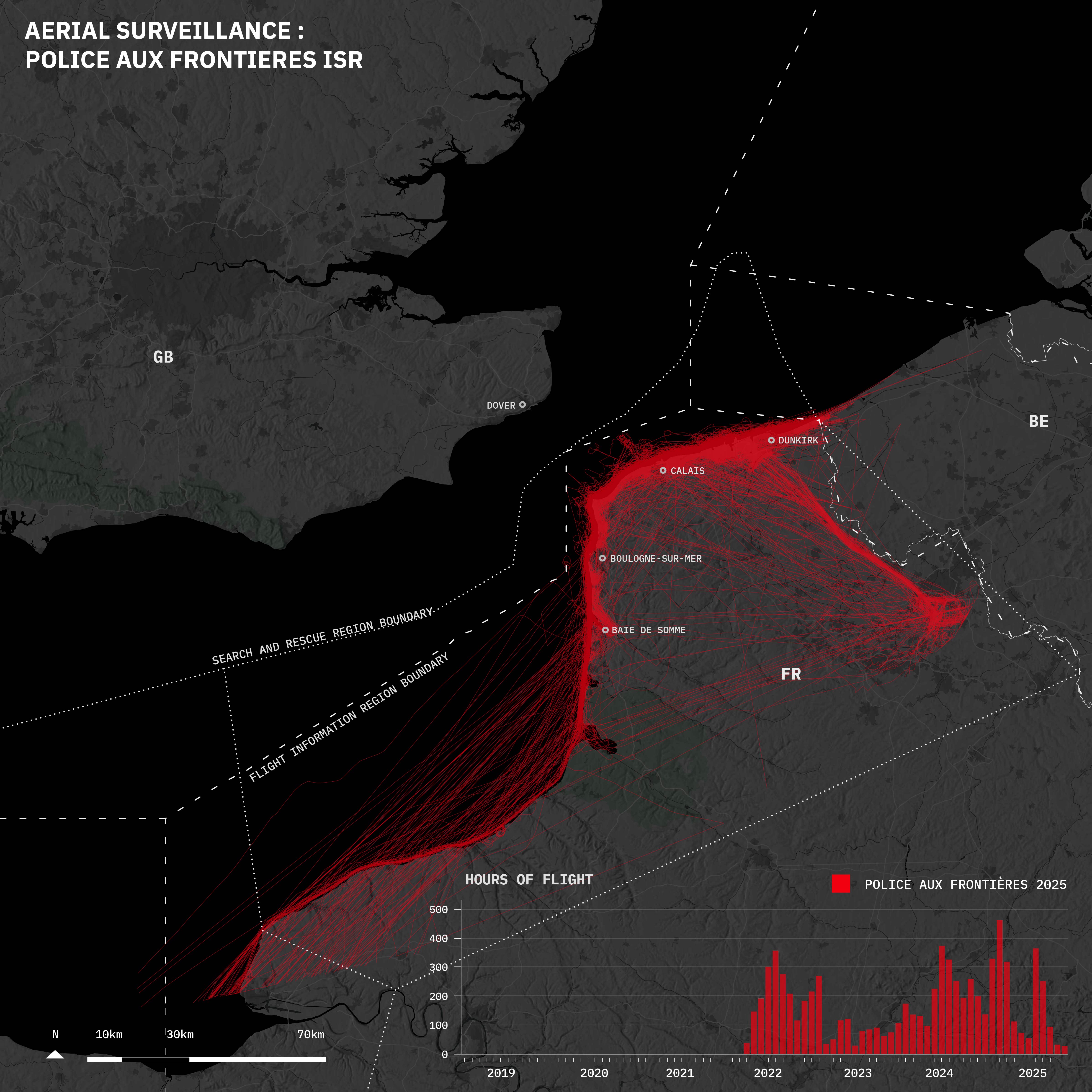
ADS-B flight data showed that the French police aircraft are typically active on nights and in the early hours of the morning when small boat departures are expected. They patrol overland and along the coast similar to the route flown by the Frontex aircraft today, although its role is likely more similar to the mission of earlier Frontex flights described in 2021:181Hymas and Barnes, ‘On Board the EU Spy Planes Helping to Stem the Tide of Channel Migrants’. providing real-time intelligence to coordinate the activities of police on the ground as they attempt to intercept people in the dunes and on the beaches and vehicles delivering boats on the roads. The aircraft are equipped with infrared and thermal imaging cameras which can easily spot large groups of people in darkness. This provides police patrols on land an important additional capability which makes them more effective at locating and intervening to disrupt dinghy launches. Not only does this contribute to a reduction in the overall number of vessels available on crossing days, but has led to facilitators adopting new tactics in response to having less time to prepare dinghies on the beaches before the police arrive.
The Home Office’s Border Security Command promotional video provides another glimpse of the direct consequences for would-be travellers of French surveillance flights in coordination with police on the ground. The opening clip shows overhead images of what appears to be a cloud of tear gas spreading over a number of figures in the surf as they attempt to launch an inflatable dinghy. Such action against people already in the sea who may not be able to escape the noxious cloud dramatically increases the risks of the embarkation, a moment when there have been multiple drownings in shallow waters.182Charlotte Boitiaux, ‘Channel Crossings: “More People Die When They Set Sail than on the Open Sea”’, InfoMigrants, 5 June 2024, https://www.infomigrants.net/en/post/57492/channel-crossings-more-people-die-when-they-set-sail-than-on-the-open-sea.
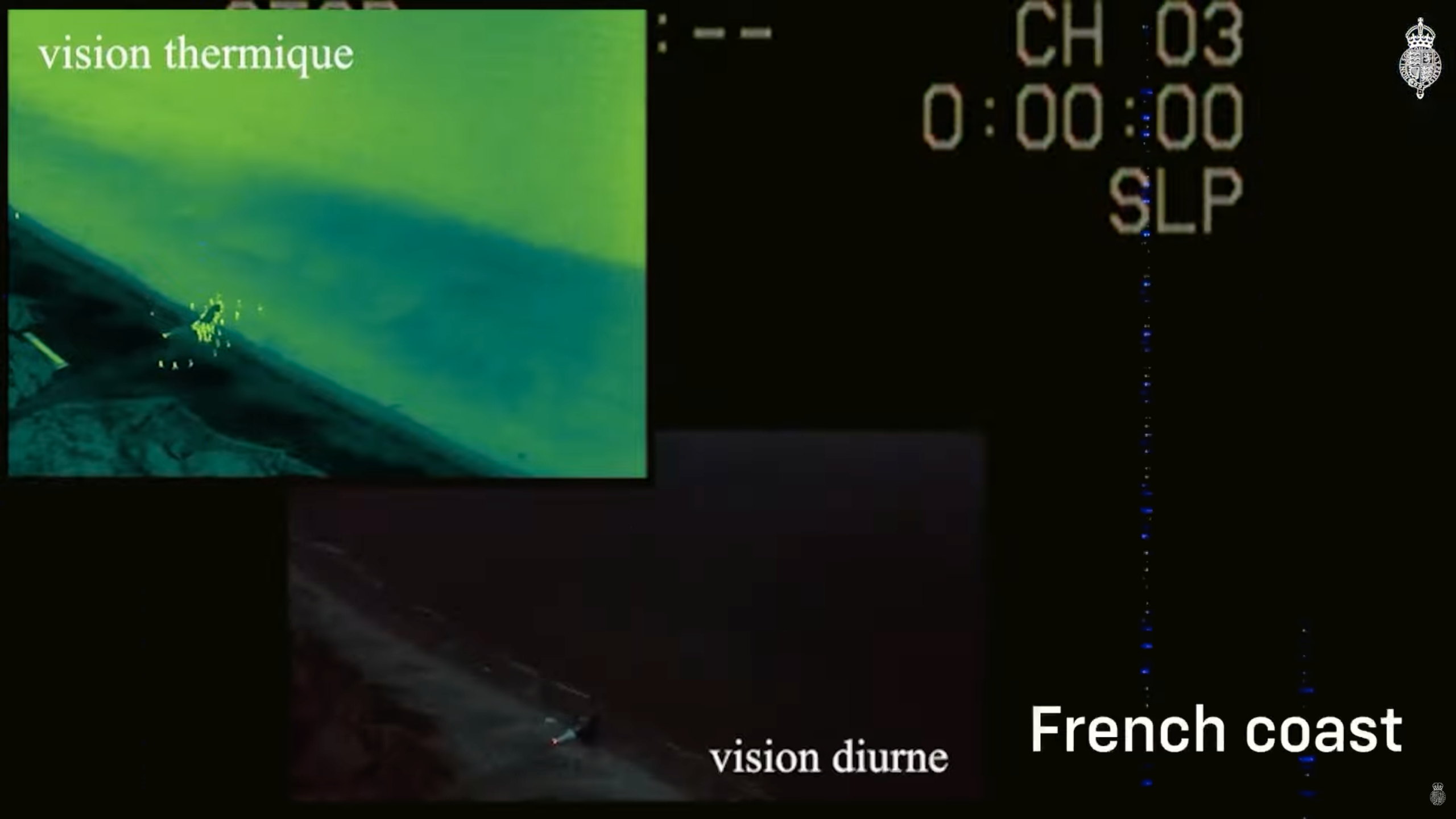
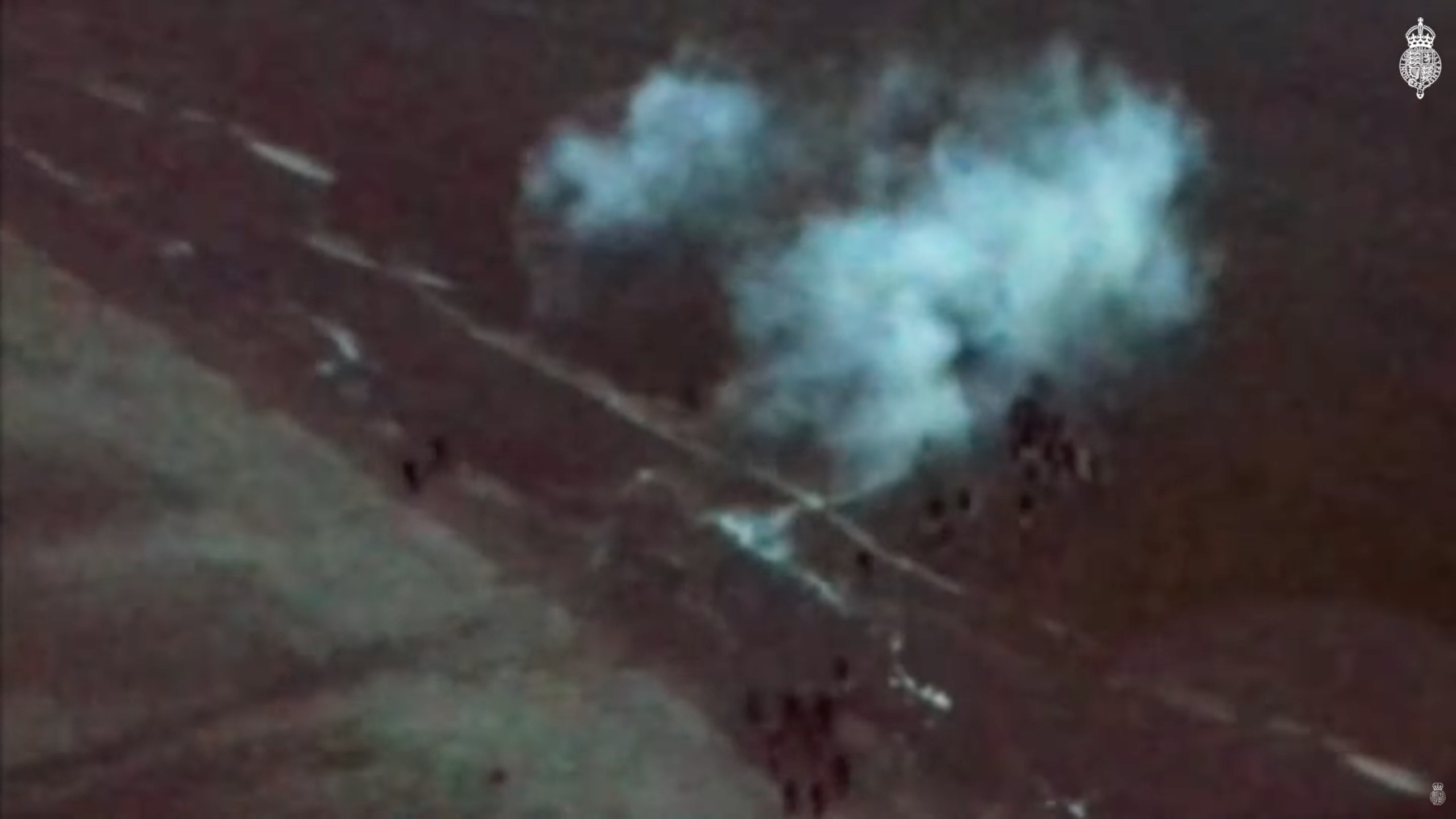
Search and rescue, or ‘stop the boats’ – conflicting interests?
In addition to law enforcement’s ISR assets whose focus is to detect and prevent small boat launches and gather evidence for counter-smuggling investigations, there are SAR specific aeroplanes and UAS which operate over the Channel. On the UK side, HM Coastguard contracts its own surveillance aircraft from 2Excel aviation and rotary-wing drones from Bristow to observe small boats and provide real-time information to coastguard officers coordinating SAR operations under Operation Caesar.183Dominic Perry, ‘Bristow Wins CAESAR Contract Extension for Small Boat Surveillance in Channel’, Flight Global, 2 December 2024, https://www.flightglobal.com/helicopters/bristow-wins-caesar-contract-extension-for-small-boat-surveillance-in-channel/160950.article. The French coastguard also has rotary-wing UAS which it can use for small boat related SAR stationed at the rescue coordination centre Gris-Nez.184Tony Kingham, ‘Schiebel Camcopter S-100 Supports European Coastguard Functions In France And Belgium’, Border Security Report, 25 September 2024, https://www.border-security-report.com/schiebel-camcopter-s-100-supports-european-coastguard-functions-in-france-and-belgium/.
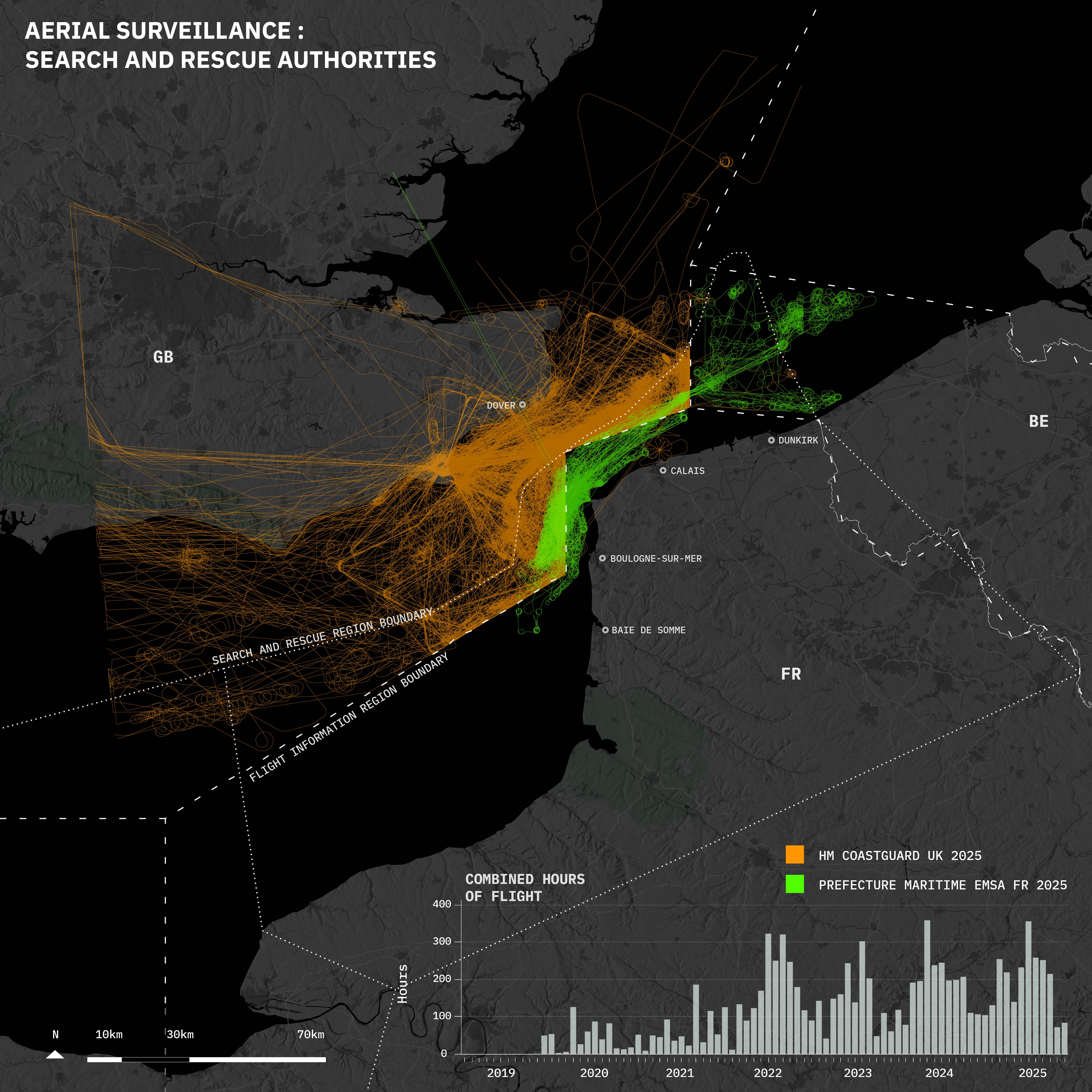
Whereas the law enforcement ISR flights purport to save lives at sea by preventing crossings, the coastguard’s missions are on paper traditional SAR: locating casualty vessels and maintaining an overwatch to provide rescue coordinators and sea surface vessels with reliable information to effect swift rescue. Although the surveillance aeroplanes have their own crews, they also provide a live video downlink to the coastguard operations room which can assist in verifying other sources of information, such as distress calls from the small boats themselves.
Despite the clear priority of the coastguard’s mission being to ensure safety of life at sea over border protection, HM Coastguard pilots periodically collect and provide information on potential departures from the French coast as well as share identifying features of boat drivers with Border Force. Responses to freedom of information requests also show that imagery collected by HM Coastguard assets is shared with prosecuting authorities.185Maritime and Coastguard Agency, ‘Response to Freedom of Information Request – 202500482’, WhatDoTheyKnow.Com, 24 November 2025, https://www.whatdotheyknow.com/request/english_channel_isr_data_sharing_3/response/3224169/attach/5/attachment.pdf?cookie_passthrough=1.
This entanglement of surveillance for the purposes of search and rescue with border policing practices should raise concerns about how information collected by the coastguard to safeguard lives at sea may be used by law enforcement agencies whose activities to prevent departures or arrest smugglers can contribute to endangering travellers. By questioning authorities’ claims that increased border security leads to fewer crossings, which leads to fewer deaths, the purpose of the dense web aerial surveillance operating today over the Channel can be reassessed. Acknowledging that the danger of small boat journeys is a function not only of factors such as quality of the dinghy, the weather, or sea state but the circumstances in which the dinghies depart the coast, the number of persons onboard, and the actions of police to prevent launches can help to rethink what information aerial surveillance should focus on gathering and amongst which agencies it should be shared in order to best prevent loss of life.
Subsection 3.3. Police patrols and use of force to prevent departures
As has just been shown, EU and UK aerial surveillance is closely tied to operations by police on the French coast. The number of officers deployed on the ground to prevent small boat crossings has grown enormously over the last five years. Beginning in 2019, 45 gendarmes reservists were brought from around France to support local units, ‘effectively doubling assets on the ground’.186Priti Patel and Christophe Castaner, ‘Small Boats Action Plan – Addendum September 2019’, September 2019, 3, https://assets.publishing.service.gov.uk/government/uploads/system/uploads/attachment_data/file/839500/Small_Boats_Action_Plan_Addendum_-_26th_September_consolidated_text__2019.10.01___002_.pdf. This deployment of reservists was then doubled to 90 in 2020 under Operation Poseidon.187Sophie Bernard, ‘Montée en puissance du dispositif de lutte contre l’immigration clandestine sur le littoral nord’, Gendinfo: Toute l’actualité de la gendarmerie nationale, 30 December 2020, https://www.gendarmerie.interieur.gouv.fr/gendinfo/sur-le-terrain/immersion/2020/montee-en-puissance-du-dispositif-de-lutte-contre-l-immigration-clandestine-sur-le-littoral-nord. A significant portion of the £54m provided in 2021 as part of the ‘next phase of collaboration’ between France and the UK went to ‘more than doubling again’ the number of police deployed to ‘patrol wider areas of coastline across the northern coast between Boulogne and Dunkirk, expanding patrols further south-west including around Dieppe’.188Gérald Darmanin and Priti Patel, ‘UK-France Joint Statement: Next Phase of Collaboration on Tackling Illegal Migration – 20 July 2021’, GOV.UK, 20 July 2021, https://www.gov.uk/government/publications/uk-france-joint-statement-next-phase-of-tackling-illegal-migration/uk-france-joint-statement-next-phase-of-collaboration-on-tackling-illegal-migration-20-july-2021. In November 2022 a ‘joint statement’ by Home Secretary Suella Braverman and Interior Minister Gérald Darmanin announced the number of police would again increase by 40% as part of a new £62.2m funding package.189Gérald Darmanin and Suella Braverman, ‘UK-France Joint Statement: Enhancing Co-Operation against Illegal Migration’, GOV.UK, 18 November 2022, https://www.gov.uk/government/publications/next-phase-in-partnership-to-tackle-illegal-migration-and-small-boat-arrivals/uk-france-joint-statement-enhancing-co-operation-against-illegal-migration. Finally, the March 2023 agreement promised UK funding for an additional 500 more police in France.190Prime Minister’s Office, ‘UK-France Joint Leaders’ Declaration’. In 2025, it was reported that there are currently ‘1,200 security personnel deployable daily on coastal smuggler operations’, of which ‘some 730 of them are paid for by the British’.191Dominic Casciani, ‘Can the Tide Turn on the English Channel Migrant Boat Crossings?’, BBC News, 1 March 2025, https://www.bbc.co.uk/news/articles/c39vjnpxy1wo.
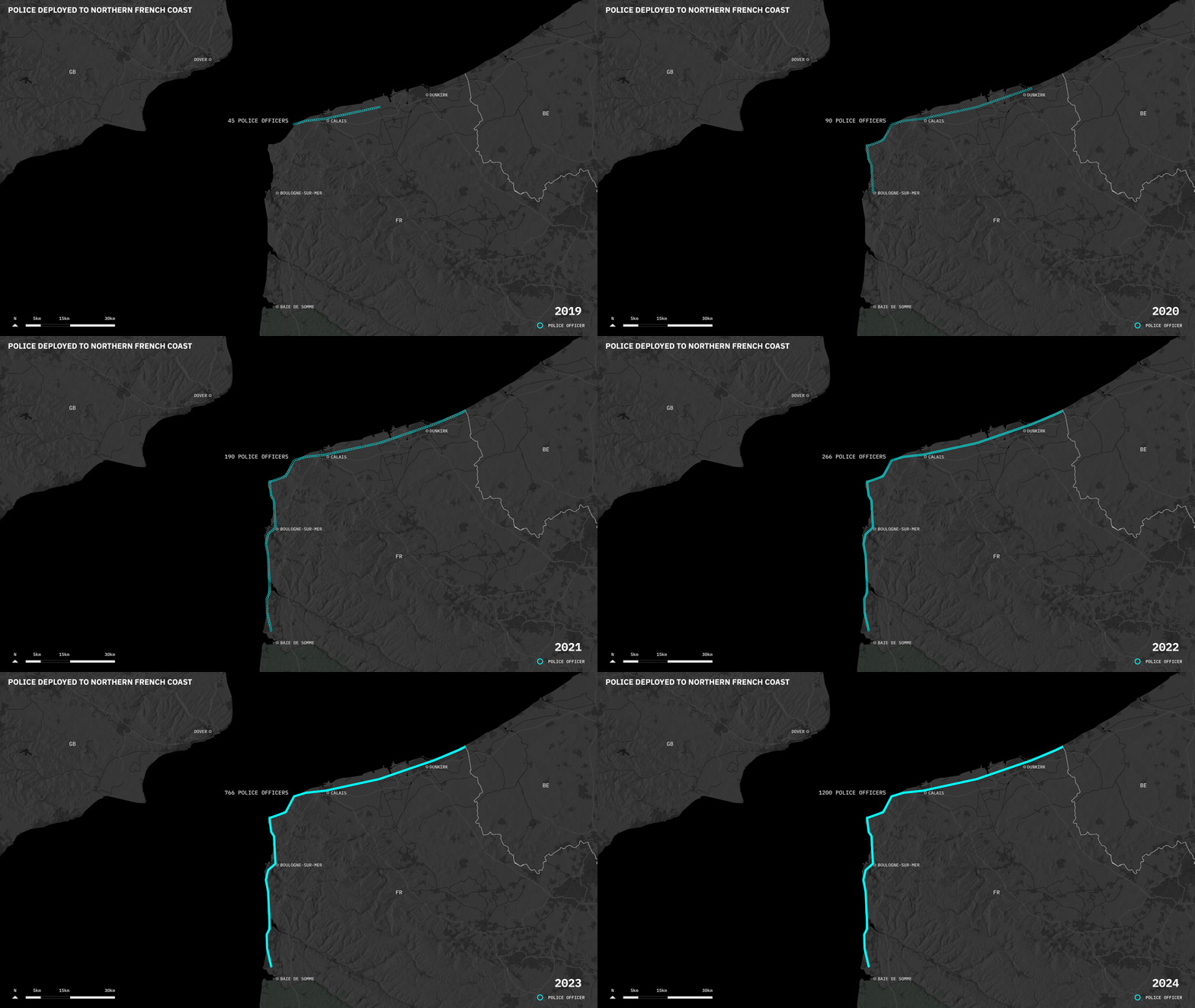
This subsection discusses how the multiplication of police units on the French coast have contributed to increased fatalities during small boat departures. First, the ways increased patrols have prompted shifts in where boats depart from, the advent of the ‘taxi boat’, and driven overall overcrowding are discussed. Then, the police’s violence and use of riot control weapons when intervening to prevent crossings, and the effect of these tactics on travellers, are considered.
Effects of greater police presence on material conditions
Having discussed the ever increasing overcrowding in previous sections, it is important to briefly highlight how increased policing in northern France contributes to the phenomenon. Police patrols along the coastal roads first of all conduct stops and searches of vehicles containing dinghies which further reduce total supply. Those which do make it to the launch location are then vulnerable to officers on foot, on dune buggies, or other four wheel drive vehicles, who race to seize or destroy the dinghy before it can be inflated and launched. However, as these disruptions only take place in the final moments, travellers have already been mobilised and are in place in the dunes and on the beaches ready to leave. Multiple dinghies are often arranged to depart from the same location and so when police intercept some, the groups of expectant travellers try to board the others regardless of whether that dinghy was originally meant for their journey. This increases the overall number of persons attempting to board the fewer dinghies which remain, and creates confusion and tension amongst the different groups of travellers which can lead to violent conflicts at launch. For example, on 28 July 2024, Dina Al Shammari, a 21 year old Bidoon woman was crushed inside an overcrowded dinghy.192Matthew Weaver, ‘Family Whose Daughter Died in Channel Say They Will Attempt Crossing Again’, UK News, The Guardian, 11 August 2024, https://www.theguardian.com/uk-news/article/2024/aug/11/family-who-lost-daughter-in-channel-crossing-attempt-to-try-again. Another asylum seeker trying to board at the same time said that there were 100 people on the beach and many could not travel as the police had just ‘destroyed two of the dinghies in the area’. 193Quinn and Taylor, ‘One Dead and Dozens Rescued in Latest Attempt to Cross Channel’.
In addition to fueling overcrowding, increased police patrols have impacted the material circumstances of small boat journeys in other significant ways. For example, policy-makers have acknowledged that police patrols impact on the sites from which small boats depart,194Darmanin and Patel, ‘UK-France Joint Statement’. and police officers also readily admit this effect. One gendarme described in 2020 how ‘the methods used by illegal immigration networks have adapted to ours… when law enforcement presence in Calais was reinforced and controls intensified, the crossing zone expanded and launches now take place much further south’.195Marine Rabasté, ‘Lutte contre l’immigration irrégulière et clandestine : la côte d’Opale sous haute surveillance’, Gendinfo: Toute l’actualité de la gendarmerie nationale, 7 September 2022, https://www.gendarmerie.interieur.gouv.fr/gendinfo/terrain/immersion/2022/lutte-contre-l-immigration-irreguliere-et-clandestine-la-cote-d-opale-sous-haute-surveillance. Departing from further south means longer journeys to the UK requiring people to spend more time at sea in a precarious situation and exposed to the elements.196MacTaggart et al., You Can’t Stay but You Can’t Go – State Violence at the UK France Border, 118.
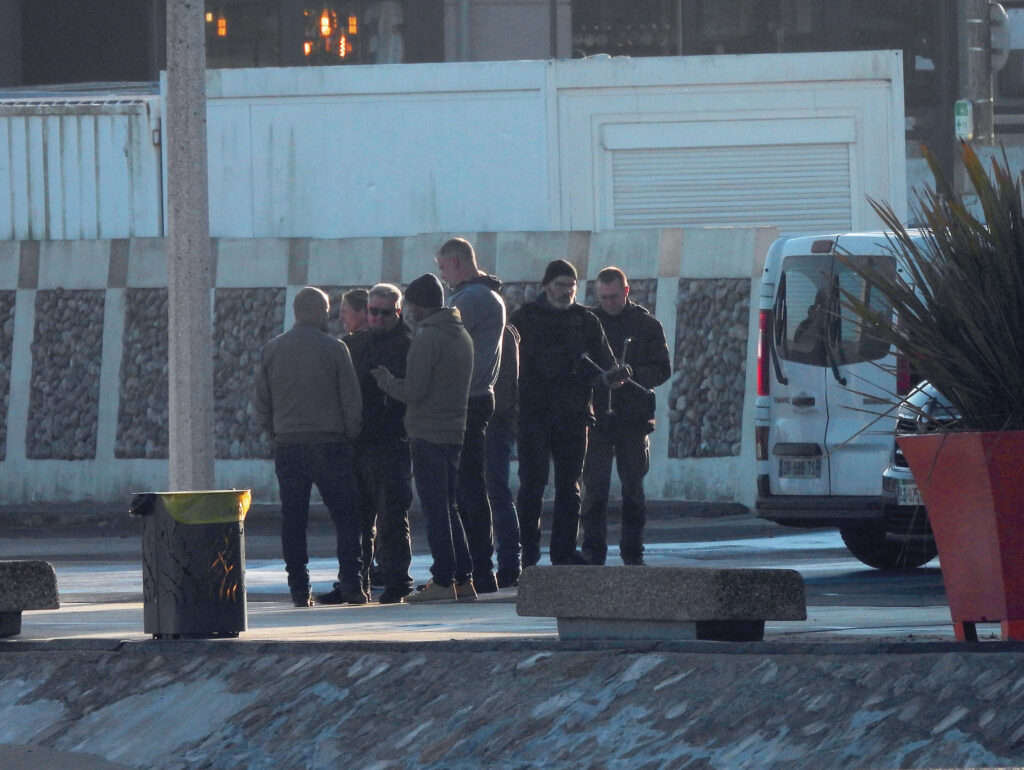
Perhaps the most significant result of increased police on the beaches has been the advent of the ‘taxi boat’. One man facing facilitation charges in France interviewed for this investigation dated the development of this tactic in his network to Spring of 2023. He described how increased police patrols made it more difficult to stash boats in the dunes, hidden to be used on a night when the weather was calm. New equipment like quadcopter drones and dune buggies meant police started intervening more quickly on the beaches to disrupt the inflation and launching of dinghies. He explained this prompted a change from inflating and launching dinghies on the beaches, often with the help of passengers, to moving the boats from delivery vehicles into the water as quickly as possible, then picking passengers up later. Remote inland waterways like rivers and canals which could be accessed directly by roads and from where dinghies could reach the sea unsurveilled also began to be used. Today there is even evidence that smugglers drive vehicles with fully inflated dinghies strapped to the roof directly on to the beaches and into the sea to get dinghies into the water before the police arrive.197Smuggling Gangs Switch Tactics to Use ‘taxi Boats’ for Journeys across the Channel | BBC News, directed by BBC News, 2025, 5:26, https://www.youtube.com/watch?v=xaPhkXmnleI.
Once afloat the dinghies are safer from the police whose official policy before 2026 has been not to enter the water to try and disrupt a journey out of fear of endangering the lives of those onboard. However, in 2022, there were already documented instances of police forcibly pulling-backs migrant dinghies or puncturing inflatables when they were afloat,198Jerome Rochas, ‘À Calais, les autorités lacèrent les zodiacs des exilés, au risque de la noyade’, StreetPress, 9 November 2022, https://www.streetpress.com/sujet/1667994002-calais-autorites-lacerent-zodiacs-bateaux-exiles-migrants-noyade-couteaux-pull-backs-non-assistance-danger. and in 2023 police boats were observed using threatening and dangerous tactics to intercept and swamp small boats departing France.199Julia Pascual et al., ‘French police use aggressive techniques to stop migrants from crossing English Channel’, France,Immigration, Le Monde, 24 March 2024, https://www.lemonde.fr/en/france/article/2024/03/23/french-police-use-aggressive-techniques-to-stop-migrants-from-crossing-english-channel_6648196_7.html. There are also documented instances of police entering the water to pierce boats which are afloat. For example, on 27 April 2024 police pierced a dinghy close to Dunkirk after being told to ‘significantly ramp up their efforts’ to prevent crossings;200Peter Allen, ‘French Police Use Knives to Sink Asylum Seekers’ Boat in Dunkirk’, Mail Online, 26 April 2024, https://www.dailymail.co.uk/news/article-13355341/French-police-sink-asylum-seekers-boat-Dunkirk-migrants-Britain-Channel.html. on 7 November 2024 it was reported that gendarmes punctured a dinghy which had broken down, casting its occupants into the water resulting in one woman being placed in a coma;201Julia Pascual, ‘La justice saisie après un nouveau naufrage de migrants dans la Manche’, Société,Immigration En Europe, Le Monde, 7 March 2025, https://www.lemonde.fr/societe/article/2025/03/05/la-justice-saisie-apres-un-nouveau-naufrage-de-migrants-dans-la-manche_6576573_3224.html. on 4 July 2025 a BBC camera crew observed gendarmes wading into the surf to cut a dinghy with a knife;202Andrew Harding, ‘French Police Slash Inflatable Migrant Boat Heading to UK’, BBC News, 4 July 2025, https://www.bbc.co.uk/news/articles/c5ygjjxjlplo. and on the night of 9-10 July 2025 gendarmes slashed a dinghy as it was departing the coast in Cayeux-sur-Mer – the dinghy then continued its journey with a deflated tube, eventually reaching UK waters with 55 travellers onboard.203Diane Taylor, ‘Leaked Document Shows Boat Slashing Failed to Stop Migrants Reaching UK’, UK News, The Guardian, 20 July 2025, https://www.theguardian.com/uk-news/2025/jul/20/leaked-document-shows-boat-slashing-failed-to-stop-migrants-reaching-uk. First mooted by then-Interior Minister Retailleau on 27 February 2025,204Virginie Wojtkowski, ‘Retailleau plaide pour intercepter les migrants en mer, une pratique « dangereuse » selon les marins’, Le marin, 12 March 2025, https://lemarin.ouest-france.fr/monde/migrants/retailleau-plaide-pour-intercepter-les-migrants-en-mer-une-pratique-dangereuse-selon-les-marins-7626206c-fe7d-11ef-9b78-58334960577c. in 2026 the French government changed its policy to sanction law enforcement officers intercepting dinghies at sea despite the increased dangers to travellers.205Julia Pascual and Tomas Statius, ‘« Small boats » de migrants dans la Manche : la nouvelle doctrine d’interception avec filets bientôt en place’, Société,Immigration et Diversité, Le Monde, 19 November 2025, https://www.lemonde.fr/societe/article/2025/11/19/small-boats-dans-la-manche-la-nouvelle-doctrine-d-interception-avec-filets-bientot-en-place_6653955_3224.html. At the time of writing, two dinghies have been intercepted in this way.206Le marin, ‘Prison ferme pour un passeur de migrants intercepté au large de Dunkerque par la gendarmerie maritime’, Le marin, 9 March 2026, https://lemarin.ouest-france.fr/monde/migrants/prison-ferme-pour-un-passeur-de-migrants-intercepte-au-large-de-dunkerque-par-la-gendarmerie-maritime-6506df88-1baa-11f1-9fa1-ca7616976f61.
In the majority of cases, however, once the dinghies have reached the sea they have been left relatively free to travel along the coast and pick up groups of people waiting in more accessible locations. This does not mean embarking onto such a ‘taxi boat’ is safe. To board, groups must wade into cold water, often up to their chest and neck, which comes with significant dangers of hypothermia and drowning, especially if passengers do not have life jackets.
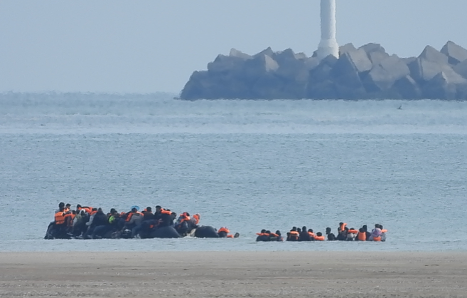
A large number of fatalities have occurred in the moment that travellers embark on the taxi boats close to the beaches. These include five Syrians on 14 January 2024 at Wimereux, two Afghan men on 9 February 2025 at Berck, and one Somali man on 19 March 2025 at Equihen. There have also been at least two people who drowned attempting to reach taxi boats in canals,207Although four canal related deaths are listed in the source for this statement (MacTaggart et al., You Can’t Stay but You Can’t Go – State Violence at the UK France Border, 118.), one of those, seven-year-old Roula Al Mayali, died when the small fibreglass boat she boarded in the Canal de l’Aa capsized; it was not suspected to be a taxi boat. Another person, a young Sudanese man named Nasreddine Hassan Ahmed, was found in a canal in Calais but it is not suspected that he entered the canal during a crossing attempt. including Jumaa al-Hasan who witnesses said jumped into the canal to escape police who were gassing, beating, and chasing people intending to board the dinghy.208Galisson et al., ‘France’.
The use of taxi boats has increased as the average number of people per dinghy has gone up over the years. Border Security Commander Martin Hewitt told the House of Commons that today the most crowded dinghies are taxi boats, the highest recorded being 125 people, ‘which is extraordinary and incredibly dangerous’.209Oral Evidence: Border Security and Irregular Migration: The Work of the Border Security Command, 2025, 10. As the number of dinghies has shrunk, and with fewer possibilities to embark travellers on the beaches, more people have had to try to climb onboard when dinghies are already at sea, which has made the moment of embarkation even more dangerous. However, taxi boats continue to remain effective at subverting police patrols on the beaches and reportedly had an 85% success rate in 2025.210Schofield and Pradier, ‘France Makes First Interception Targeting Small Boat Crossings to UK’. It is therefore likely they will continue to be used so long as police patrol to the beaches to prevent departures, despite the added risk to travellers when boarding.
Dangerous police interventions
While greater numbers of police have affected the modus operandi of Channel crossings, leading to facilitators and travellers taking greater risks in their journeys, their interventions can also directly endanger lives. The migrants and organisations interviewed for this investigation described an increase in the aggression of police beginning Summer 2023. They suggested that the Joint Leaders’ Declaration may not only have increased the numbers of officers but precipitated a cultural shift within French law enforcement that officers needed to be seen to be acting more decisively to ‘stop the boats’ in exchange for the additional funds from the UK. There is evidence of a precedent for this: remember in September 2021 then-Home Secretary Priti Patel was accused by the French of ‘financial blackmail’ when she threatened to withhold the £54m of additional funds if France did not reach a 75% percent interception rate.211Swinford et al., ‘France Accuses Priti Patel of Financial Blackmail over Migrant Crossings’.
When the French police and gendarmes find groups attempting to launch or reach a dinghy they will rush towards the group, often firing tear gas and other less-lethal riot control munitions regardless of if there are women, young children, or even infants in the group;212MacTaggart et al., You Can’t Stay but You Can’t Go – State Violence at the UK France Border, 108–9. indeed the presence of children is often invoked as a justification for police intervention.213La Défenseure des droits, Décision Du Défenseur Des Droits N° 2025 -225, nos 24–019029 (La Défenseure des droits, 2025), 8. This causes the group to panic and flee towards the water and clamber onto the dinghy which appears the only route to safety from police attack. As one woman testified in a recent report on state violence at the UK-France border:
‘Most people die from drowning because when they see French police they will run to the boat. In between [the shore and the boat] most people die because they don’t want to be caught by French police. When people are trying to board small boats, the police come and people run in fear from the police.’214MacTaggart et al., You Can’t Stay but You Can’t Go – State Violence at the UK France Border, 14.
In a recent decision by the French human rights ombudsperson, le Défenseur des droits, it was stated that there appears to be no protocol governing the use of force and weapons by police against persons attempting to leave France in small boats.215Arthur Carpentier and Julia Pascual, ‘Traversées de la Manche : la Défenseure des droits critique l’emploi d’armes pour empêcher les départs de migrants’, Société,Immigration et Diversité, Le Monde, 26 January 2026, https://www.lemonde.fr/societe/article/2026/01/26/traversees-de-la-manche-la-defenseure-des-droits-critique-l-emploi-d-armes-pour-empecher-les-departs-de-migrants_6664112_3224.html. An instruction issued by the Prefecture in January 2022, however, authorised ‘all means at [the police’s] disposal to prevent people from leaving’.216Arthur Carpentier and Julia Pascual, ‘Traversées de la Manche : la Défenseure des droits critique l’emploi d’armes pour empêcher les départs de migrants’, Société,Immigration et Diversité, Le Monde, 26 January 2026, https://www.lemonde.fr/societe/article/2026/01/26/traversees-de-la-manche-la-defenseure-des-droits-critique-l-emploi-d-armes-pour-empecher-les-departs-de-migrants_6664112_3224.html. The use of ‘less-lethal’ riot control weapons such as tear-gas, rubber bullets, and stun grenades ‘endangers people,’ according to the ombudsperson’s decision, who went on to recommend that they be prohibited from use ‘to prevent people from boarding a boat’.217Peter Allen, ‘Stop Firing Rubber Bullets at Small Boat Migrants, French Police Told’, The Telegraph, 26 January 2026, https://www.telegraph.co.uk/world-news/2026/01/26/stop-firing-rubber-bullets-small-boat-migrants-france/. Such violent police actions significantly affect the circumstances in which small boats depart, provoking chaos and panic during launch and embarkation, and endangering life and limb through use of riot control weapons and violent charges.
Taken together, all these distinct but entangled border policing practices have had the cumulative effect of creating more dangerous circumstances for migrants attempting the Channel crossing, and shown state policies to prevent small boat crossings as being a clear driver in the increased number of deaths amongst migrants in the Channel.
Organisations such as Alarm Phone, Calais Migrant Solidarity, Human Rights Observers, Humans for Rights Network, Project Play, and Utopia56 have been monitoring and condemning police violence, and its effects on illegalised travellers in northern France, for many years. This investigation has complemented their work by placing the moment of police intervention, and its objective violence, into a much longer continuum of border policing practices across temporal, geographic, operational scales. By combining quantitative analysis of deadly trends with qualitative data, this section has illustrated how key interventions along the whole continuum of the UK’s externalised border stretching from the north coast of France ‘upstream’ to countries where journeys are staged, such as Belgium and Germany, and through which materials transit, like Bulgaria, China, and Turkey, has significantly increased the dangers for travellers. Efforts to disrupt smugglers’ supply chains has led to the use of alternative suppliers of larger, poorer quality, inflatables, and driven overcrowding. And as French policing on the ground became more effective with increased aerial surveillance, it became nearly impossible for under-resourced, independent groups to cross the Channel autonomously of professionalised smugglers. The geographic range over which small boats departed also increased, and new dangerous tactics, such as the use of taxi boats which require passengers to enter the cold waters of the Channel up to their torsos, were required for journeys to be successful. Taken together, all these distinct but entangled border policing practices have had the cumulative effect of creating more dangerous circumstances for migrants attempting the Channel crossing, and shown state policies to prevent small boat crossings as being a clear driver in the increased number of deaths amongst migrants in the Channel. Although policy-makers have clearly at times been aware their ‘effective measures had had harmful consequences, leading to an increase in deaths and violence’218Bruno Retailleau, ‘Bruno Retailleau on X: “J’ai Rencontré Mon Homologue Britannique, Mme Yvette Cooper, Lors Du G7…”, X (Formerly Twitter), 3 October 2024, https://x.com/BrunoRetailleau/status/1841891630007124414. they have continued to pursue them even as they have failed to achieve the authorities’ stated intentions of ‘stopping the boats’.
At what cost?
Conclusions and looking ahead
The key finding of this investigation is that behind the sharp rise in numbers of people dying at the Channel border since Summer 2023 lies the UK governments’ policies and work with international partners to ‘stop the boats’. However, the question which remains is why, after acknowledging the deadly consequences of their policies, do authorities persist despite the statistical data demonstrating they have failed in their stated objectives?
In 2025 the number of small boat arrivals (41,472) increased compared to 2023 (29,437) and 2024 (36,818). Although there were significantly more arrivals, the data analysed for this investigation showed 29 deaths throughout calendar year 2025. The decline compared to the 83 in 2024 is not necessarily reassuring. There were still 20 fatal incidents in 2025 compared to 22 the year before, although there were fewer mass casualty incidents like that of 23 October 2024 when a dinghy sank just two kilometres from the port of Calais – three bodies were recovered at the scene, while over the coming months the bodies of 13 missing people would be found at sea or washed up on French beaches.219Simon Mauvieux et al., ‘À Calais, les autorités comptent trois morts dans un naufrage et oublient treize disparus’, Mediapart, 8 November 2024, https://www.mediapart.fr/journal/france/081124/calais-les-autorites-comptent-trois-morts-dans-un-naufrage-et-oublient-treize-disparus. Perhaps improvements in search and rescue, for example the fact that French rescue ships shadowing dinghies towards the UK now sometimes provide lifejackets to the passengers,220Charles Hymas, ‘French Border Force Demand Return of Life Jackets in Migrant Handover’, The Telegraph, 10 July 2025, https://www.telegraph.co.uk/news/2025/07/10/french-demand-return-life-jackets-migrant-handover/. are in part to thank. However, with more people aboard the dinghies now than ever before, the next mass casualty incident, which can happen at any time, may be the largest yet.
There is also evidence that the French police forces have recognised their aggressive attacks, criticised by Le Défenseur des droits,221Allen, ‘Stop Firing Rubber Bullets at Small Boat Migrants, French Police Told’. were killing people. One gendarme told a journalist while watching a taxi boat pass by in September 2025 that doing more to prevent the departure endangers travellers: ‘These are overloaded boats, people would panic, and then what? Who would be held responsible?’222May Bulman, ‘“I’ve Seen at First Hand That Stopping the Boats Is Simply an Impossible Task”’, The Independent, 13 September 2025, https://www.independent.co.uk/news/uk/home-news/small-boats-immigration-channel-crossings-b2825479.html. Even police unions protested plans to implement new tactics to stop boats already at sea, claiming ‘police would be taking a big risk if they try to stop them and people fall into the water or the boat capsizes’.223David Chazan, ‘French Police Unions Block Crackdown on Channel Crossings’, The Times, 28 December 2025, https://www.thetimes.com/world/europe/article/french-police-unions-block-crackdown-on-channel-crossings-9h60cp3tm.
Rather than heed warnings of officers on the ground, policy-makers appear intent on continuing with their prevention policies which have been demonstrated here to increase the level of danger involved in small boat journeys. Currently, France and the UK are finalising the next round of Sandhurst funds to begin to be paid in the tax year April 2026 when the current deal agreed as part of the Joint Leaders Declaration expires. The UK claims it is committed in any new deal ‘to fund Maritime action, increased law enforcement response onshore and inland, alongside new joint upstream working to tackle the issue at source and in transit’.224Prime Minister’s Office, ‘UK-France Leaders Declaration’. As in 2021, when Priti Patel was accused of using ‘financial blackmail’ to tie disbursement of funds to prevention metrics,225Swinford et al., ‘France Accuses Priti Patel of Financial Blackmail over Migrant Crossings’. a source with knowledge of the negotiations from inside the French Ministry of Interior spoken to for this investigation said that the UK was demanding France change its policy to allow dinghies already at sea to be intercepted in exchange for ongoing funding. In January 2026 it seems the UK got what it wanted. Following pressure from the British, the French government agreed to change its policy to begin conducting dangerous interceptions at sea.226Andrew Harding and Jennifer McKiernan, ‘France to Start Intercepting Small Boats in the Channel after Pressure from UK’, BBC News, 28 November 2025, https://www.bbc.co.uk/news/articles/c1kpmm20zwwo.
Even if French policy currently still prohibits law enforcement from intercepting dinghies at sea once they have taken on more passengers,227Gower, Unauthorised Migration: UK-France Border Cooperation, 21. it remains to be seen what new tactics will emerge to counter the new interception tactic and if they will further endanger travellers; there has already been evidence of further displacement of departures to Belgium.228Alex Bish, ‘Minister Holds Talks in Belgium after Migrant Boat Launches’, BBC South East, 13 March 2026, https://www.bbc.com/news/articles/cwyxzw1w14go. As even Britain’s top border police note, facilitators are ‘incredibly adaptable’ and can ‘work around the problem’, especially given the sustained high demand for people to travel where they choose.229Oral Evidence: Border Security and Irregular Migration: The Work of the Border Security Command, 2025, 11 & 30. The question now is whether politicians can adapt to this reality, or whether they will continue trying to appease populist anti-migrant political urges with more ‘stop the boats’ policies despite their human cost? So far the answer appears to be the latter.
The UK Government has recently doubled-down on the deadly strategies detailed in this report in its communications regarding the next stage of cooperation with France.230Prime Minister’s Office, ‘UK-France Leaders Declaration’. Clearly illustrating its priorities, when £7m of Sandhurst funds were reallocated in 2025, only €326,500 went towards ‘supplying crucial safety of life at sea (SOLAS) equipment’ while nearly €4m was spent on mobilising additional police.231Home Office, ‘New UK-French Action to Go after Smuggler Gangs’, GOV.UK, 28 February 2025, https://www.gov.uk/government/news/new-uk-french-action-to-go-after-smuggler-gangs. In evidence to the Home Affairs Committee, Border Security Commander Martin Hewitt stated that his ‘real focus’ was ‘using any money that we are giving to France in a way that is… going to make the biggest operational difference’ and that he had ‘really challenged France to step up its level of ambition’.232Oral Evidence: Border Security and Irregular Migration: The Work of the Border Security Command, 2025, 12.
The UK government has also intensified its collaborations with international partners to disrupt the ‘supply chains’ which policy-makers and researchers agree have driven extreme overcrowding. In December 2025 Germany, after pressure from the UK, amended its law to allow police to prosecute those holding or providing materials intended for Channel crossings,233Joe Coughlan, ‘More than 800 People Cross Channel in Dinghies, Breaking Record for December’, UK News, The Guardian, 21 December 2025, https://www.theguardian.com/uk-news/2025/dec/21/people-channel-dinghies-record-december. and in January 2026 China agreed to assist in impeding the distribution of inflatable dinghies and engines manufactured in the country. 234David L. Suber, ‘Why the UK Has Announced a Border Security Deal with China – and What It Could Mean for Small Boat Crossings’, The Conversation, 16 February 2026, https://doi.org/10.64628/AB.ju5rqvdke.
Meanwhile, the sole provision in the new Border Security, Asylum and Immigration Act 2025 explicitly directed at ‘protecting life at sea’ is the new offence of ‘endangerment’.235Home Office, ‘Border Security, Asylum and Immigration Bill 2025’. This offence holds a heavier criminal penalty than ‘arriving to the UK without a valid entry clearance’, under which alleged dinghy drivers are mostly prosecuted,236Taylor, ‘No Such Thing as Justice Here: The Criminalisation of People Arriving to the UK on “Small Boats”’. for specific ‘actions which take place at sea which need to be discouraged’: one example given is continuing to travel to the UK after a fatality or serious harm has occurred onboard. While the offence’s aim is to ‘reduce the number of people attempting to cross the Channel as well as the fatalities and injuries of those who do’ it is difficult to imagine how the law can be effective. It does nothing to address the root causes of overcrowding or violent confrontations detailed in this report and, with only illegalised travellers in scope, provides no deterrent for physical aggression from the French police whose attacks endanger travellers during launches.
There is every reason to think the continuation and further development of stop the boats policies will have the same results as in years past, precipitating more deaths in the Channel. However, given the evidence that increased supply chain disruptions, law enforcement surveillance, and violent police interventions to prevent departures have driven the rate of fatalities rather than ‘save lives’, it will not be possible for officials to say that increased migrant deaths were not a foreseeable consequence. It is still not known how far they are willing to go with further enforcement action which they claim will end illegalised small boat crossings, whatever the human costs.
Investigation team
Research team
Centre for Sociodigital Futures (CenSoF) at the University of Bristol
Lead researcher: Travis Van Isacker
Review and editing: Bridget Anderson, Sanja Milivojevic
Border Forensics
Geostatistical researcher: Stanislas Michel
Review and editing: Charles Heller
Extended team:
Translation: Mathilde Le Viavant
Visual and spatial analysis and production team
Border Forensics
Data and geostatisical analysis: Stanislas Michel
Cartography and visualisation: Nico Alexandroff
Layout and publicity: Jelka Kretzschmar
Acknowledgements
There are dozens of people without whom this investigation would not have been possible. First and foremost are the people who passed through, or who are still in, northern France who shared their stories with researchers: Thank you for your knowledge and trust. A huge debt is also owed to those working with activist groups and associations struggling against border violence at the United Kingdom’s externalised border: Alarm Phone, Calais Migrant Solidarity, Humans for Rights Network, Human Rights Observers, Groupe Décès, Project Play, and Utopia56. If not for the data and insights which they graciously shared, this research would not have been possible. Finally, many thanks to those who read and commented upon early drafts. Your feedback and clarifications greatly improved the report, and hopefully you see your contributions reflected in the final version.
Press coverage
25.03.2026 | fr | Mediapart
Morts des exilés dans la Manche : des chercheurs pointent la responsabilité de la France et du Royaume-Uni
25.03.2026 | en | Independent
Migrant Channel deaths soared after UK-France deal to stop illegal crossings, report warns
Project Funding
This investigation was funded by the ESRC Centre for Sociodigital Futures at the University of Bristol. The support of the Economic and Social Research Council (ESRC) is gratefully acknowledged. Grant Ref ES/W002639/1.
The research also benefitted from a Short-Term Scientific Mission at Border Forensics funded by the EU COST Action CA22135 – Data Matters: Sociotechnical Challenges of European Migration and Border Control (DATAMIG).
Migration Mobilities Bristol, a Faculty Research Institute at the University of Bristol, also supported with field work for this investigation in northern France.